Under the Pale Stones of Palmyra: After the Strike, the Desert Keeps Its Secrets
Palmyra is a place that does not forgive haste. Rubble here holds generations, and the wind carries the dust of empires. On a raw morning this week, with the sun scraping the horizon like a coin, the U.S. and its allies announced “large-scale” strikes across Syria aimed at the Islamic State. The operation—named Hawkeye Strike by U.S. Central Command—was framed as retribution for a brutal December 13 ambush near Palmyra that killed two U.S. soldiers and a U.S. civilian interpreter. But strike boxes on a map rarely capture how violence bleeds through lives, markets, and stone.
“We used to come and take tea beneath the colonnades,” said Fatima al-Hourani, a teacher who grew up in nearby villages and now lives in a displacement camp outside Homs. “Now we know the columns as a memory in a photo. We also know the sound of planes too well.”
What happened—and why it matters
The U.S. military said the strikes targeted Islamic State positions across Syria as part of Operation Hawkeye Strike, launched in direct response to the Palmyra attack. The incident on December 13—the first such targeting of U.S. personnel since the overthrow of President Bashar al-Assad in December 2024—reawakened fears that IS, though diminished from its peak, remains capable of lethal violence.
“This was a deliberate attack on service members doing a difficult job,” said Col. Marcus Ellison, a U.S. Central Command spokesperson, in a terse post on X. “Our response is calibrated but decisive—meant to degrade ISIS’ ability to conduct future attacks.”
The U.S. and Jordan had already carried out an earlier round of strikes in the same operation last month, officials said, hitting dozens of IS targets. The pattern is familiar: a fresh strike follows an attack, coalition spokespeople emphasize precision, allied capitals nod, and the region returns to a brittle calm.
Palmyra: ruins, resilience, and strategic symbolism
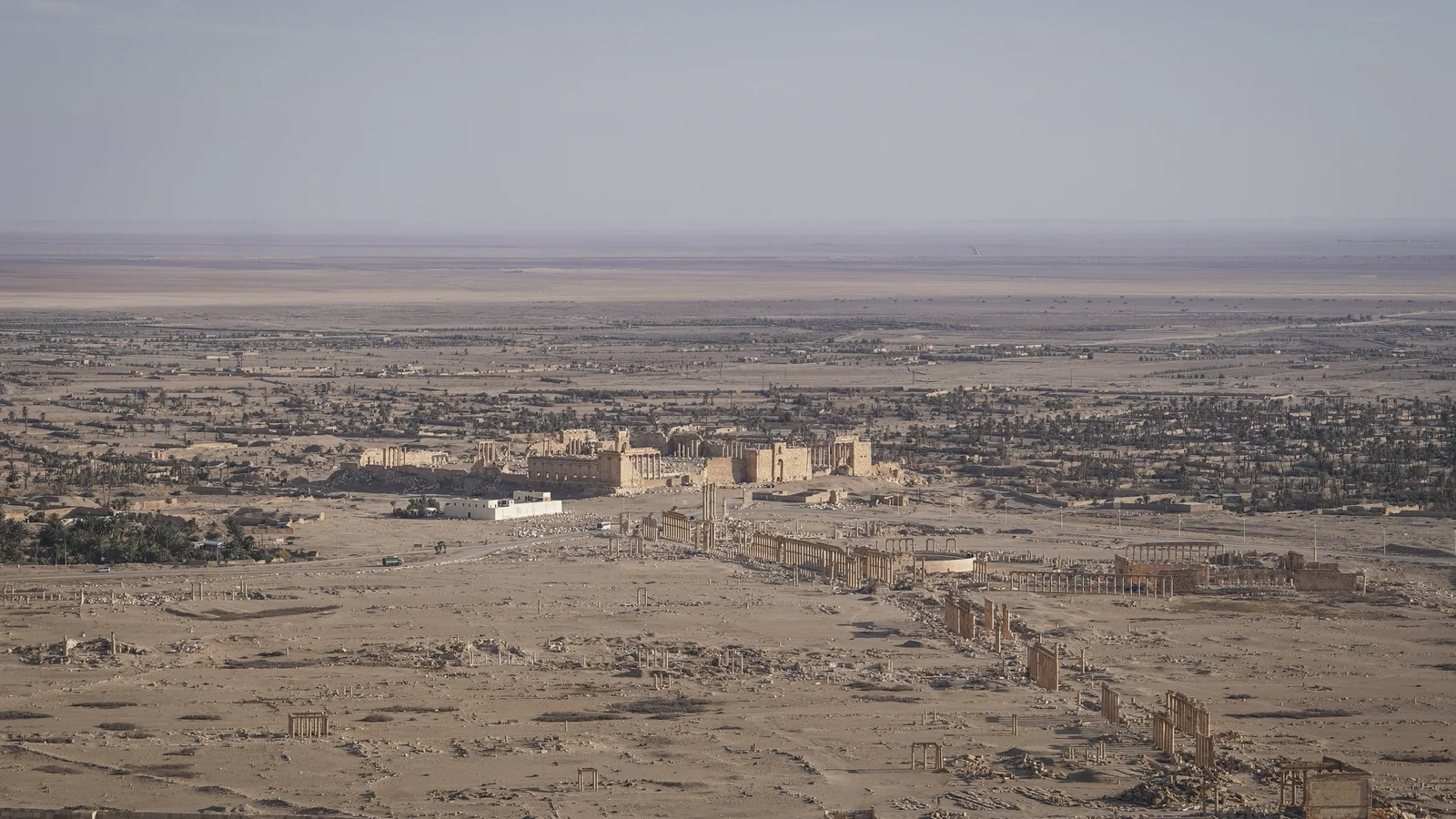
Palmyra’s ancient ruins are more than a tourist postcard. They are a living ledger of cultural memory—Roman colonnades, an amphitheater, funerary towers—inscribed with the names of civilizations that traded, worshiped, and fought across these same stretches of desert. UNESCO designated the site as a World Heritage site decades ago, and when jihadist fighters seized Palmyra during IS’s 2014-2017 run, the world watched in horror as priceless artifacts were smashed and looted.
“When you attack Palmyra, you are attacking the idea that some things last,” said Dr. Leila Haddad, a Brussels-based analyst who has followed Syria for 15 years. “That symbolism matters. Terrorist groups know this. They do not only seek tactical advantages; they seek to erode memory.”
But Palmyra’s value is not only symbolic. Situated deep in Syria’s central desert, it sits along routes that have long been used for trade—and, in modern conflict, for movement of fighters and weapons. After losing their territorial caliphate between 2017 and 2019, IS retreated into deserts, caves, and the margins of state control. From there, the group has staged guerrilla-style attacks, ambushes, and bombings that keep security forces—local and international—on edge.
Voices from the ground
In the dusty market near Tadmur—the modern town that hosts Palmyra’s ruins—shopkeepers shrug and call the strikes “another chapter.” You can sense exhaustion more than fear. “We are used to warnings and curfews,” said Hassan, who sells tea and plasticware. “We just want to keep our children fed.”
A humanitarian worker with a U.N. partner, who asked not to be named for safety reasons, explained how cycles of violence hamper recovery. “Every strike displaces families again,” she said. “Shelters fill, schools close, and livelihoods stop. The people who pay the price are not the commanders in the deserts.”
Jordan, which has itself suffered from spillover and is a partner in the strikes, signed on publicly to the operation. A Jordanian military official described the action as “necessary to protect our citizens and stabilize border regions,” speaking on condition of anonymity. Jordan has long balanced delicate security concerns with hosting hundreds of thousands of Syrian refugees—an economic and social strain that the Hashemite kingdom continues to manage.
The American calculus
The strikes come against a shifting American posture in Syria. President Donald Trump, during his first term, ordered a partial withdrawal of U.S. troops from Syria but ultimately left some forces in place. In April, the Pentagon announced it would halve the number of U.S. personnel in Syria in the coming months—a move justified as reducing America’s footprint while maintaining counter-IS pressure. U.S. envoy Tom Barrack later said Washington intended to reduce its presence to a single base over time.
“There is a tug-of-war between retrenchment and residual responsibility,” said Michael Durant, a former diplomat and Middle East specialist. “Policymakers don’t like open-ended commitments, but they also understand what an abrupt exit can allow—space for IS resurgence and broader regional instability.”
Context: what numbers tell us
At its apex in 2014–2015, the Islamic State controlled large swathes of Syria and Iraq and declared a “caliphate” that drew thousands of foreign fighters. A U.S.-led coalition, alongside local partners—including Syrian Democratic Forces (SDF) in the northeast—helped roll back that territorial control by 2019. But IS never disappeared as an ideology or a network; it simply morphed into an insurgency.
Recent years have seen periodic spikes in IS activity in Syria’s northeast and central desert. According to open-source monitoring groups, hundreds of attacks attributed to IS have occurred across Syria since 2020—ranging from roadside bombs to targeted assassinations—though numbers fluctuate with the intensity of local operations.
Each strike, each counterstrike, adds to a mosaic of instability that has displaced more than half of Syria’s pre-war population since 2011, according to the U.N. Millions remain internally displaced or living as refugees in neighboring countries.
Looking outward: the global ripple effects
Why should a reader in Tokyo, Lagos, or São Paulo care about strikes over a desert town’s ruins? Because the fight against groups like IS is not confined to local battlefields. Terrorist networks inspire copycats, radicalize online followers, and exploit ungoverned spaces. The stability—or instability—of Syria affects migration patterns, regional alliances, energy markets, and global counterterrorism strategies.
“This is not just a Middle Eastern problem,” Haddad warned. “It’s a global governance challenge—how to deter violent extremism, protect cultural heritage, and support people whose lives have been suspended by war months or decades at a time.”
After the dust settles
The desert will hide many stories. The strikes will be tallied in press releases and military briefings. Families will mourn, and some will try to go back to markets and schools. And Palmyra, for now, will keep being both a ruin and a battleground—an ancient city caught in modern politics.
As you read this, think beyond the headlines: what does it take to rebuild a place where stones remember more than people sometimes can? How do nations weigh the cost of presence against the cost of absence? And what obligations do we share—across borders and languages—to protect both human lives and the fragile memories carved into a world that has seen empires rise and fall?
“We are tired of being a line on somebody else’s map,” Fatima said, quiet and steady. “We do not want our children’s memories to be rubble.”