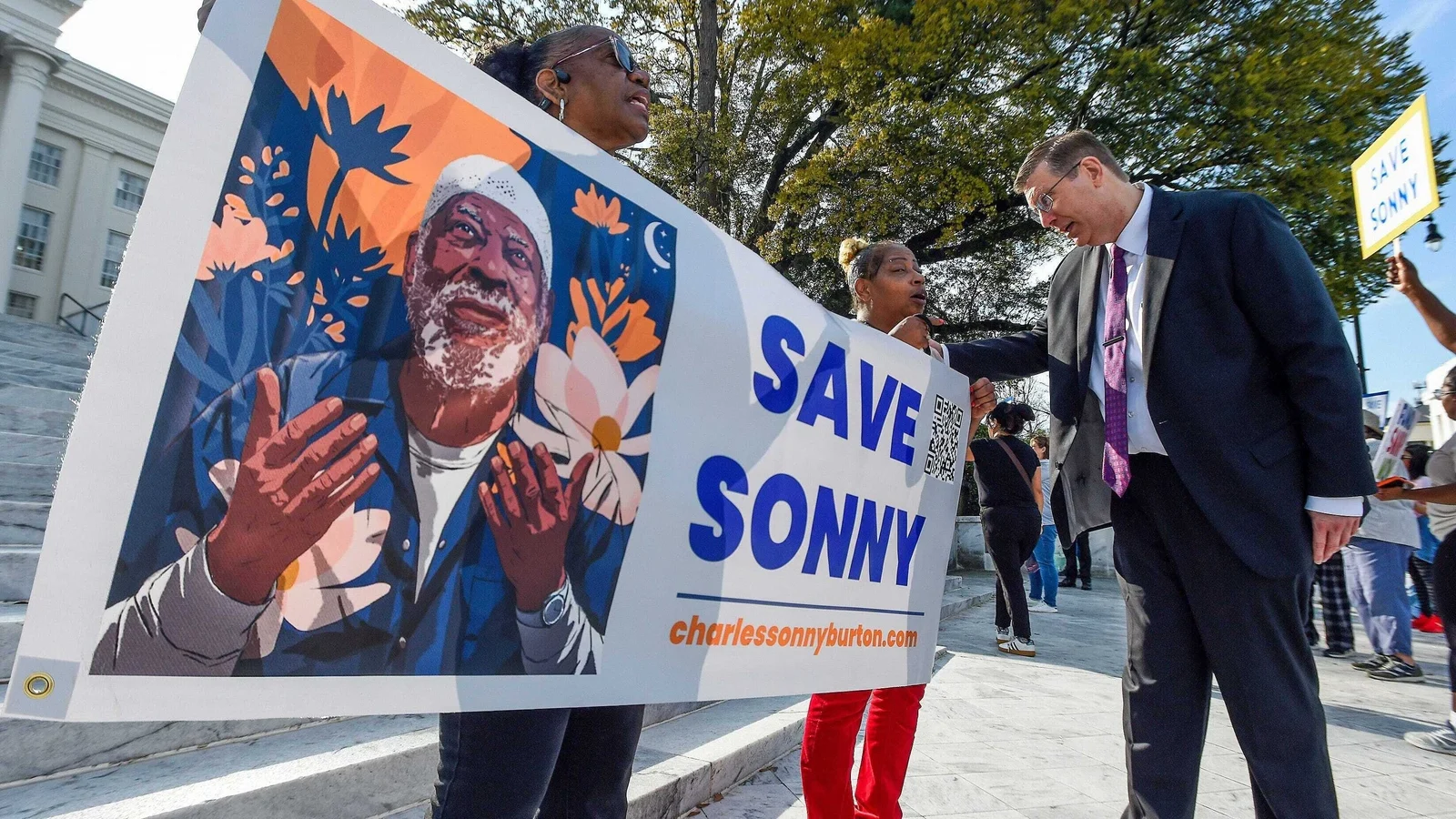
A Last-Minute Reprieve in Talladega: When Justice, Mercy and Memory Collide
On a humid evening in central Alabama, the courthouse clock kept its steady, indifferent rhythm as news rolled across the county: the governor had commuted the death sentence of Charles “Sonny” Burton, a 75-year-old man who had lived for more than three decades with a blue paper calendar of dates he couldn’t ignore.
For residents of Talladega — a town known for its roaring NASCAR weekend crowds and Baptist church steeples that punctuate the skyline — the commutation felt like the resolution of an old wound that never quite healed. “It’s not like we get radio silence and then suddenly light,” said Marjorie Lewis, who runs the little diner three blocks from the courthouse. “You live with the echo of a thing for so long. You don’t forget whose name was called. You don’t forget the man who was gone.”
What happened, briefly
In November 1991, a robbery at a small shop ended with a customer, Doug Battle, dead. Six men were involved that night. Investigators later concluded that Burton was outside the store when the fatal shot was fired; he did not pull the trigger. Yet in 1992 he was convicted under Alabama’s capital felony murder theory and sentenced to death as an accomplice.
The man who fired the shot, Derrick DeBruce, had been sentenced to death as well, but his punishment was reduced to life without parole; he later died behind bars. On the eve of Burton’s scheduled execution by nitrogen hypoxia — a controversial new method Alabama has sought to deploy — Governor Kay Ivey stepped in.
“Charles Burton did not shoot the victim, did not direct the triggerman to shoot the victim and had already left the store by the time the shooting occurred,” Governor Ivey said in a statement. “I cannot proceed in good conscience with the execution of Mr Burton under such disparate circumstances. I believe it would be unjust for one participant in this crime to be executed while the participant who pulled the trigger was not.”
Inside and outside the law
For decades, Alabama’s application of the felony-murder rule has produced sharp divisions. The law allows accomplices to be held just as culpable as the person who fired the gun — a doctrine rooted in the idea that people who participate in violent felonies bear responsibility for any deaths that result.
“On paper, the rule aims at deterrence — if you join a dangerous enterprise, you accept its possible consequences,” said Professor Eli Moreno, a criminal law scholar who has followed the case. “But in practice, it flattens differences in culpability. A man who pulls the trigger and a man who was standing outside the store get slated for the same ultimate punishment.”
That flattening can collide with human details: age, intent, whether a person directed the violence, or whether they were even present. Burton, who has been in prison for more than 30 years, is now serving life without parole instead of facing execution — a shift that has reignited questions about proportionality and mercy in capital sentencing.
Faces of a small town
Walk past the brick storefronts in downtown Talladega and you hear the layered stories of a place where people remember better than they forget. At the barbershop, a man named Leroy shook his head as he talked about the case. “I believe in the law,” he said. “But we’ve got to be fair. Ain’t no use killing a man when we can call it conscience and call it justice. It don’t sit right.”
Another neighbor — a younger woman named Hannah who grew up blocks from the shop and who asked that her last name not be used — described the mix of relief and unease in town. “Some folks say it’s overdue. Others say it’s still not justice for the family who lost someone,” she said. “There’s no turning back for the Battle family. That remains.”
There are, of course, two families in this narrative: the family of the man who was killed and the family of the man whose life was nearly taken by the state. Both carry the heavy load of loss. “You don’t get what you want from vengeance,” said Rev. Thomas Jenkins, who has counseled people on both sides of many local tragedies. “People want closure. But closure isn’t a sentence or a number. It’s reckoning.”
How rare — or not — is this?
Governor Ivey’s decision is notable for being the second commutation she has granted since taking office in 2017; during her tenure, she has signed off on 25 executions. It comes in a country where the death penalty has been narrowing: about 27 states still authorize capital punishment, and national use has declined substantially from its peak in the 1990s.
According to the Death Penalty Information Center, five executions had been carried out in the United States earlier this year. But the landscape is uneven: some states push forward with capital punishment, others have outlawed it, and still others remain in legal limbo as courts and legislatures wrestle with methods and fairness.
- 27 states currently retain the death penalty (state-by-state patterns vary).
- Methods of execution have shifted in recent years: lethal injection remains common, but states like Alabama have explored nitrogen hypoxia, firing squads and other alternatives amid drug shortages and legal hurdles.
- Sentencing disparities — by race, geography and legal representation quality — continue to trouble researchers and activists.
Questions this case raises
Why commute one man’s sentence while the other participant’s punishment was already reduced? Who decides when the scales tip from lawful punishment to unjust cruelty? These are not hypothetical queries for Talladega residents; they are daily reckonings for families who have waited decades for answers.
“We have to ask ourselves what the death penalty is supposed to accomplish,” said Dr. Marion Clarke, a sociologist who studies punishment and public policy. “Is it retribution? Deterrence? Rememberance? And if it’s any of these, are we achieving it equitably? Cases like this force us to confront whether the law is doing what we think it is doing.”
Readers might ask themselves: would you accept a sentence determined in such broad strokes? If you learned that someone was condemned largely because they were connected to a crime rather than because they pulled the trigger, would that sit with your sense of justice?
What happens next
Burton will spend the rest of his life in prison without the possibility of parole. For some in Talladega, that is an appropriate compromise: the state will not take his life, but he will not be free.
The legacy of the case will ripple beyond one man and one town. It will influence debates about felony murder laws, execution methods, and the latitude of governors in the shadow of final sentences. It will also remind us of the people left in the wake of violent crimes — the mothers, sons, friends, and clerks who are left trying to stitch together a sense of meaning.
On a late afternoon walk, with sunlight hitting the racetrack grandstands in the distance, I asked a small group of local residents what they wanted the world to remember from this moment. “That life is complicated,” said Marjorie from the diner. “That mercy isn’t weakness. And that no law can bring back Doug Battle. But maybe, just maybe, it can stop us from making the same mistake twice.”
In a justice system that often treats dates and statutes as absolutes, moments like this invite a quieter question: when does the law bend to mercy, and when does mercy bend to the law? The answer — fragile, contested, and human — lives somewhere inside the courthouse, the diner, and the memory of a town that has held a long, unquiet grief.