Ukraine’s Volodymyr Zelensky said he is encouraged by what he described as a shift in tone from US mediators as Ukraine and Russia returned to the negotiating table in Abu Dhabi for a second day, while insisting any deal must come with firm security guarantees for Kyiv.
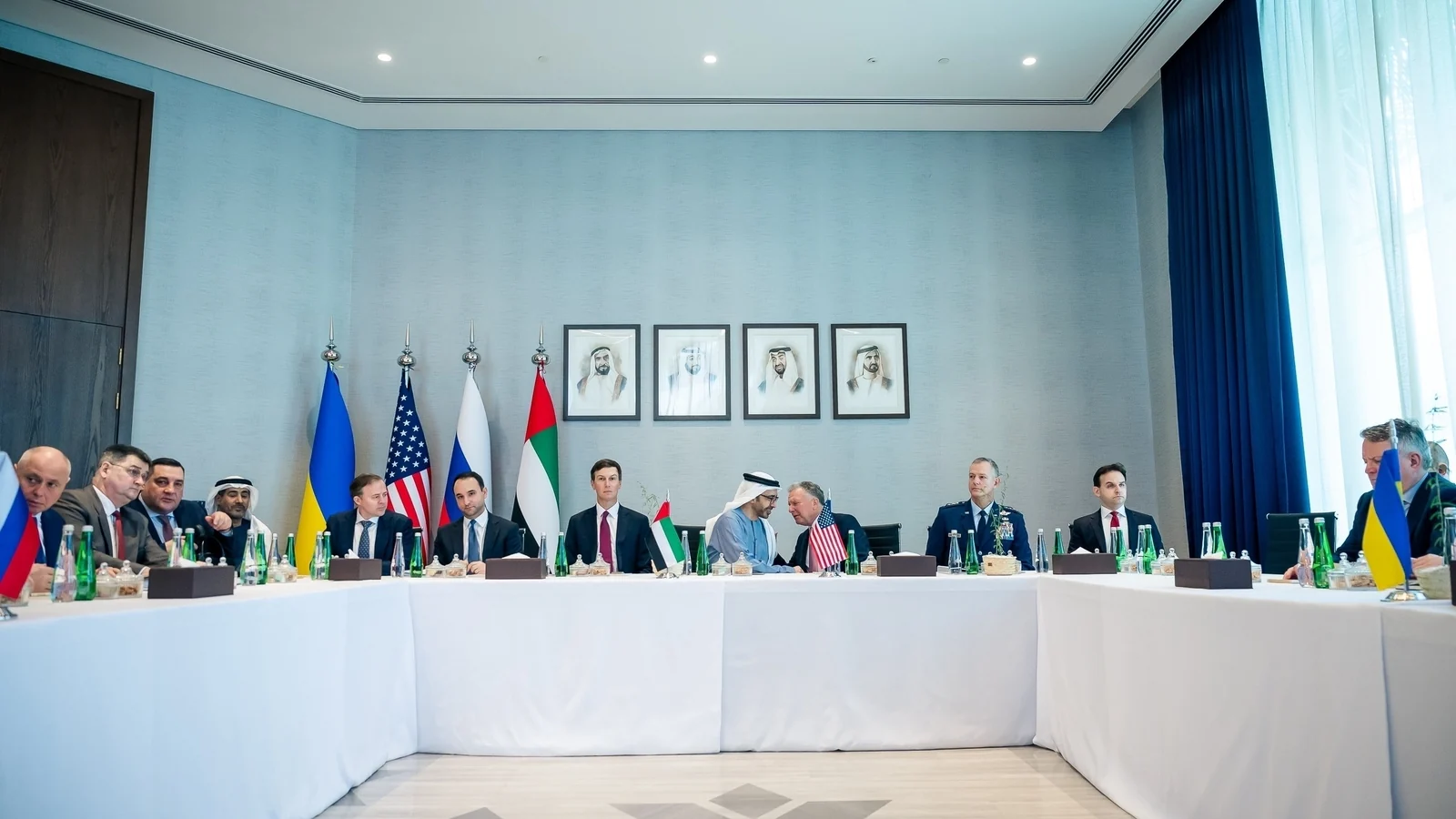
Delegations from Ukraine and Russia opened talks in the Emirati capital yesterday, marking their first face-to-face negotiations since February, when discussions stalled and Washington’s attention was diverted by the Iran war.
US representatives — including President Donald Trump’s son-in-law Jared Kushner and businessman Steve Witkoff — are serving as mediators.
The initial session stretched on for several hours as both sides sought momentum toward ending the war in Ukraine and, according to the United States, exploring a “new” security framework that would also encompass Europe.
Mr Kushner told those attending that the United States had “narrowed the gaps” between the parties, though he did not elaborate, and said he wanted to move toward a “solution” to what he called Europe’s worst conflict since World War II.
Speaking in Copenhagen yesterday, Mr Zelensky described the discussions as “constructive and quite substantive”, saying his team reported that humanitarian concerns and security guarantees were among the issues raised.
Volodymyr Zelensky speaks with Denmark’s PM Mette Frederiksen during a visit to Copenhagen
Pressed on whether Mr Kushner and Mr Witkoff had altered their approach, the Ukrainian leader replied: “I see changes. I’m very happy with what I hear.”
Mr Zelensky said negotiators in Abu Dhabi were working toward a “large-scale exchange of prisoners”, adding that US officials would travel to Russia for further talks on the issue.
Even as diplomacy continued, hostilities carried on overnight. Aleksandr Drozdenko, governor of Russia’s Leningrad region, wrote on Telegram that a Ukrainian drone strike triggered a fire at Ust-Luga, a major Baltic port used for oil exports.
He also said Russian air defences shot down 146 drones amid “continuing” combat operations.
‘New’ security framework
In Paris, US Secretary of State Marco Rubio called this week’s contacts “very productive” and argued that European countries should ultimately take a seat at the table “because they are part of solving this problem”.
Mr Zelensky echoed that view, saying it was “time” for Europe to select a representative for the negotiations.
Across the continent, anxiety has grown as Mr Trump has floated the possibility of striking a deal with Russia that would rewrite Europe’s post-war security order, fuelling fears that Washington could pressure Kyiv into accepting a de-facto defeat.
Mr Kushner said Washington aimed to “create a new framework” of security involving Ukraine, Russia and Europe — one he said could secure “decades, if not centuries, of peace”.
Ukrainian soldiers travel along a road in the Donetsk region
Russia has also framed the broader security question as central. Several weeks before launching its invasion, Moscow issued an ultimatum demanding Western nations roll back forces from eastern Europe.
Ukraine, for its part, has warned against what it calls a “Yalta 2.0” — a reference to post-World War II arrangements in which Western leaders divided Europe with the Soviet Union — while the EU has said any security arrangements should only be discussed after a ceasefire.
“Putin wants the USSR back,” Mr Zelensky told Danish media.
Putin has repeatedly rejected wider ceasefire proposals and has said his forces will continue their campaign in Ukraine.
Moscow pushes security review
Underscoring its push to revisit Europe’s long-standing security setup, Russia included diplomat Sergei Ryabkov in its delegation — a figure associated with presenting Moscow’s pre-invasion demand that NATO withdraw from eastern Europe.
A source within the Russian delegation said ending the war was “merely one item on the agenda”, and that Moscow’s chief aim was a security review “for the entire continent”.
Ukraine’s chief negotiator, Rustem Umerov, met US envoys as well as European, EU and NATO officials ahead of the Abu Dhabi talks.
The senior US and NATO commander in Europe, Alexus Grynkewich, is also involved.
In a joint statement, European countries, Ukraine, the United States and NATO reaffirmed their “shared commitment to a strong post-war European security architecture”.
Ukraine pushes for truces
Mr Umerov said Kyiv’s priorities had not changed: a ceasefire and credible security guarantees. “Our people are waiting to end this war,” he said.
In Paris, Ukrainian and French foreign ministers praised US efforts aimed at “partial truces”, describing such steps as a potential “first step toward a complete and unconditional ceasefire”.
Last month, a localized truce in Ukraine’s Kherson region brokered by US First Lady Melania Trump became the longest pause in fighting seen during the war.
Ukraine is also seeking assurances of long-term backing for its armed forces after any settlement.
A senior Ukrainian source told AFP that Kyiv wants at least 10 years of financial support to maintain an 800,000-strong army capable of deterring any future Russian attack.
Before the talks, Mr Trump suggested Ukraine could be forced to cede territory, saying: “They’re going to end up with a little bit different shape.”
Russian forces have pushed westward but have not captured all of the strategically sought Donetsk region, while Moscow is demanding that Kyiv hand over the parts of the battered area still under Russian control.
Russia continues to bombard Ukraine and its energy infrastructure, stoking fears of another winter in which millions could be left without heat, running water or electricity.