When the Night Turned Orange: Fires, Heat and the Fragility of a Bush Life
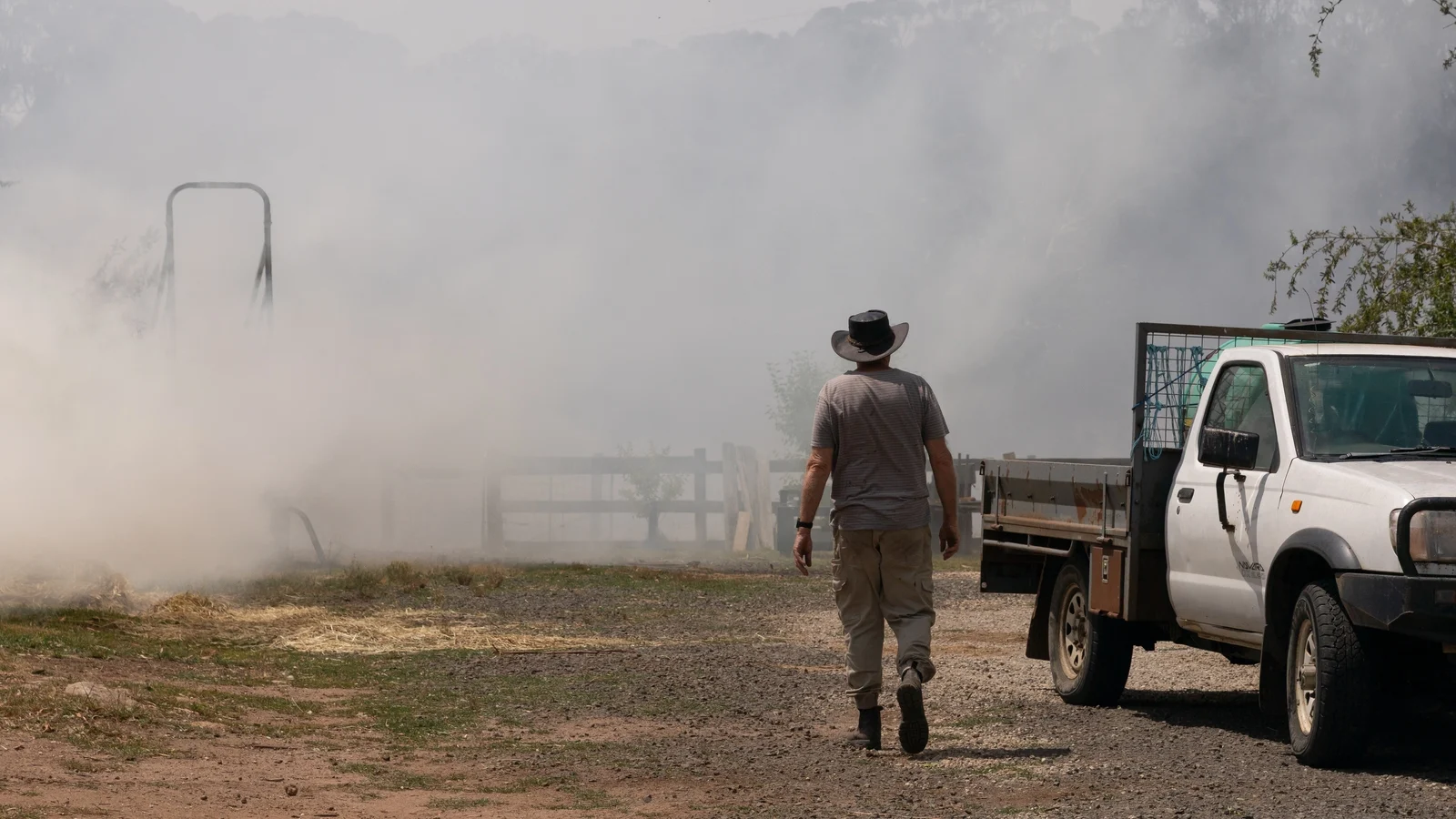
By the time the moon rose, the horizon had been swallowed by an impossible orange. Embers floated like falling stars, and the smell of burning gum leaves clung to everything — woolen shirts, hay bales, the inside of cars. In the small Victorian town of Longwood, where shepherds and cattlemen measure their days by seasons and rainfall, people stood in driveways with torches and teacups, watching the dark breathe fire.
“There were embers falling everywhere. It was terrifying,” said Scott Purcell, a cattle farmer who lost part of a fence line and saw the night sky glow like a furnace. “You don’t sleep; you listen for the sound of trees popping and the gap in the fire line. That gap becomes everything.”
The hard numbers behind the ash
Authorities say this latest wave of blazes has been devastating. Fire services reported more than 300,000 hectares torched across southeast Australia, and Emergency Management Commissioner Tim Wiebusch confirmed that over 300 buildings — including sheds, farm structures and outbuildings — have burned. More than 70 houses were lost, and tragically, police confirmed one death near Longwood.
- Areas affected: 300,000+ hectares
- Buildings destroyed: 300+ (including rural structures)
- Houses destroyed: 70+
- Fatalities: 1 confirmed
- Temperatures recorded: above 40°C across parts of Victoria
“We’re starting to see some of our conditions ease,” Commissioner Wiebusch told reporters as firefighters, exhausted and mud-splattered, rotated out of crews. “And that means firefighters are able to start getting on top of some of the fires that we still have in our landscape.”
Heat, wind and a wildfire recipe
Across the state, thermometers tipped past 40°C as a heatwave settled in. Hot, dry winds whipped through forests and paddocks, turning tinder-dry ground into a conveyor belt of flame. In one unusual and terrifying spectacle, a blaze near Walwa was energetic enough to spawn its own lightning — a pyrocumulonimbus — throwing embers and creating thunderstorms of its own.
“When a fire makes its own weather, that’s a different beast,” said Dr. Amita Rao, a bushfire scientist who has spent two decades studying fire behavior in Australian landscapes. “Those vertical columns can project embers huge distances, and the localised updrafts can change wind direction in minutes. It overwhelms even the best-laid containment plans.”
Communities on the line
On the ground, the responders came in a human tide. Hundreds of firefighters — volunteers and career crews — were mobilised from across Australia. Local Country Fire Authority brigades worked alongside Forest Fire Management teams and interstate reinforcements, and Prime Minister Anthony Albanese said Canberra had reached out to allies in Canada and the United States to discuss additional support.
“It’s the volunteer spirit you notice first,” said Chris Hardman from Forest Fire Management Victoria. “People turn up greasy, tired, determined. But the grief is real. When you lose homes, fences, a mate’s milking shed, a part of your life is gone.”
Neighbours became lifelines. In towns where phone reception is patchy and the mains sometimes fail, people ran hose lines from farm dams, ferried children and pets to safety, and opened community halls as temporary refuges. In one evocative image, a trio of old horse floats — battered but serviceable — were pressed into service to carry livestock away from flame fronts.
What this means in the long run
For many Australians, the images dredge up memories of the “Black Summer” fires of 2019–20, when blazes tore across vast swathes of eastern Australia. Back then, an estimated 18.6 million hectares burned, thousands of homes were destroyed and entire communities inhaled toxic, smoky air for weeks. The trauma lingers like ash in the throat of the nation.
Climate scientists say extreme conditions like those seen this week are now more likely. According to long-term records from the Bureau of Meteorology and the CSIRO, Australia’s average surface temperature has risen by roughly 1.5°C since 1910 — a figure that aligns with elevated risks for heatwaves, drought and fire-weather severity.
“We still have a window to reduce the worst impacts, but it closes faster than we’d hoped,” said Dr. Rao. “What we see this season is a preview of what warmer, drier summers will look like if emissions trajectories aren’t curbed.”
Policy, protections and the push-pull of the economy
Australia sits at a knot in a global conversation. It is a country that has built much of its postwar prosperity on fossil fuels — coal and natural gas have been economic mainstays, driving exports and jobs. Yet those same fuels are central to the global warming that scientists point to as a key driver of worsening fire seasons.
“There’s a tension here that feels impossible sometimes,” admitted a local councillor in a regional town who asked not to be named. “People want secure jobs; they want heated homes and good schools. But they also walk through bushland and see the gum trees turned to cinders. How do we reconcile these things without leaving people behind?”
Some communities have turned to traditional knowledge for answers. Indigenous fire stewardship — low-intensity, controlled burning conducted in cooler months to reduce fuel loads — is being revisited and revived in many parts of Australia. Elders and fire practitioners say these practices can help make landscapes more resilient, but scaling them up requires resources, respect and cross-cultural collaboration.
“We have been doing this for millennia,” said Aunty Lorraine, a Wurundjeri elder who runs community burn workshops. “It’s about looking after Country. It’s not a quick fix, but when we work with the land rather than against it, the land looks after us.”
Questions we’re left with
When the smoke clears and the last ember is stamped out, three difficult questions hang in the air: How will communities rebuild? How will policy adapt to the new normal? And can the choices of nations — about energy, land use and emissions — be aligned with the urgent need to protect places like Longwood?
There are small promises of hope. Fire crews, exhausted and blistered, were still turning up to shift hoses and check hotspots. Neighbours who’d never met before shared generators and tarpaulins. Emergency services are re-evaluating pre-emptive strategies. International support lines are being opened. But hope alone is not a plan.
So ask yourself: if heat records keep tumbling and seasons stretch and twist, what does resilience look like for your community? How much of the burden is borne locally, and how much requires national and global shifts? These are not abstract questions. They are the ledger of human choices — political, economic, cultural — written in ash.
After the flames
In the mornings now, the sun rises through a silver haze. Blackened trunks stand like sentinels in paddocks. The birds are quieter, and the air tastes faintly of charcoal. In kitchens across the region, people pour stronger tea, mend fences, count what they’ve lost and start to plan.
“We will get through this, as we always do,” said Purcell, his voice steady but raw. “But getting through isn’t enough. We have to learn. We have to change what we do with the land and the temperature of our politics. Otherwise, we’ll keep repeating the same fire.”
For a country of great heat and deeper stories, the question remains: will the lessons of this orange night become a turning point, or another verse in a looping refrain of rebuild-and-repeat? The answer will be written in policy, in community resolve, and in the quieter choices each of us makes about the fuel we burn — literally and figuratively.