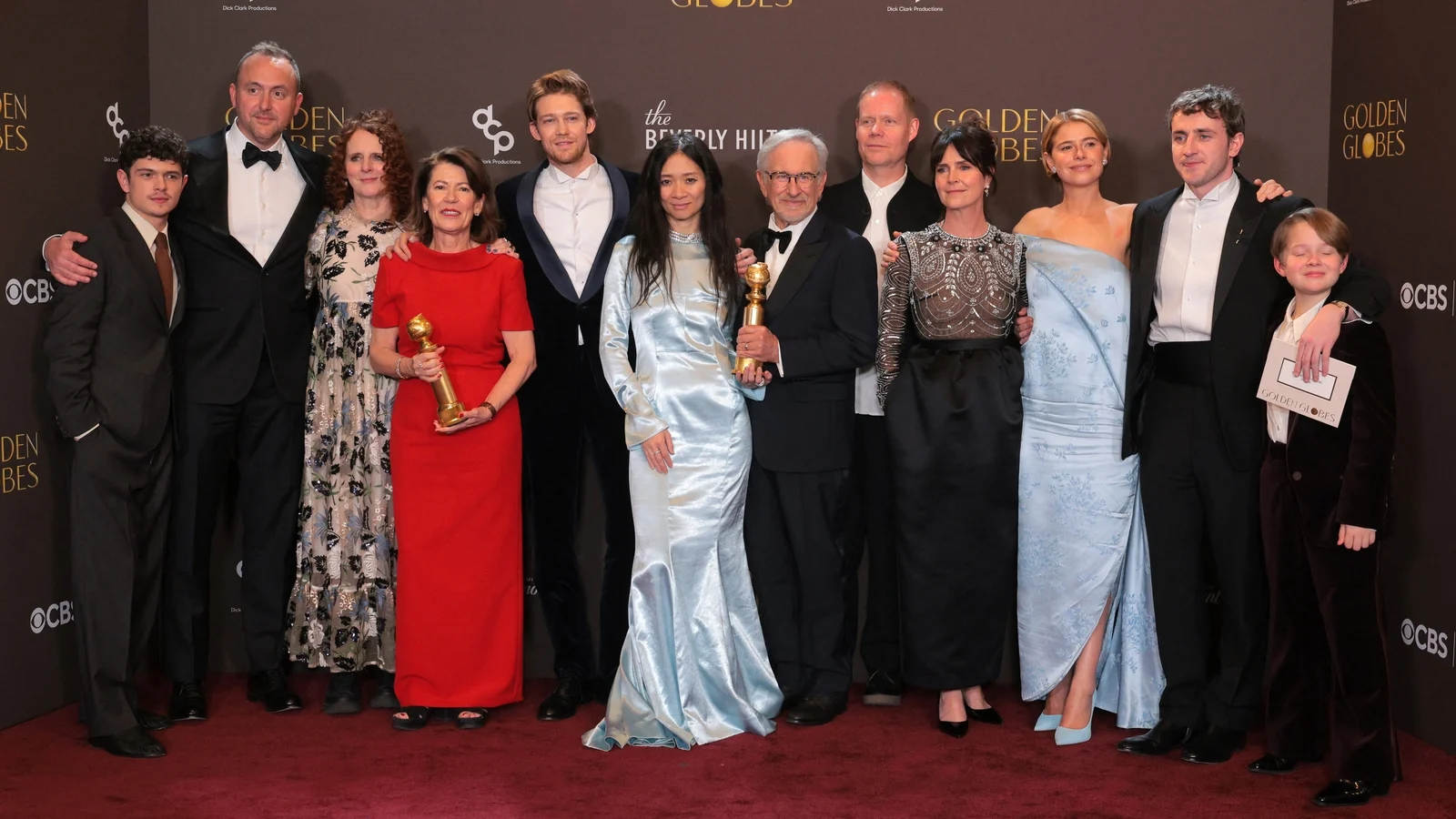
When Killarney Applauded in Los Angeles: Jessie Buckley’s Golden Globe and the Quiet Power of “Hamnet”
It was barely daylight in Killarney when the cheers started, soft and surprised, like someone tapping the rim of a teacup and waiting for the music to begin.
At O’Malley’s Bar on Main Street, a television perched above the dartboard flickered to life and a handful of locals — farmers, a primary school teacher, a woman who’d once run a small guesthouse — drifted in to see the moment their fellow Killarney native, Jessie Buckley, had been crowned Best Actress at the Golden Globes.
“We all knew she’d be brilliant,” said Eamon Fitzgerald, the bar’s owner, wiping a glass with a rag thumbed by years of service. “But there was still that gasp when she won. It felt like watching one of our own climb a hill and plant a flag.”
A performance that crosses oceans
Buckley’s award was not merely personal triumph. It was a recognition of a film that reaches deep into grief, imagination, and history. Hamnet — adapted from Maggie O’Farrell’s bestselling novel — imagines the private life around one of history’s most luminous but enigmatic figures, William Shakespeare, portrayed in the film by Paul Mescal. Buckley, as Agnes, anchors the story with a fierce, tender intelligence that critics and audiences alike have described as incandescent.
“Jessie carries the role like someone carrying a small country,” said a film scholar I spoke with in Dublin, who asked to remain anonymous because she’s mid-revision on a book about contemporary Irish cinema. “She doesn’t just act; she translates a cultural memory into something we can feel in our ribcage.”
From the Kerry hills to the LA red carpet
The win in Los Angeles rippled back across the Atlantic. President Catherine Connolly issued a warm congratulatory statement, and the Taoiseach, Micheál Martin, took to Twitter to call the victory “richly deserved.” Their words mattered not because of ceremony but because they framed Buckley’s achievement as part of a larger national moment — a reminder that storytelling remains one of Ireland’s most persuasive exports.
Maggie O’Farrell, who won the Women’s Prize for Fiction in 2020 for the novel Hamnet, was in Los Angeles when the awards were announced. Speaking to reporters, she captured what many felt: that this film is less a singular auteur’s triumph and more a communal labor of love. “We’re all part of the Hamnet family,” she said. “This recognition is for everyone who breathed into the film.”
Who was nominated (and who went home with what)
- Jessie Buckley — Golden Globe winner, Best Actress (Drama), Hamnet
- Paul Mescal — nominated for Best Supporting Actor, Hamnet (winner: Stellan Skarsgård for Sentimental Value)
- Maggie O’Farrell — nominated for Best Screenplay; director Chloe Zhao also nominated for Best Director (both awards won by One Battle After Another)
- Element Pictures and Wild Atlantic Pictures — production companies behind Hamnet
Not every nomination became a trophy — such is the way of awards nights — but nominations themselves are markers, signposts indicating which stories are moving across borders and into conversations.
Inside the press room: tributes and small human things
After the announcement, Paul Mescal, his voice still soft from the rush of the ceremony, didn’t mince words. “Jessie carries grief and love in the same breath,” he said, according to a recording shared by journalists at the event. “She works like she’s carrying a lantern through fog, and she lights the way for everyone else.”
Back in Killarney, jars of turf smoke and the salty tang of the nearby Atlantic seemed to settle into the story as the town reflected on one of its daughters becoming a global symbol of craft and resilience. “She’s always been a quiet force,” said Mary O’Leary, who teaches local history. “We used to see her at the small festivals. She’d be gone for a while, and then suddenly everyone would be talking about her again.”
What Hamnet means beyond awards
Hamnet’s success sits at the intersection of several larger currents. It’s an adaptation that proves literary fiction can find cinematic life without diluting its intricacies. It’s proof that stories anchored in local specificity — in the smell of peat, the cadence of conversation, the way women grieve and protect — can resonate globally. And it’s another chapter in the growing influence of Irish storytelling in international cinema.
People often ask: why do these wins matter beyond the glamour? For one, recognition like the Golden Globe can open doors for funding, distribution, and future projects from smaller studios. Element Pictures and Wild Atlantic Pictures, both credited with producing Hamnet, are emblematic of a creative ecosystem that mixes international ambition with local roots. Such success can mean more crews hired in small towns, more film students inspired, and a stronger pipeline for telling diverse narratives.
Stories as cultural diplomacy
There’s also a diplomatic dimension. Cultural exports — films, music, literature — shape how countries are perceived. An Irish film that travels well tells audiences worldwide not just about Ireland’s past, but about its present: its filmmakers, its actors, its production crews, its marketplaces for ideas. “Soft power is quieter than armies or treaties,” an industry analyst in Cork told me. “It’s a song people remember when they meet you.”
And yet, awards season also forces a conversation about who gets the spotlight. Mescal’s nomination, O’Farrell’s screenplay nod, and Zhao’s director nomination (even as both awards went elsewhere) underscore ongoing debates about representation on and off screen — about whose stories are funded, whose histories are adapted, and who gets to tell them.
What to watch next — and why you should care
If you haven’t seen Hamnet, the film is an invitation: to sit with loss, to consider the slivers of history that give rise to myth, and to listen to performances that ask the audience to do more than look — to feel. If you have seen it, Buckley’s win is a moment to celebrate craft and the invisible teams behind every polished frame.
So where do we go from here? Perhaps the most useful question is this: what stories from your own town, your own family, have power beyond their borders? Who is doing the work of making them visible? That’s what wins like Buckley’s can do best — they remind us that the local and the global are braided together, that a voice raised in a Kerry pub can be heard in a Hollywood press room, and that a lifetime of quiet work sometimes ends in a single, incandescent second on stage.
“It’s not the statue,” Eamon in O’Malley’s said later, turning the television off. “It’s the doors it opens — for Jessie, for our town, for the people who will now try.”
And in that small, stubborn hope, the evening belonged not just to an actress on a stage in Los Angeles, but to a community that has long known how to listen to stories. It belonged, too, to everyone who believes that art can be a bridge between the one and the many.