Night of Mud and Metal: A Town Wakes to Loss
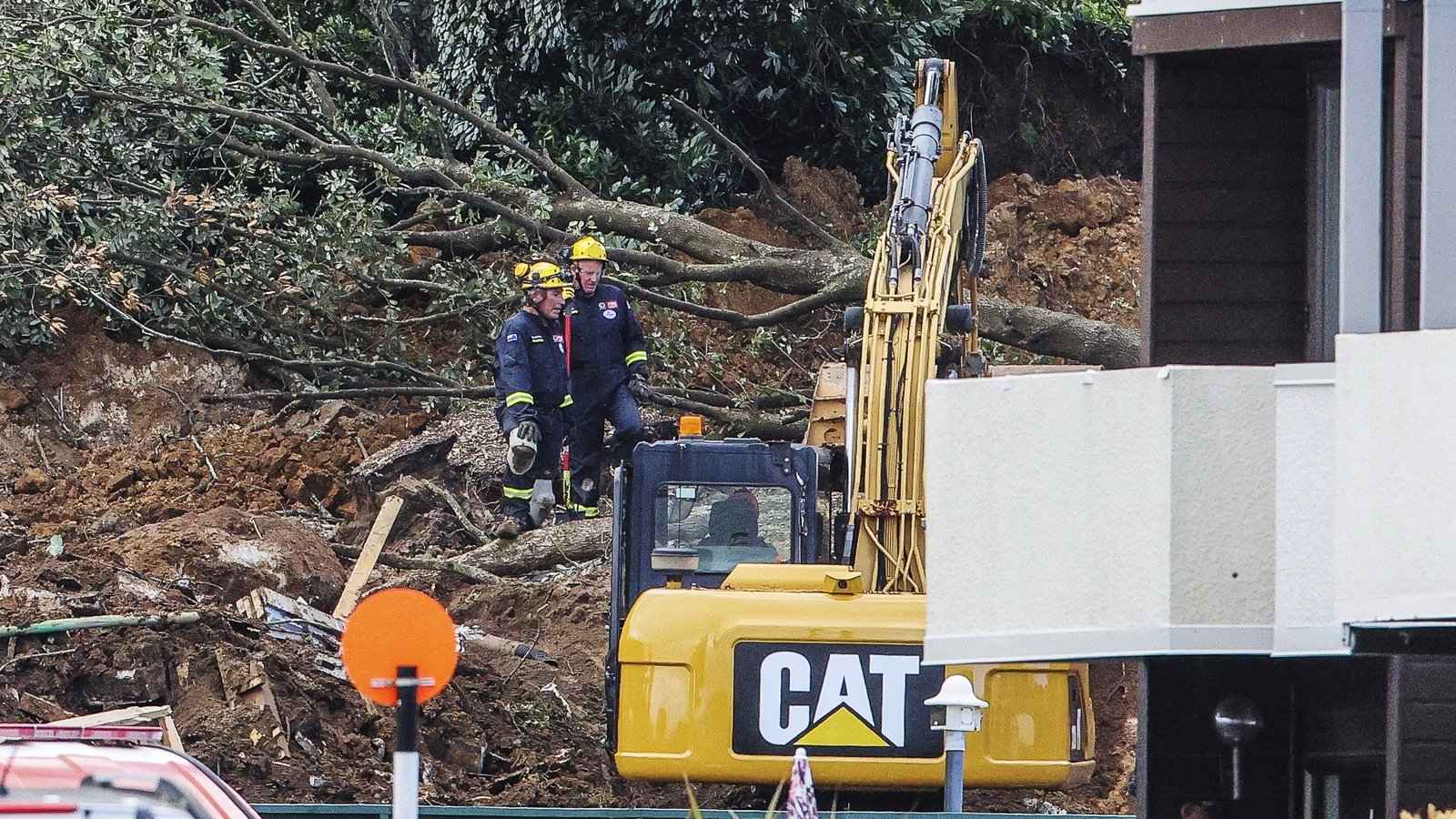
When the rain finally stopped in the early hours, Mount Maunganui looked like a place that had been quietly erased and rewritten by a force half-earth, half-water. In one sweep of brown, a slope let go—tons of volcanic soil and rock hurtling down into a family home and a nearby campsite, crushing a shower block, tossing caravans like matchboxes, and filling a heated pool with mud and wreckage.
By morning the harbourside city of Tauranga — a sunny stretch on New Zealand’s North Island that usually smells of sunscreen, salt, and summer barbecues — was wrapped in emergency tape and the low-thrum of diggers. Rescuers had already pulled two bodies from the ruined house; officials said others were unaccounted for, and a young girl was among those missing. “Police are working to support their loved ones at this incredibly difficult time,” a spokesperson said, the words thin against the roar of machinery and the quiet, knotting grief of families across the road.
Voices Beneath the Mud
People who were there describe a surreal, terrifying sequence: the mountain gave, the ground shuddered, and then a wave of dirt slammed into the campsite. “The whole room started shaking,” recalled Dion Siluch, a Canadian tourist who had been getting a massage at the Mount Hot Pools. He walked out and found a caravan floating in the pool. “It took me a while to realise that the mountain had collapsed and had pushed everything into the pool,” he said. His voice carried both the confusion of someone who had just seen the world tilt and the brittle steadiness of someone who expected answers.
Other witnesses spoke of frantic digging, of hands clawing at wet earth, and of voices—human cries—that cut through the chaos. “I could just hear people screaming,” said hiker Mark Tangney, who ran from the track to help. “We were on the roof of the toilet block with tools trying to take the roof off because we could hear people shouting: ‘Help us, get us out!’” For a while, those calls for help were vivid, immediate, unbearably close. Then the land kept moving and rescuers had to pull back for everyone’s safety. The voices went silent.
On the Front Line
Emergency services worked like a well-rehearsed human machine—police, firefighters, and volunteers coordinating around the risk that more ground could come away. Assistant Police Commissioner Tim Anderson described the operation as a rescue mission while the slope remained unstable, and would not be drawn on exact numbers, saying only that the missing were “single figures.” Nearby, a dozen family members watched from across the street, wrapped in blankets, eyes fixed on a scene that felt part disaster movie, part private tragedy.
Tourist Season, Traditions, and Tipped Caravans
Mount Maunganui is both a neighbourhood and an idea: a compact beach town where the summit walk up the extinct volcanic cone is a morning ritual and the sands fill with enthusiastic sun-seekers. In summer the mountain hums with walkers and families drawn to the white beaches and the local cafés that do a brisk business before noon. The campsite that was struck is a seasonal hub; camper vans, couples, and spontaneous road-trippers gather there with a view of the sea and the mountain.
“You expect to get sunburn or a flat tyre, you don’t expect the ground itself to betray you,” said Aroha Rangi, a local café owner who watched the rescue efforts from the corner of her shop. “This place is built around the outdoors—people walk the mountain every day. Now we’re all looking up at it differently.”
What Science and History Tell Us
Landslides aren’t new to New Zealand; the country’s steep, volcanic landscapes and temperate, wet climate have always set the stage. Mount Maunganui itself is the remnant of an ancient volcano—beautiful, benign, and in a single night dangerously mobile. Scientists say events like this fall at the intersection of geology and extreme weather. GNS Science, New Zealand’s geoscience authority, has long warned that saturated slopes following intense rain are the classic trigger for slope failure.
Globally, researchers link the increasing frequency and intensity of extreme rainfall events to climate change. The IPCC’s past assessments note that some regions are seeing heavier downpours that can overwhelm soil stability. For coastal communities and popular outdoor spots, that translates into a new sort of vulnerability: landscapes we assume are permanent are, in fact, dynamic and changing faster than many of us imagine.
Local Data and Wider Context
- Tauranga, home to roughly 155,000 people, is one of New Zealand’s fastest-growing cities.
- Mount Maunganui is a magnet for domestic and international tourists, particularly in the southern summer months.
- New Zealand’s emergency services regularly contend with landslides, flood events, and storm damage—risks compounded when heavy rain follows extended wet periods.
Faces in the Crowd
At the site, grief and grit sat side by side. A dozen family members gathered on the opposite kerb, sharing cigarettes, making tea, and clinging to each other’s arms. “We’re just waiting to hear if our daughter is alive,” one woman said, voice small but firm. Nearby, a retired builder handed out gloves and bottled water to volunteers who had spent hours trying to free anyone trapped under the mud.
“It felt like trying to hold a tide back with a bucket,” said William Pike, a Fire and Emergency commander, of the initial rescue attempts. “We heard voices, we responded. Then it became too dangerous to push on because the slope was still moving. It’s a terrifying decision—to step back when people might still be trapped.”
Questions to Sit With
How do communities balance the lure of outdoor life with the unpredictability of the land beneath their feet? What does safety look like in places where nature shifts rapidly? These are not only local questions. From the Philippines to British Columbia, people are grappling with how to live with landscapes that can change in an instant.
For the families waiting in Tauranga, the technical and philosophical debates are secondary to the urgent, human ones: are our people safe, are they coming home, what support will be there in the aftermath? The answers will come slowly—identification, counseling, rebuilding—and some will never be complete.
Where We Go From Here
Rescue crews continue to work, but with caution. Heavy machinery scrapes and lifts, crews map the unstable ground, and specialists assess how to proceed without triggering further collapse. The city has closed off the area and begun the grim work of recovery and accounting.
In the weeks ahead, expect investigations into why the slope failed, whether warnings existed, and what mitigation measures—drainage, slope reinforcement, updated risk maps—might prevent another tragedy. Expect also the quieter work of community recovery: counselling centres, fundraisers for affected families, and conversations about whether some camps or structures should be relocated.
For now, Tauranga breathes in a held way, waiting for news, counting the missing by single figures and holding rituals of grief. The mountain is still there, a silhouette against a shaken sky, as beautiful and as unsettling as ever. What would you do if the ground beneath your feet began to change? How do we reconcile a love of the outdoors with the reality that the earth is not always steady? These are the questions communities everywhere must answer—not as abstractions, but in the rubble, with the people who live and love there.