On the edge of the slope: Pasirlangu after the mud
They arrived in the gray light of dawn, under a sky that still smelled of rain. Men in mud-streaked jackets hunched over shovels. Women in headscarves clutched thin blankets. Children sat on overturned crates, eyes hollow with the slow, stunned grief that follows sudden loss.
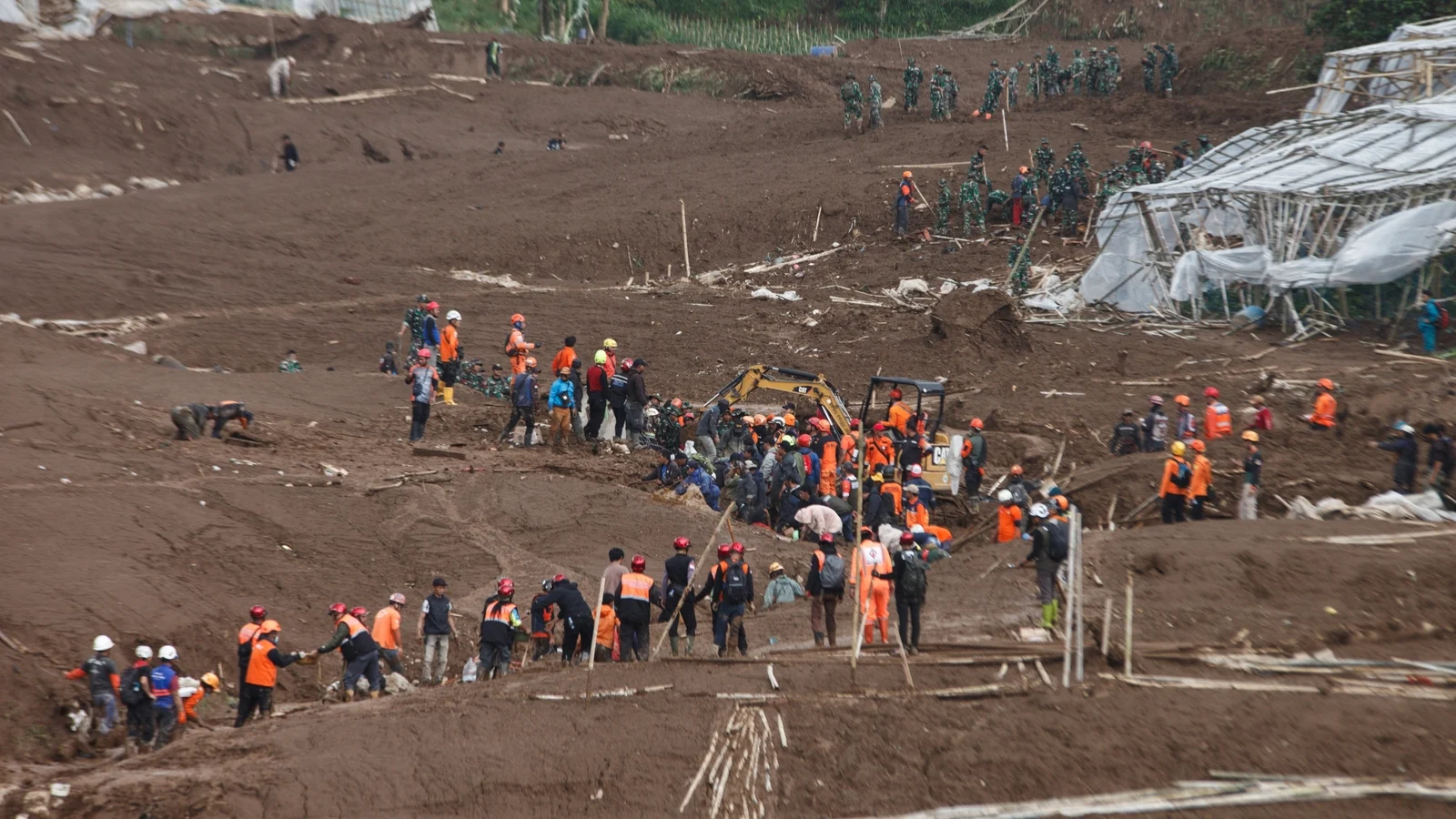
This was Pasirlangu, a village tucked at the foot of Mount Burangrang in West Bandung. Early on a recent Saturday, a wall of wet earth and debris tore down the hillside, sweeping through homes, gardens and the narrow lanes where neighbors greet one another by name. By evening the official tally was grim: 17 confirmed dead, 73 people still unaccounted for, more than 50 houses severely damaged and upwards of 650 residents displaced.
“We keep coming back because we can’t stop,” said Aep Saepudin, gripping a paper list of names. “There are 11 of my family missing. I don’t know if we will find them alive. All I want is to find them, even if it is only to say goodbye.”
The hunt beneath the mud
Rescue teams—dozens of people deployed by local and national agencies—worked in a choreography of urgency and caution. Heavy excavators moved slowly, their tracks stirring a scent of wet soil. Where the machines could not go, volunteers and search-and-rescue personnel dug by hand, probing the unstable ground with poles and hope.
“The fear is that another slide could come down at any time,” said Rifaldi Ashabi, a volunteer rescuer who has been on landslide operations before. “You can feel the slope change under your boots. We are looking for people, but we also have to think about our own safety.”
Officials said the operation was complicated by persistent rain and the danger of further slope failures. The national disaster agency confirmed the fatalities, while local authorities continued to comb through the tangled wreckage of roofs, trees and the bright plastic of household items.
People, place, and memory
Pasirlangu is not an anonymous dot on a map. It sits in West Java’s Sundanese countryside, where morning markets sell steaming bowls of soto and vendors tuck packets of tempeh into banana leaves. Plantations and smallholdings slope up the hills—plots of vegetables and corn that feed nearby towns and feed families’ incomes.
“We are a close community,” said Siti Nurhayati, an elderly woman whose house survived the slide with its front gate warped and its small yard full of mud. “Everyone knows everyone. When something like this happens, it is as if the whole village is a single family grieving.”
Neighbors gathered at the edge of the wreckage, exchanging scraps of information—“My brother’s house was near the banyan tree,” “We last saw her at the market on Friday”—and offering small comforts: cups of hot tea, hands on shoulders, a borrowed umbrella. The air smelled of damp leaves, smoke from a kettle and the metallic tang of earth freshly upended.
Where the land ends and human choices begin
This disaster did not happen in a vacuum. Indonesia is no stranger to seasonal flooding and landslides: the monsoon rains, typically strongest between October and March, have long tested the archipelago’s slopes and rivers.
But scientists and officials increasingly point to human activities that make these ordinary hazards turn catastrophic. The government linked a spate of deadly floods and landslides in Sumatra late last year—disasters that killed around 1,200 people and displaced more than 240,000—to the loss of forests. Jakarta has filed lawsuits seeking more than $200 million in damages from several firms and revoked permits from multiple forestry, mining and hydroelectric companies.
“Forests hold the soil together,” said David Gaveau, founder of environmental startup The TreeMap and a researcher well acquainted with Indonesian landscapes. “When you strip the slopes of trees and replace them with monocultures or open fields, the land loses its natural sponge. Heavy rain then runs off faster, carving channels and turning slopes into sliding planes.”
Local leaders in West Java echoed these concerns. Governor Dedi Mulyadi has blamed sprawling vegetable plantations around Pasirlangu for increasing landslide risk and has urged relocation for families living in high-vulnerability zones.
Questions that linger
What should a community do when the land it has farmed for generations becomes a danger? How do we weigh the short-term needs of families relying on hillside plots against the long-term stability those slopes once enjoyed when forests still stood?
These are not abstract questions in Pasirlangu. They are the kind of practical dilemmas that fill municipal offices late into the night: where to build temporary shelters, how to compensate displaced families, and whether to redraw zoning maps that have been written for a different climate and landscape.
“People need alternatives,” said Dr. Lina Kartika, a disaster risk specialist based in Bandung. “Relocation is complex. It involves land rights, livelihoods, and the social fabric of villages. If you move people without plans for income or cultural continuity, you risk creating new vulnerabilities.”
Small measures, big ripples
There are steps communities and governments can take: stricter enforcement of land-use permits; restoring tree cover on vulnerable slopes; investing in early warning systems and emergency shelter; and supporting livelihood transitions for families who will no longer be able to farm fragile hillsides.
- Indonesia’s monsoon season typically runs from October to March—this is when landslide and flood risks spike.
- Recent government actions include lawsuits and permit revocations aimed at companies linked to deforestation in Sumatra.
- For residents displaced by this landslide, immediate needs include shelter, clean water, and psychological support.
Beyond Pasirlangu: a global pattern
This tragedy is familiar in many parts of the world: steep hills, heavy rain, human alteration of landscapes, and the heartbreak when old margins collapse. From the Andean highlands to mountain towns in South Asia, communities are grappling with the same collision of climate variability, economic necessity and land-use change.
“You see the same story again and again,” said an international environmental aid worker who has worked in Southeast Asia for years. “It’s about the pressure to produce, to feed families, and sometimes to cash in on land value. The consequences are local, but the drivers are global—demand for commodities, inadequate planning, and a heating planet that intensifies storms.”
What happens next in Pasirlangu?
Rescue work will continue. Families will wait and hope and, perhaps, begin the slow business of rebuilding. Officials have promised relocations and pledged resources. Yet the harder work—the reshaping of livelihoods, the rethinking of land use and the reconciliation of economic needs with environmental resilience—lies ahead.
As you read this, ask yourself: how should communities be supported to live safely on lands that are changing under their feet? Whose responsibility is it to protect places like Pasirlangu—from corporate decisions, from short-term planning, from a warming climate—and what will we do differently when the next monsoon comes?
At the edge of the mud, a neighbor set down a steaming cup of tea and offered it to a young man who had been digging for hours. “Rest for a moment,” she said. “We will find a way.” It was a small kindness, but in the shadow of catastrophe it felt like the first truthful thing spoken: decisions must follow the gratitude for life, and the stubborn, human work of rebuilding must begin now.