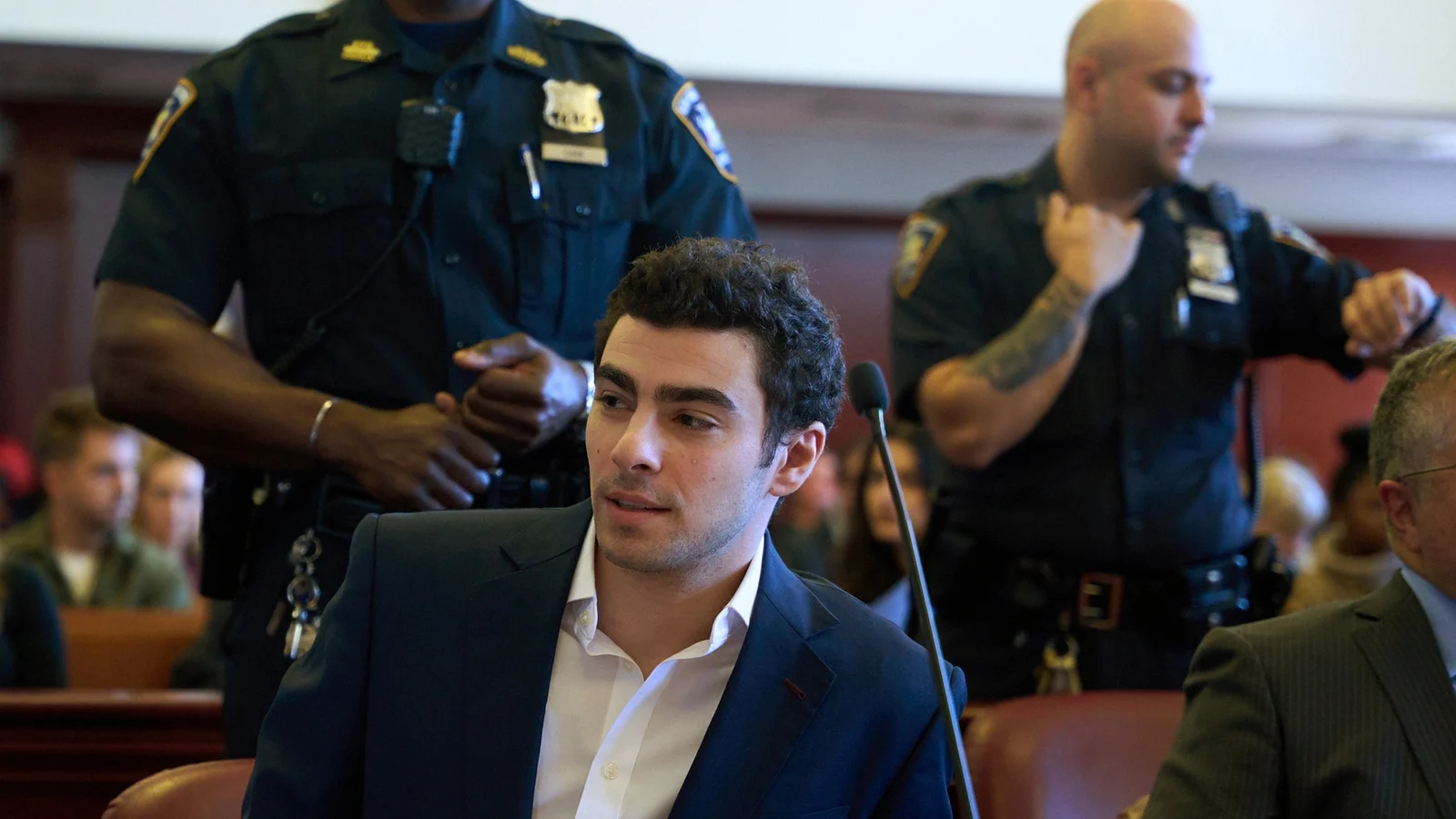
A judge removes the death penalty from a case that shocked a nation — what happens next?
New York’s morning rush had not yet settled into its usual rhythm when a grainy piece of surveillance footage blinked across screens and paused the city’s breath: a man aiming a gun at close range at a health insurance executive, a flash, then a body collapsing on the pavement. The clip traveled fast — through social feeds, cable news tickers and conversations at corner bodegas — and it did something else: it turned a local crime into a national mirror, reflecting deeper anger over healthcare, safety and the limits of the law.
This week, the story took another turn. A federal judge has barred prosecutors from asking jurors to consider the death penalty in the case against 27-year-old Luigi Mangione, accused of killing UnitedHealthcare executive Brian Thompson in December. “This decision is solely to foreclose the death penalty as an available punishment to be considered by the jury,” Judge Margaret Garnett wrote in a court filing.
What the judge’s ruling means — and doesn’t
That sentence from Judge Garnett narrows the range of outcomes in a case that already threads federal and state jurisdictions: federal prosecutors trimmed two charges that carried capital punishment — murder and the use of a firearm equipped with a silencer — while leaving intact two federal stalking counts. In federal court, Mangione faces the prospect of life in prison without parole if convicted on those stalking charges; state murder charges still loom in New York.
To put it plainly: the jury that will be empaneled in September will not be given the choice to sentence Mangione to death. But the case is far from over. Jury selection is scheduled to begin on 8 September, and the trial is expected to lay bare evidence recovered at the time of arrest — including a backpack that officers say contained a handgun, a silencer, a loaded magazine, bullets reportedly wrapped in underwear and a red notebook described by prosecutors as a “manifesto.”
Defense attorneys had argued the search of that backpack violated legal standards; Judge Garnett rejected the challenge. For now, the itemized pieces of the case — the footage, the tip-line arrest five days after the murder at a McDonald’s restaurant in Altoona, Pennsylvania (some 370 kilometers from the scene), the notebook of writings — remain part of the record.
From surveillance footage to a small-town tip
When the first images of the killing circulated, people across the political and geographic spectrum reacted, often with the same stunned disbelief. “It looked like something out of a horror film,” said Maria Alvarez, who runs a storefront in Manhattan’s Midtown. “But then you remember it happened to someone’s father, to someone’s colleague, and it stops being an image and starts being a life.”
The arrest itself carried a small-town human touch: a McDonald’s worker in Altoona noticed a customer whose description fit the suspect and called authorities. “We see all kinds of people here,” the manager told a local reporter. “But something about him made the crew uncomfortable, and they did the right thing and called.” The tip led to an arrest five days after the killing.
Evidence and legal dance
Prosecutors say the backpack search yielded items that tie Mangione to the killing; the defense countered that the retrieval and search violated constitutional protections. Judge Garnett’s ruling not only rejected suppression of the backpack evidence but also boxed in the prosecution: no death penalty option in federal court.
“A life sentence without parole is still a grave and permanent punishment,” said defense attorney Rachel Lennox outside the courtroom. “Our client maintains his innocence and we intend to show the jury why the facts do not support these severe charges.”
Prosecutors, for their part, emphasized accountability. “When someone takes another’s life in cold blood, we will pursue justice to the fullest extent allowed,” a spokesman said. “This ruling does not lessen our obligation to seek the truth and to protect the public.”
Why the death penalty decision matters — and how it fits a larger debate
Capital punishment in the United States is a contested, patchwork policy. Roughly half the states still retain the death penalty; the federal government retains it as well, though federal capital prosecutions are rare in modern practice. Presidential administrations, shifting public opinion and legal roadblocks have made federal death sentences uncommon and controversial.
That context is crucial. Stripping capital punishment from the federal options in Mangione’s trial places the case within a broader national trajectory: an era in which prosecutors increasingly weigh the legal, moral and practical costs of seeking death sentences. The decision gives the nation an opportunity to focus not simply on punishment but on the web of causes that precede such violence.
“We must ask what pushed this individual to violence, and what systems failed along the way,” said Dr. Hannah Kline, a criminologist who studies stalking and targeted violence. “That doesn’t excuse criminal behavior, but it does compel us to look at prevention: mental health services, early intervention, and the role of online harassment in escalating threats.”
Stalking, guns and the American context
Stalking is often dismissed in casual conversation as annoyances or obsessive behavior, yet it is a serious, escalatory type of violence. Government reports indicate that roughly one in six women and one in seventeen men experience stalking at some point in their lives. Many stalking incidents involve access to firearms: a lethal combo that raises the stakes for victims and communities.
Meanwhile, calls for reform in healthcare — the very sector represented by the victim, a UnitedHealthcare executive — have taken on new intensity. The killing of a corporate leader in that industry tapped into simmering public frustration about insurance denials, high premiums and a perception that profit motives sometimes trump patient care. “It’s not an excuse, but people’s grievances with systems do spill over,” said Maya Patel, a patient advocate. “We need policy answers, not vigilante justice.”
Voices from the city and beyond
On the streets where the surveillance footage first circulated, conversations were intimate and varied. A nurse who worked near the site paused to collect her thoughts. “Every time I see something like this I think about the patients I couldn’t help and the system we have,” she said. “But this — killing someone — is a choice. We can’t let anger justify homicide.”
Across political lines, reactions blended grief with a desire for systemic change. “Justice must be served, but we also have to acknowledge why we’re here,” said Miguel Soto, a community organizer in Queens. “If people believe the system is stacked against them, violence becomes one of their answers. It’s on all of us to change that.”
What to watch next
The federal trial will begin with jury selection on 8 September. In the coming months, the public will see the evidence, the arguments and, possibly, a broader discussion about the role of criminal law in addressing violent acts tied to social grievances.
- Key dates: Jury selection begins 8 September.
- Charges narrowed: Death-penalty-bearing federal charges dismissed; federal stalking counts remain.
- State-level charges: New York still pursues murder charges.
- Evidence to watch: Surveillance footage, the backpack contents, and the contents of the red notebook described as a “manifesto.”
As this case moves toward a courtroom full of witnesses, lawyers and jurors, it invites a larger question: how should a society balance the demands for retribution, the need for public safety and the imperative to address the systemic ills that sometimes culminate in violence? How do we mourn and seek justice while still asking, with open eyes, what might prevent the next tragedy?
Whatever the outcome, the streets that morning, the McDonald’s in Altoona and a courtroom in Manhattan serve as reminders that violence reverberates far beyond a single act — into families, into policy debates and into the everyday conversations of a nation wrestling with how best to live together.