A crowd, a chant, and a judgment that refuses to be tidy
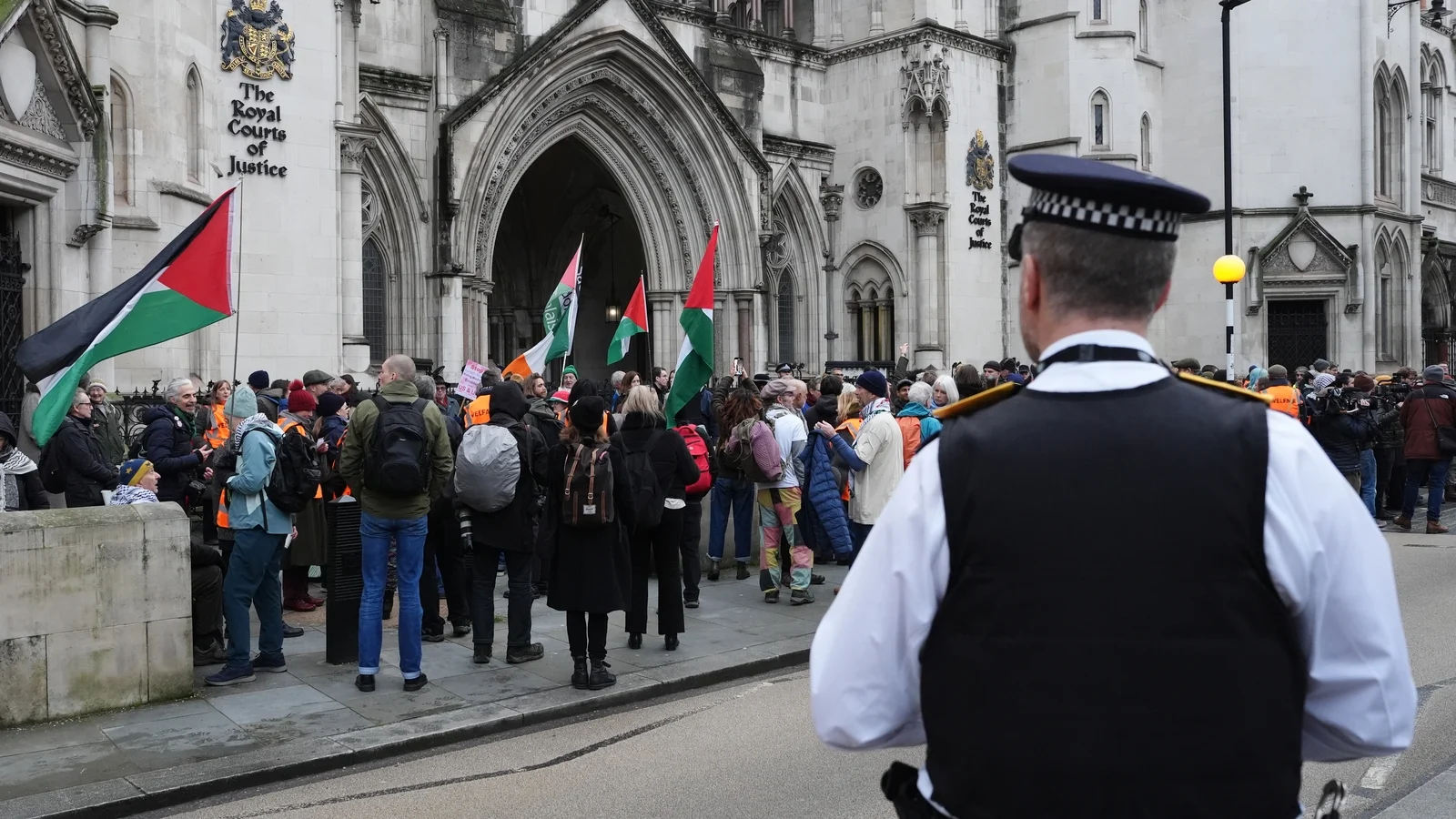
It was a grey morning in central London, the kind that drapes the city in a muted palette and sharpens the sound of voices. Outside the High Court, roughly a hundred people had gathered — students with worn backpacks, a grandmother clutching a thermos, a former serviceman wearing a flat cap — and their chorus rose and fell in waves: “Free Palestine.” When the court announced that Huda Ammori had won part of her legal challenge, the crowd cheered; when they learned the ban would remain in place for now, the cheer curdled into frustrated applause and determined chanting. It was protest, but also a ritual of defiance: communal, noisy, and full of questions.
“We came to be seen and to be heard,” said Fatima Khan, 28, who works as a nurse and travelled from east London. “This feels like the state telling us whose grief counts, and whose doesn’t. We can’t let them make our politics into a crime without answering.” Her voice shook, not from heat or cold, but from long-held indignation.
How we got here: a legal fight and a partial win
The story began in the summer, when the Home Office moved to proscribe Palestine Action under the Terrorism Act 2000. The ban — which came into effect on 5 July 2025 — made membership of, or support for, the direct-action group a criminal offence, carrying a maximum sentence of up to 14 years in prison. Within weeks and months, arrests followed. Government figures and defence counsel referenced more than 2,000 arrests linked to the proscription; on the first day of one hearing, police detained 143 people amid demonstrations.
Huda Ammori, a co-founder of the group, challenged that decision in the High Court, arguing the ban was heavy-handed, discriminatory and procedurally flawed. On the other side, the Home Office defended the proscription as a legitimate tool to protect national security and public order. The court’s answer was not simple: sitting with two other judges, Lady Justice Victoria Sharp said Ms Ammori had succeeded on two of the four legal grounds she raised, but she refused to lift the ban immediately. Instead, the order stays in place to allow the government time to assess and to appeal.
“I am disappointed by the court’s decision and disagree with the notion that banning this terrorist organisation is disproportionate,” said interior minister Shabana Mahmood in a swift reaction that left no ambiguity about the government’s next move. “Home secretaries must … retain the ability to take action to protect our national security and keep the public safe. I intend to fight this judgement in the Court of Appeal.”
Arguments, analogies, and the fight over civil disobedience
In court, the legal theatre was as much about precedent and principle as it was about one organisation. Barristers for Ms Ammori argued the proscription was alien to the traditions of common law and the protections of the European Convention on Human Rights. They described a broad sweep that swept up “priests, teachers, pensioners, retired British Army officers” — ordinary people whose support, they said, was symbolic rather than criminal.
“This is classic civil disobedience territory,” one defence counsel told the judges, invoking a history of protest that ranges from suffragettes to sit-ins to the refusal of segregation-era bus laws. “If we permit the state to criminalise mere expressions of alignment, we hollow out the right to contest unjust laws. Rosa Parks would be a criminal without conscience in the current formulation.”
Government lawyers countered with a different frame: the proscription is a proportionate step to stifle organisations whose tactics cross into activity the state must deter. “Proscription signals that such groups cannot rely on the oxygen of publicity or vocal and financial support,” their submissions said, adding that supporters may still protest lawfully without endorsing criminal conduct.
Lives caught in a legal net: arrests, authors, and unintended consequences
The practical fallout has been sharp. More than 2,000 arrests, legal representatives say, paints a picture of enforcement that blurs the line between quoted slogans and operational activity. That has real human consequences: people charged, futures potentially curtailed, and community relationships strained.
Then there is an unexpected cultural wrinkle. Novelist Sally Rooney — author of Normal People — provided evidence in support of the challenge after revealing plans to donate certain earnings to Palestine Action. She warned in written testimony that it was “unclear” whether companies could legally pay her under anti-terror laws, and that her ability to publish, produce or profit from new works in the UK could be “enormously restricted.” The suggestion that artistic life might be chilled by proscription lit up conversations among authors, publishers and free-speech advocates.
“When culture becomes collateral in a legal battle, we lose a space where ideas are tested and refined,” said Dr Laila Mansour, a political sociologist at a London university. “Artists don’t just make objects — they are part of civic debate. The risk is that proscription can shrink that debate into whispers.”
Voices from the street and the lecture hall
On the pavement outside the courthouse, a retired magistrate who has been named in court papers told me, softly and with a rueful chuckle, “I never expected to be on the wrong side of a law I once judged under.” An ex-army lieutenant, who requested anonymity, said he felt frustrated that people he considered principled civil disobedients were being labelled as criminals. “This isn’t about violence — it’s about moral pressure,” he said.
Not everyone shares that view. “When protests escalate into targeted sabotage or intimidation, the state has a duty to act,” argued a former counter-terrorism official. “Proscription is one of many tools in the toolbox. The question is whether it’s used with care — and whether the legal checks are sufficient.”
What this moment tells us about democracy and dissent
At stake is a larger civic question: how do liberal democracies balance the protection of public safety with the messy, sometimes uncomfortable business of political contestation? In a decade marked by intense polarisation over foreign policy, migration and identity, the lines between protest and criminality are increasingly litigated rather than debated. That shift has consequences beyond any single organisation.
Consider the facts on the table: a statutory framework (the Terrorism Act 2000) designed for a different era; a government anxious about tactics that might verge on illegality; protesters and artists warning of chilling effects; thousands of arrests and a chorus of public concern. Each of those facts is a prismatic fragment of a national argument.
What happens next — and what you might ask yourself
The government has said it will take this to the Court of Appeal. The legal fight will continue; the ban will, for now, remain. But the case has already raised durable questions: should support for a controversial political cause be equated to supporting a proscribed organisation? Where does civil disobedience end and criminality begin? And how do we preserve robust dissent without sacrificing safety?
As you read this, ask yourself: when the law narrows the space for public expression, who decides which voices are legitimate? And when state power expands to silence, what becomes of the very pluralism it claims to protect?
The High Court decision was neither a ceremonial victory nor a complete defeat. It was messy, contested and very much alive — a mirror held up to a society wrestling with the shape of its own freedoms.