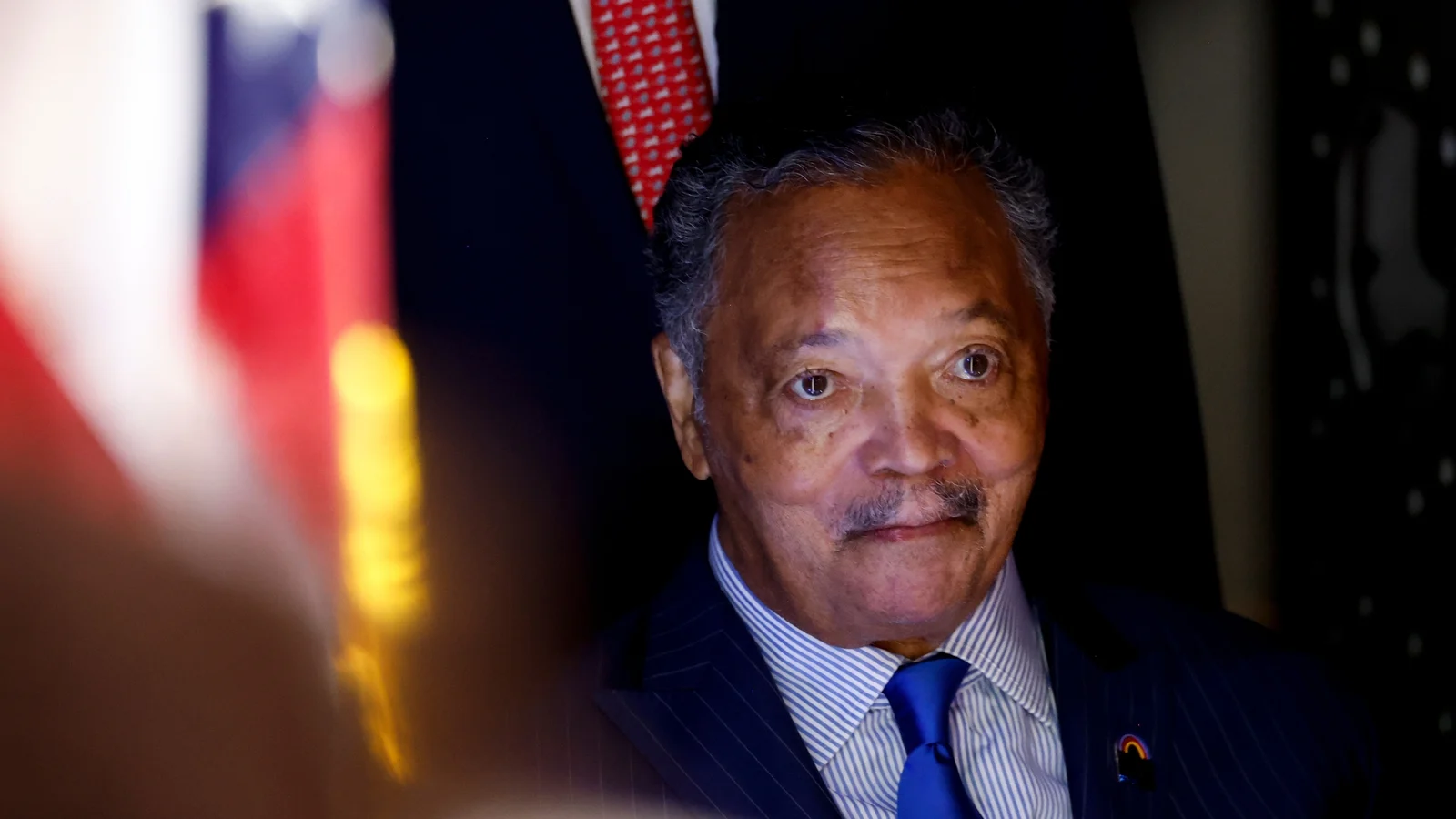
A Giant Has Passed: Remembering Reverend Jesse Jackson
There are mornings when a city wakes to a familiar sound—the clatter of buses, the hum of a bakery, a radio voice that has become part of the domestic furniture. This morning Chicago woke differently. Word moved through neighborhoods like a ripple: Reverend Jesse Jackson had died, age 84, surrounded by his family. The short family statement—stark, tender—called him a “servant leader” who “elevated the voices of the voiceless.” For many, that was simply true; for others, the man was a complex, sometimes controversial fixture of American life. All of it mattered.
“He shared himself with the world and the world became our family,” his wife Jacqueline and their children wrote. “Honor his memory by continuing the fight for the values he lived by.” Those words hang over Jackson’s life like a banner—an invitation, a demand, a benediction.
From Jim Crow South to Chicago Pulpits
Jesse Louis Jackson was born on October 8, 1941, in Greenville, South Carolina, into a world that the Jim Crow laws had mapped in sharp, unforgiving lines. His mother was 16; his father, 33 and living next door. He was adopted by his mother’s later husband, and his early life was stitched with the small humiliations and big dangers of being Black in the segregated South.
There is a childhood picture that explains something of the man: a lanky teenager, a football scholarship that would open one door and close another, walking past a “Whites Only” sign toward activism. At North Carolina A&T, at the University of Illinois briefly, at Chicago Theological Seminary where he was ordained in 1968, Jackson learned to make moral conviction sing. He was arrested attempting to enter a whites-only public library in South Carolina and, in doing so, joined a long catalogue of personal risks civil rights leaders took to change a nation’s habits.
The Drummer in King’s Band
Jackson was more than a foot soldier; he became a lieutenant to Dr. Martin Luther King Jr., often traveling with him, learning the pulse of protest and the grammar of moral argument. He was on the floor below King at the Lorraine Motel on the day King was assassinated in 1968—an image that has haunted Jackson’s public life ever since. He later claimed to have cradled King and been the last to hear his words. Others disputed that account. The moment crystallizes the messy intimacy of movements: grief, myth, memory, tangle together.
Organizing, Oratory, and the Rise to National Prominence
Chicago became Jackson’s chosen ground. He turned a local pulpit into a national platform—founding Operation PUSH in the early 1970s, later the National Rainbow Coalition in 1984, and finally merging those efforts into the Rainbow/PUSH Coalition in 1996. Through those organizations he pushed corporations, politicians and the public to reckon with inequality—not just racial but economic and gendered, and later LGBTQ rights as well.
He had a voice that could both soothe and sting. In the 1980s his oratory drew crowds and headlines. His presidential campaigns—1984 and 1988—were more than vanity quests. In 1984 he won roughly 3.3 million votes in Democratic nominating contests (about 18% of those cast), a surprising figure that announced Black political power on a new scale. In 1988 he was more polished, more prepared: he won 11 primaries and caucuses and amassed nearly 6.8 million votes—about 29% in the nominating contests—pushing the Democratic Party to listen, to reconsider its base, its language, its future.
“America is not a blanket woven from one thread, one colour, one cloth,” he told delegates at the 1988 Democratic National Convention. “Hold your head high, stick your chest out… Don’t you surrender.” That kind of line—simple, biblical, electrifying—made him a bridge to the people who needed a bridge and a lightning rod for those who feared change.
Personal Diplomacy on the Global Stage
Jackson’s activism was not confined to speeches and ballot boxes. He became, remarkably, an unofficial diplomat. He negotiated the release of prisoners from Syria, Cuba, Serbia and Iraq. In 1984 he secured the freedom of U.S. naval aviator Robert Goodman Jr. from Syria; in the early 1990s he met Saddam Hussein to press for the release of hostages after Iraq’s invasion of Kuwait. These missions earned him invitations to the White House and a reputation as someone who could move across borders where governments could not—or would not—act.
“He did what governments sometimes could not do: he humanized bargaining,” said a longtime colleague. “He put a face to a negotiation.”
Triumphs, Controversies, and Human Frailty
To call Jackson’s life a straight narrative of triumph would be to flatten it. He weathered controversies: crude remarks that cost political momentum in 1984; personal scandals that troubled his movement; the ignominious fall of his son Jesse Jackson Jr., who resigned from Congress and later served time after a fraud conviction. Leaders, like humans, are not monoliths. They are public and private, heroic and flawed.
Still, awards arrived. President Bill Clinton gave him the Presidential Medal of Freedom in 2000. He hosted a weekly CNN show from 1992 to 2000. He continued to lean into public life well into old age—speaking out against police killings in 2020 and reminding the nation that a guilty verdict in the murder of George Floyd might be relief, “but not a time for celebration.”
Later Years: Parkinson’s and Passing the Torch
In 2017, at 76, Jackson announced a Parkinson’s disease diagnosis after years of symptoms. Globally, an estimated 10 million people live with Parkinson’s, according to WHO figures, and his disclosure humanized a common-but-misunderstood ailment. He stepped down as president of Rainbow/PUSH in 2023 after more than five decades in leadership, leaving a movement to a new generation.
“He asked us to keep going,” said a young organizer in South Side Chicago. “He told us to keep our feet on the ground and our eyes on the prize.”
What He Leaves Behind
When leaders die, we tend to tally achievements and transgressions like ledger entries. Jackson’s ledger is long: millions registered to vote, millions more inspired to run for office, civil rights organizations that persisted for decades, the kind of rhetorical fire that could raise a crowd and sometimes raise tempers. He never held elected office, yet he bent the arc of politics around him.
His life forces questions: How do movements sustain themselves when their charismatic architects age and fall ill? How do societies distinguish between the public utility of a life and the personal mistakes that accompany it? How do we honor the gains made while honestly appraising the harms?
If you have ever felt excluded by a system, Jackson’s voice—flinty and consoling—reminds you that exclusion is not inevitable. If you have ever wondered whether a single voice can alter a conversation, Jackson’s life argues yes. He made bridges where bridges were scarce; he made noise where silence prevailed.
Close the Loop: A Call
There will be memorials and eulogies and heated reassessments. There will also be the quieter things: community meetings, voter registration drives, a young organizer quoting “Don’t you surrender” into a cellphone camera. That, perhaps, would be the truest honor.
So what will you do with the inheritance of Jesse Jackson’s years? Will you register a neighbor to vote, speak up at a PTA, lobby that councilperson, mentor a teenager? He would ask you to act—not for the cameras, not for the plaques, but to narrow the gap between promise and practice.
“He gave us faith that faith will not disappoint,” a friend said. “Now, we have to finish the work.”