Four Years On: Morning Bells, Burned-out Buildings, and a President’s Quiet Defiance
On a raw February morning, the streets of Kyiv carried an odd, stubborn mix of routine and rupture. Shopkeepers swept slush from their doorways while a mural of a sunflower — petals painted bright against a slate wall — watched over a city that refuses to be ordinary. Somewhere, a church bell tolled, as it always does, but this time the sound felt like a ledger being rung: memory marked, debts kept.
“Putin has not achieved his goals,” President Volodymyr Zelensky said that day, his voice steady as ever, a line meant for more than domestic ears. It landed like a stone thrown into a wide, tense river: ripples of relief for some, a spur to vigilance for others. Four years after the invasion that began on February 24, 2022, Ukraine is a country still under siege and still very much itself — scarred, resourceful, and resolute.
Morning After Morning: Small Rituals in the Shadow of War
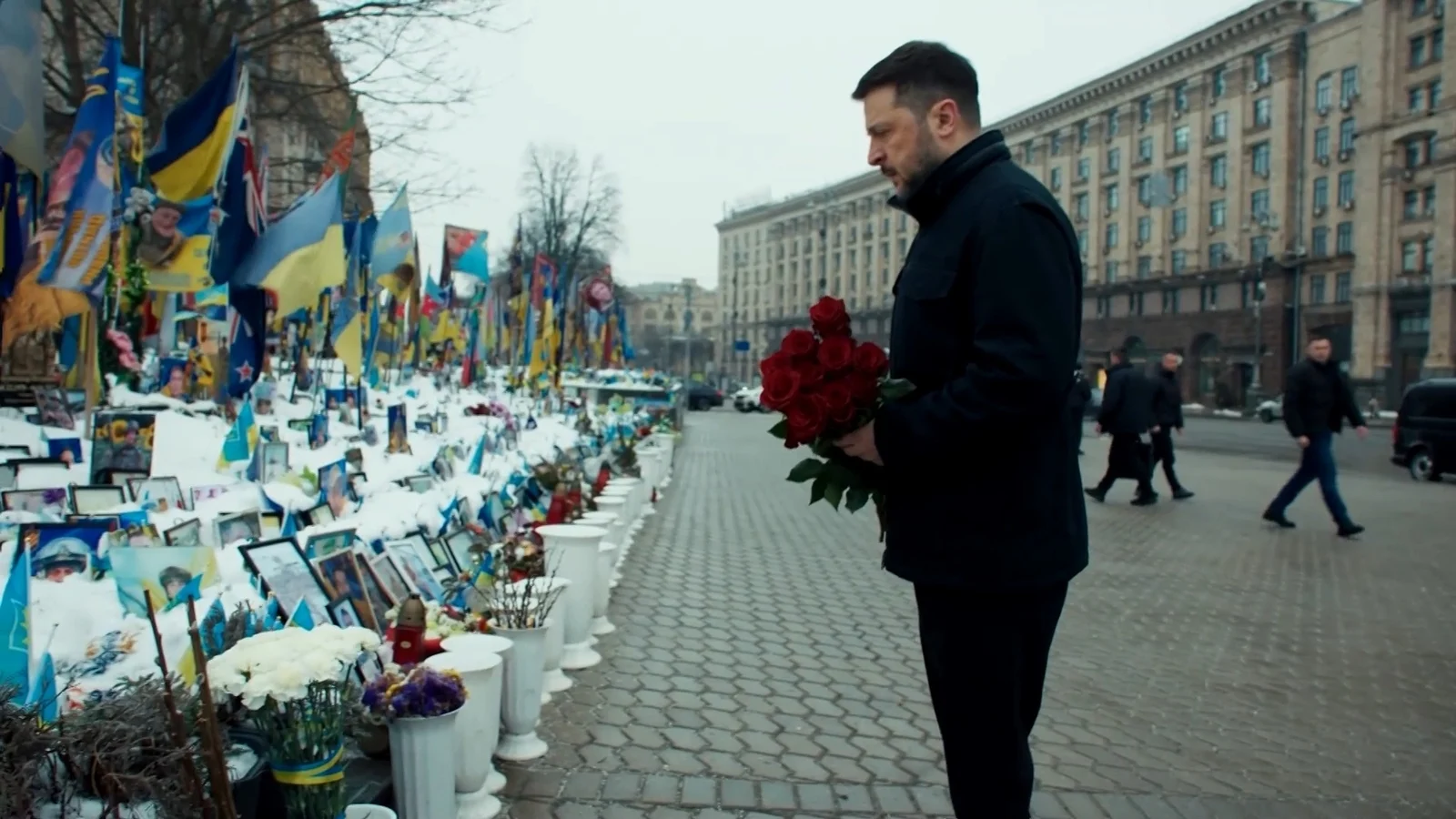
Across towns and villages — from the broad avenues of Kyiv to smaller, shell-scarred communities in the east — people observed the anniversary in ways both quiet and fiercely public. At a makeshift memorial outside a school, a woman arranged candles and photographs of sons; at a military cemetery, a soldier placed a pair of scuffed boots beside a fresh slab of stone. In cafés, conversations dipped and rose between grief and the mechanical necessities of daily life: bills to pay, bread to bake, children to warm.
“We do what we must,” said Olena, a schoolteacher who lost her classroom to a rocket strike two winters ago. “We teach where we can. We make borscht for neighbors. We remember.” Her hands — ink-stained from lesson plans, callused from hauling sandbags — told a story of work that war had rewritten but not erased.
Signs of Endurance
There is endurance in the little adaptations that have become routine: generators humming at night, lines at water points, volunteer centers doubling as shelters, and apartment balconies blooming with potted plants as though every green thing were a small act of rebellion. The human geography of Ukraine has shifted dramatically — millions have moved inside the country or across borders, global agencies have documented waves of displacement, and families have had to redraw the map of their lives.
Voices From the Ground: Not Just Headlines
“We read the speeches, yes,” said Mykola, a volunteer medic who drives supplies two hours east every week. “But the work is mostly quiet. You stitch. You cook. You listen. That’s how you keep things from falling apart.” He spoke with the blunt cadence of someone who has seen a lot of endings and a few more beginnings. “If the world thinks we will simply stop, they are wrong.”
A local grocer in Kharkiv — who asked to be called Nadia — described how commerce itself had become a kind of resistance. “People come in with small pockets,” she laughed, a brittle, warm sound. “They buy a candle, a bag of flour. We take it in turns to give change or to put goods aside for those who cannot pay. It’s how we keep our dignity.”
Leadership in a Time of Attrition
Zelensky’s message for the anniversary was both a report and a rallying cry: a country that had not bent to the invader’s will. “Not achieved his goals,” he said, echoing the mantra of resistance that has threaded through four years of diplomacy and conflict. His words were meant to underscore a political truth — that the original objectives of the invasion had been met with fierce unpredictability and cost — and to remind supporters abroad that Ukraine’s future remains a matter of international consequence.
Outside Ukraine, responses have been variegated. Western capitals have balanced support — military, economic, humanitarian — with their own domestic calculations. Diplomatic fatigue and political shifts have complicated the steady flow of aid, even as private donors and civil society have filled gaps that governments sometimes cannot. “Long wars are tests not just of arms but of attention,” observed an EU analyst who has followed Kyiv’s plight for years. “Maintaining that attention is harder than firing one missile.”
Numbers and What They Mean
Fact: this is not a small conflict. Millions of lives have been disrupted, cities have been damaged, and the cost — human, material, psychological — is being tallied daily. International organizations report displaced populations in the millions and damage assessments in the hundreds of billions of dollars. Those numbers are blunt instruments; they point to scale but not to particular griefs. For every “million,” there is a family with a single photograph and a single missing name.
Statistics matter because they shape policy and humanitarian responses. But they do not alone explain why people wake at dawn to shove snow away from a memorial or why a family refuses to leave a home with one usable wall and a stove that still works. Those are acts of identity.
Local Color: Sunflowers, Bread, and the Language of Home
There is cultural texture here that survives the worst of what war can do. Sunflowers — Ukraine’s unofficial emblem — continue to be pressed into wreaths and murals. The scent of freshly baked bread remains one of the most reliable markers of normal life: a simple loaf passed between neighbors is, in many ways, a currency of comfort.
Language, too, plays its part. In small ways, daily speech holds territory. In markets, patrons speak in a chorus of Ukrainian dialects; in neighborhoods once contested, people retell old jokes about winters and harvests as a way of laying claim to continuity. These details are not quaint. They are the mortar of community.
Beyond the Frontlines: A Question for the World
What does four years teach us about conflict, morality, and the geopolitical order? One lesson is blunt: wars reshape not only borders but attention spans. The global systems that respond to human suffering can be both nimble and brittle — moving mountains in one week and faltering when the news cycle shifts.
For readers far from these frozen streets and scorched fields, the anniversary invites a question: how do you keep grief and solidarity alive at a distance? There are no simple answers. But there are small acts: donating, amplifying unheard voices, pressing leaders for humane policy, and refusing to let the human lives at the center of this crisis become a background image in an inbox.
Where Do We Go From Here?
Ukraine’s future will be written by negotiations, by rebuilding, and by the quiet work of citizens who continue to live here. There will be debates — international and local — about security guarantees, reconstruction funds, and the legal reckonings that follow mass violence. There will be art, too: murals, songs, novels. Memory will demand monuments and apologies and histories that tell the truth rather than the tidy narrative.
For now, the country keeps stepping forward, one small ritual at a time. A bell rings. A loaf cools on a windowsill. A volunteer car departs into the snow. As you close this piece, ask yourself: what would your morning ritual be if your map of home were suddenly redrawn? How would you keep your community alive?
On this fourth anniversary, Ukraine is teaching the world a lesson in obstinacy and hope. That lesson is not just about resisting an aggressor. It is about refusing to let the ordinary be erased — even as the extraordinary things of war keep intruding on daily life. And for many who live here, that refusal is the story worth remembering.