Smoke over Beirut, Sirens across the Region: A City Wakes into War
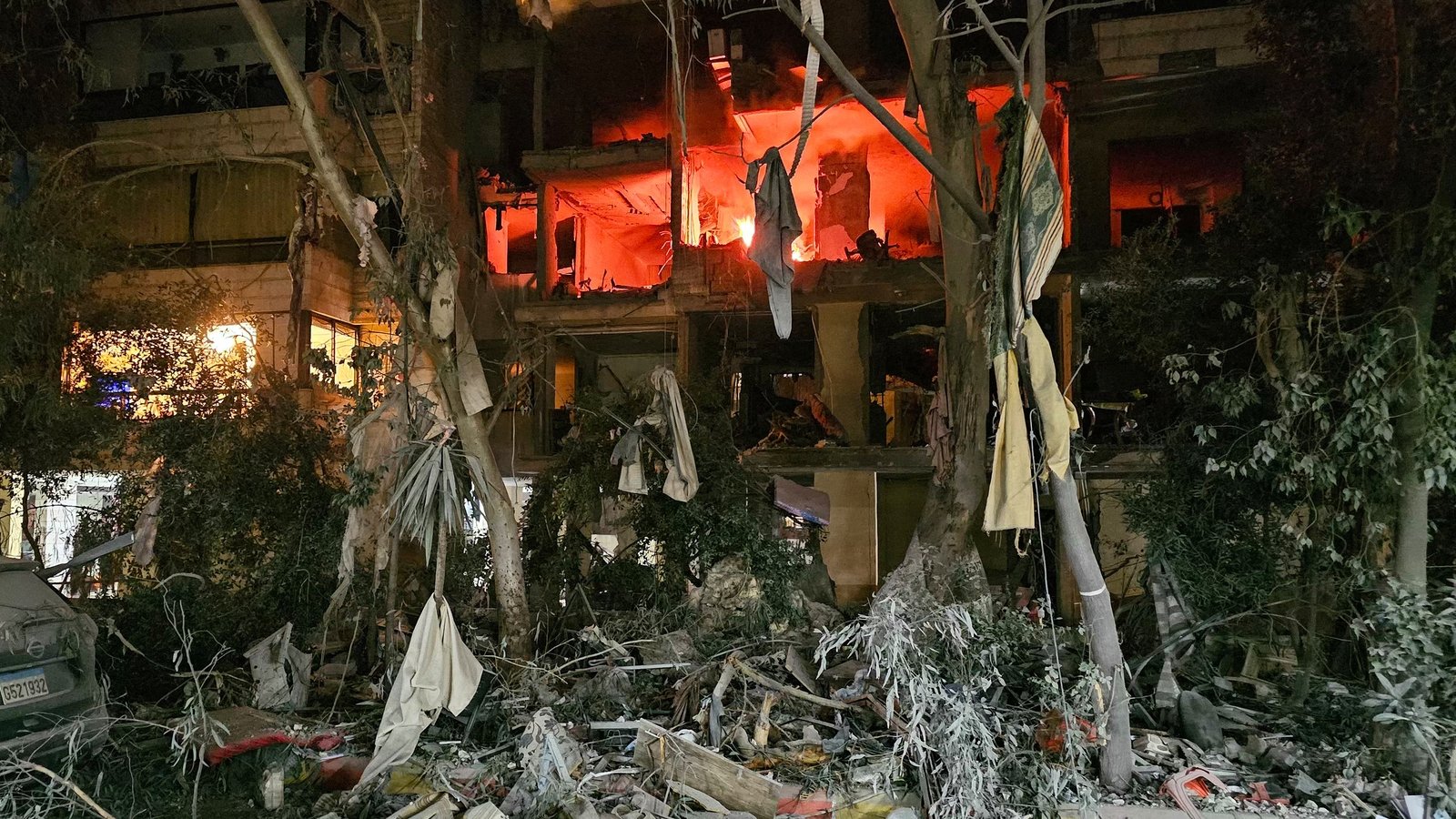
By dawn, the southern neighborhoods of Beirut—once a jumble of laundry lines, lemon trees, and late-night street cafés—looked as if someone had swept a dark hand across them. Black smoke coiled into the sky, and families shoved suitcases into cars, helmets on the back seats, children clutching pets and toys as if their small comforts could anchor them to home.
“We fled with nothing but the clothes on our backs,” said Mona, a schoolteacher from the Dahiya district, her voice raw with exhaustion. “My students used to hide under their desks during drills. Today, the drills were real.”
Lebanon’s health ministry released an initial toll: at least 31 dead—20 in Beirut’s southern suburbs and 11 in the country’s south—and 149 wounded after a wave of Israeli air strikes. The strikes came in response to an unprecedented rocket and drone barrage fired by Tehran-backed Hezbollah, which the group said was retaliation for the death of Iran’s supreme leader.
The Immediate Flashpoint
The morning’s violence was not an isolated flare but a snap in a much more frayed thread. Hezbollah—whose fighters and political leaders have long been entwined with Lebanon’s social fabric in the south and across Beirut’s suburbs—said it had struck an Israeli army site south of Haifa “with a barrage of high-quality missiles and a swarm of drones”. In military terms, it was the most overt claim of responsibility since a fragile ceasefire brought a halt to more than a year of cross-border hostilities in late 2024.
“Hezbollah chose the Iranian regime over the State of Lebanon and initiated an attack on our civilians… they will pay a heavy price,” Rafi Milo, head of the Israeli military’s Northern Command, declared in a statement that promised increased intensity of strikes. Hours later, the Israeli military said it had “precisely struck” senior Hezbollah figures in Beirut and the south, and issued evacuation orders to around 50 towns and villages in Lebanon — places where Hezbollah’s presence is deeply rooted.
Voices from the Ground
An aid worker who had been coordinating ambulances at a hospital near the southern suburbs described a scene of improvisation. “We ran out of blood bags by mid-afternoon. Mothers were carrying infants, fathers were trying to call relatives, and we kept getting reports of new strikes,” she said. “This is not how a city should breathe.”
Lebanese Prime Minister Nawaf Salam condemned the rocket fire as “irresponsible” and pledged to “stop the perpetrators and protect the Lebanese people.” President Joseph Aoun warned that allowing attacks from Lebanese territory risked dragging the country into a wider regional conflict—a resonant fear in a nation still stitched together after years of political turmoil and an economy on the edge.
From Tehran to Tel Aviv: An Escalation that Spreads
The night’s violence did not confine itself to Lebanon. Air raid sirens flared across Israel, including in Tel Aviv and Jerusalem, after state media in Iran said another wave of missiles was being launched toward “enemy locations.” Tehran reported explosions near its own intelligence ministry, and international witnesses described blasts heard as far afield as Dubai and Doha.
The US and allied forces, already engaged in a sweeping campaign against Iranian military infrastructure across multiple fronts, said their own operations had struck more than 1,000 Iranian targets since the outset of major hostilities. The cost has not been only strategic: US officials confirmed the first American casualties of the campaign, with three service members killed in an attack at a base in Kuwait.
“This is a conflict of telescoping consequences,” said Miriam Haddad, a Middle East analyst based in Amman. “Local strikes become national, national operations slip into regional clashes, and regional clashes ripple into the global economy.”
Collateral Shockwaves
Global commerce felt the tremors. Dubai’s airport—one of the world’s busiest international hubs—was briefly closed, grounding flights and sparking one of the most significant disruptions to air travel in recent memory. Shipping lanes also shifted as hundreds of vessels, including oil tankers, dropped anchor farther from the Strait of Hormuz, a critical chokepoint for global energy supplies.
The economic echoes were immediate: Asian airline stocks tumbled, some by over 5%, and commodity traders braced for a likely uptick in crude oil prices. “Every missile and every strike has a price that someone, somewhere, eventually pays,” Haddad said.
Politics, Public Opinion, and the Weight of Leadership
Back in Washington, President Donald Trump framed the campaign as ongoing and resolute. “Operation Epic Fury continues unabated,” a senior White House official said, echoing the president’s warning that military strikes would persist until objectives were achieved. A Reuters/Ipsos poll suggested public appetite for continued operations was thin—only about one in four Americans approved of the campaign.
“There will likely be more casualties,” Mr. Trump said in a pre-recorded video tribute to fallen American service members, urging Iranians to rise up against their rulers and offering immunity to those who surrendered. Iran’s temporary leadership council, however, signaled no eagerness to negotiate. Voices within Tehran’s inner circle, like former adviser Ali Larijani, dismissed the notion of talks with the US, calling such overtures delusional.
So What Now? The Broader Pattern
Ask yourself: when a fire spreads from a match to a forest, is the blame purely on the spark, or on the centuries of drought? In the Middle East, decades of proxy battles, unaddressed grievances, and brittle governance have created tinderbox conditions. The return to open conflict between Israel and Hezbollah—a pair that has repeatedly flirted with war—underscores how quickly local disputes can cascade into regional crises.
Humanitarian organizations are already warning of mounting needs. Hospitals strained, food supplies disrupted, and civilians displaced—these are the predictable outcomes. The political calculus is less immediate but no less consequential: a prolonged campaign could reshape domestic politics in several countries and leave long-term scars on an already fragile regional order.
Small Stories, Big Consequences
In a narrow alley off the main road in the southern suburbs, an elderly grocer named Hassan swept glass from his doorway. “We have lived with sirens before,” he said, voice steady though hands trembled. “But every time, it feels like the first time. The children ask when they can play again. What do I tell them?”
His question hangs in the air like the smoke: who offers the answer? Military victory or strategic gain are abstract to the family whose home is rubble. For them, the calculus is immediate—shelter, safety, the chance their children will dream without the taste of fear in their mouths.
Where Do We Turn from Here?
There are no tidy exits. Diplomacy, when it returns, will have to navigate not just the demands of states and militias but the daily reality of communities caught between them. International actors face choices: reinforce a fragile balance, push for de-escalation, or double down on military means with all the risks that invites.
For readers watching from afar, consider the human texture beneath every headline: the mother in Beirut, the naval crew in the Gulf, the airline passenger stranded in Dubai. Conflicts are often presented as chess matches between high-level actors. But the pawns are neighborhoods, grocery stores, schools, and market stalls—the fragile infrastructure of ordinary life.
As the region holds its breath, the question remains: can a broader regional ceasefire be stitched together before the fire becomes an inferno? Or will each retaliatory move redraw maps of loss for another generation? The answer will depend not only on leaders and missiles, but on the quieter, harder work of preserving the lives and dignity of those who live nearest the smoke.