A Breath, a Blowhole, and a Crowd Holding Its Breath: The Whale They Called “Timmy” Finds the Sea Again
Morning on the coast has a way of rearranging your priorities. The gulls argued above the harbor. Sea spray tasted like salt and memory. Onlookers huddled on the pier with steaming cups of coffee, their faces lit by the low sun and the faint hope that a creature beaten by the shore might be given back the one thing it needed most: space to swim.
Then a sound — not the wild, acoustic boom of a ship’s horn but the intimate, unmistakable exhale of a whale. A column of white steam popped through a blowhole, and an enormous, mottled back slipped into blue water. People cheered. Some cried.
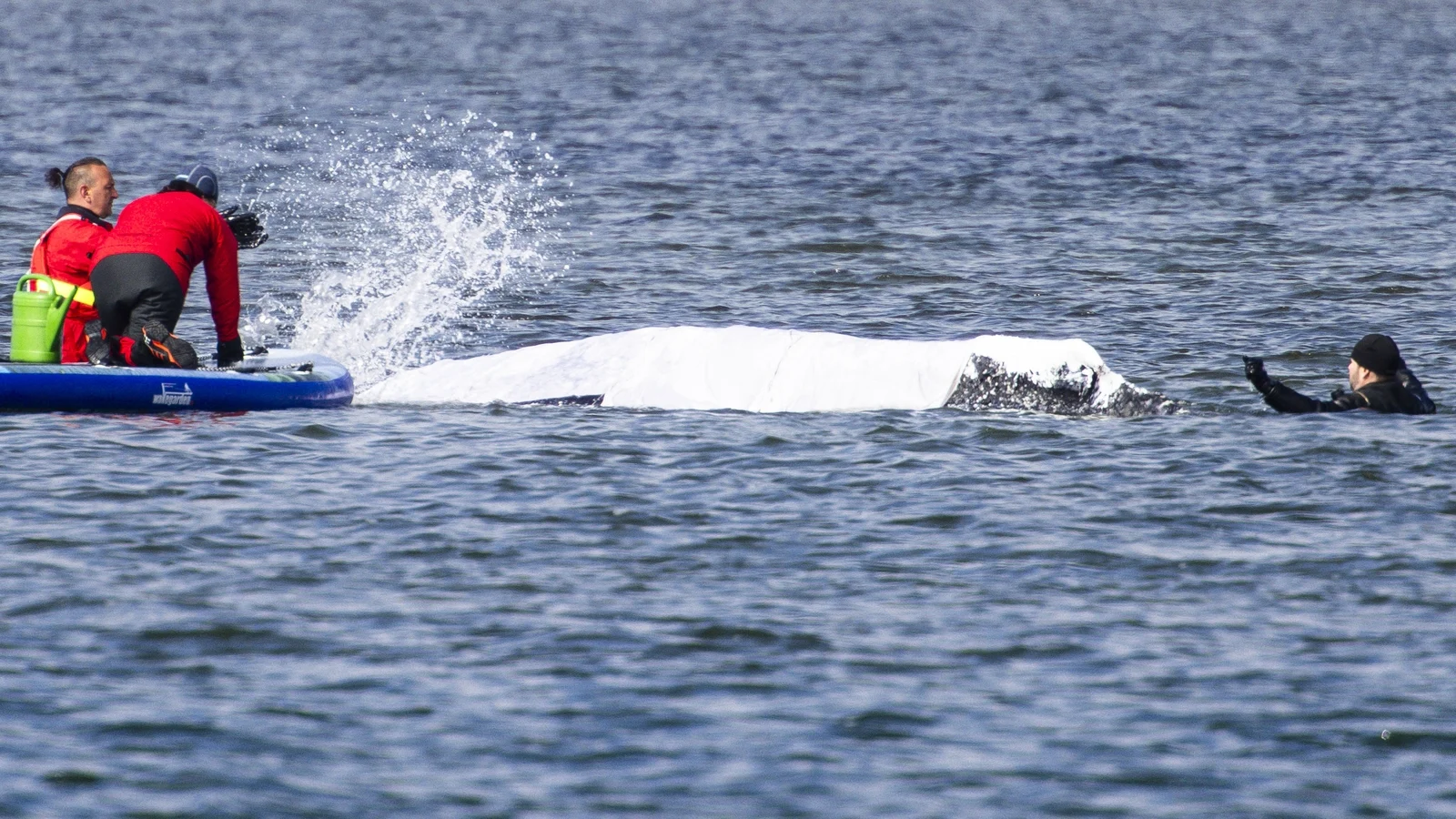
That creature, for a few weeks the star of Germany’s evening news and the subject of countless social feeds, had been nicknamed “Timmy” by a crowd that needed names for what they were watching. Timmy had been paradoxically famous and fragile. Stranded on sandbanks near Lübeck on March 23, entangled by tide and geography, the humpback became the focus of rescue teams, veterinarians, armchair experts and, eventually, two entrepreneurs who bankrolled an audacious plan.
The Long, Uncertain Road Back to Open Water
The last days of Timmy’s stay on the sand were a patchwork of attempts and setbacks. Locals remembered the first sighting, a lone dark shape inked against a wide expanse of shallow Baltic, and the slow, terrible logic of a large marine mammal finding itself in an environment that resembles a trap.
“In the Baltic, the tides are low and the sands shift,” said Jens Kappel, a fisherman who had watched the whale from his skiff. “You don’t realize how quickly the waterline changes until you see a thing that huge stranded on a patch that looks dry from the shore. We couldn’t leave it there.”
Teams tried inflatable cushions, pontoons and coaxing — the tools of choice for many animal rescues — but the sea remained stubborn. Strandings are complicated. Humpback whales (Megaptera novaeangliae) are migratory marvels, often traveling thousands of kilometers between feeding grounds and breeding grounds. Adults can reach 12–16 meters in length and weigh up to 40 tonnes. They live decades and, for the most part, recovered well globally after the era of industrial whaling; the species is listed as “Least Concern” by the IUCN in broad terms. Still, local populations can be vulnerable, and individual whales, like Timmy, can find themselves in mortal danger because of a simple navigational error or environmental shifts.
When Experts Doubt and Private Money Steps In
At one point, officials signaled their limits. Resources, logistics, risk to rescuers — these are not small concerns. When the formal rescue operations began to wither, two private backers entered the scene. One of them, Karin Walter-Mommert, a German entrepreneur known in some circles for her investments in sport and racing, helped underwrite something that looked part dream, part salvage operation: a specially adapted barge with a water-filled hold, designed to cradle a whale for towing.
“We couldn’t just watch,” Ms Walter-Mommert told a cluster of reporters after the release. “When veterinarians said the whale could be moved without undue risk, we made a choice to act quickly. You feel very small standing next to such a magnificent animal. It felt like the only moral thing to try.”
Not everyone applauded. Some marine biologists warned that moving a large whale could increase stress and injury. “Handling a cetacean of that size is like carrying a heart that must keep beating continuously,” said Dr. Anja Möller, a marine mammalogist who has studied strandings for decades. “There are always risks of internal trauma, masking of illness, or disorientation after transport.”
Engineering Hope: The Barge, the Channel, the Moment of Release
The operation itself had the air of a theater production: specialist crews, heavy straps, a channel hand-dug into the sand to make a runway to water, and a barge waiting with a flooded hold to receive Timmy. Rescuers swam alongside as the whale moved into the vessel — an intimate ballet of human determination and cetacean instinct.
“He didn’t cooperate like a dog at the beach,” joked one volunteer, wiping his hands on a jacket afterward. “But when he took off his tail and slid into that hold, we all felt like someone had pressed the reset button.”
Veterinarians were on hand throughout. After a tense tow, with the barge creaking and the North Sea’s swells testing every seam, the crowning moment came off Denmark’s coast. At about 08:45, Timmy slipped from the barge, breathed deeply, and turned toward the open water. Ms Walter-Mommert later said the whale had some superficial injuries — likely scrapes from the journey — but nothing that would stop it from continuing its migration.
What Happens Next?
For now, the whale is “swimming under its own power,” Ms Walter-Mommert said, and seemed to be heading in the direction of the Norwegian coast and, eventually, the Arctic — the northbound route humpbacks take to feed on dense shoals of fish and krill.
But the question that hangs over the whole episode is both practical and philosophical: when is intervention right? And who gets to decide?
After the Big Rescue: Questions That Outlast the Applause
The rescue has sparked celebration — and debate. Social feeds were awash with triumphant footage, but also with theories about why the whale stranded in the first place. Some accused sonar and shipping noise, others blamed changing prey distribution due to warming seas. Conspiracy-laden comments rubbed shoulders with heartfelt notes from schoolchildren who had drawn whales and taped them to telephone poles.
There are larger, systemic issues here. Strandings are not isolated events; they’re symptoms. Climate change is reshuffling marine life: prey moves, and predators follow. Increased coastal development and noisy shipping lanes add new obstacles to old migratory instincts. At the same time, maritime nations wrestle with limited resources for wildlife emergencies, and private funding can step in both as creative solution and a provocation — who pays, and why?
- Humpback whales migrate thousands of kilometers annually and can live up to around 50 years.
- Global humpback populations have largely rebounded since whaling bans, though local groups face varied pressures.
- Strandings may be caused by illness, navigational error, human noise or shifts in prey distribution linked to climate change.
That list is small, and the reality is messy. It is the kind of problem that resists neat answers.
Walking Away, Watching the Horizon
After the cheers, some stood in quiet — the kind of silence you hear when a good thing has been done and yet the world remains complicated. A child asked her mother if whales remembered people; a fisherman lit another cigarette and said he hoped Timmy would find his old lanes again. An activist phoned her colleagues to document the transport and the fact that private money had intervened. A scientist sent the coordinates to colleagues to keep monitoring.
We can celebrate this outcome without pretending it solves everything. We can applaud the bravery of volunteers, the ingenuity of engineers, and the compassion of private donors — and still ask: are we building a world where rescue is the rule rather than the exception? How do we prevent these situations from happening in the first place?
For now, Timmy is a streak on monitoring maps and a hopeful anecdote people will tell over dinner in seaside towns for years. But the image that will linger is not of a barge or a bracket of straps; it’s that first breath, a white plume rising against a grey horizon, and a huge, wild animal turning toward the vast, uncertain blue.
What would you do if you were standing on that beach? How much are we willing to invest — in money, in policy, in the slow, patient work of protecting habitats — to make sure there are fewer rescues and more reasons for whales to find their way home on their own?