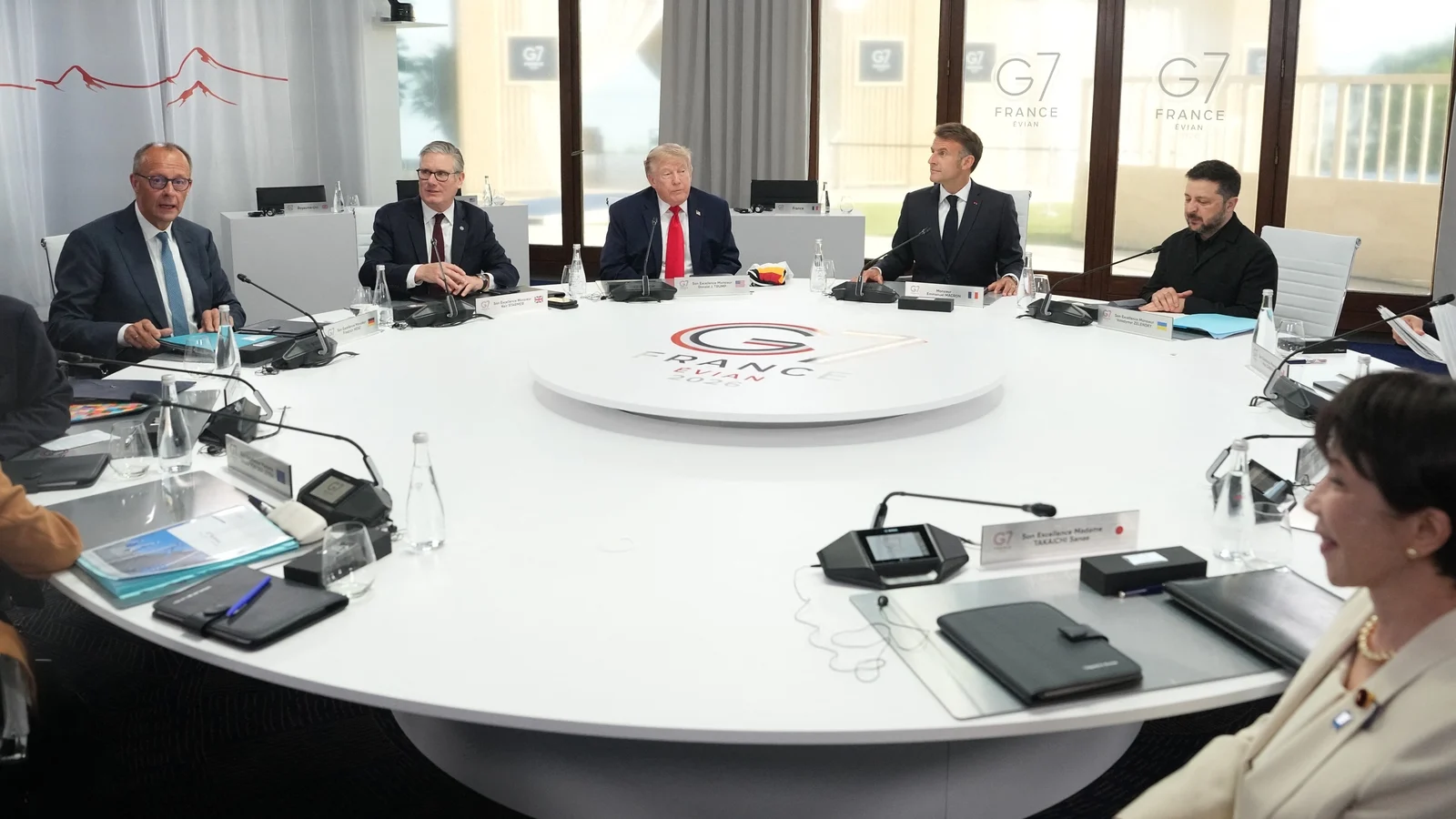
Against a backdrop of war, market strain and a technology boom that is rewriting economies, leaders of the world’s seven richest democracies have gathered in the French lakeside resort of Évian-les-Bains for talks spanning Ukraine and Iran, global financial imbalances, and the accelerating rise of artificial intelligence.
The summit lands at a moment when the G7, now marking a half-century of meetings, is again confronting questions about its influence as multilateralism weakens and economic and political clout shifts elsewhere. Over decades, the group has wrestled with shocks from the 1970s oil crisis to the global repercussions of US President Donald Trump’s military strikes against Iran.
What is the G7?
The G7 is an informal grouping of wealthy nations. It has no permanent secretariat or legal status.
Its members are the US, Britain, Canada, France, Germany, Italy and Japan. The European Union attends all summits but does not count as one of the core “seven” and does not hold the rotating presidency, as it is not a single nation but a bloc of 27.
Russia was included in what became the G8 in 1997, but was later suspended in 2014 after annexing Crimea from Ukraine.
France took over the presidency from Canada in 2026.
US President Donald Trump and Canada’s Prime Minister Mark Carney
How long has it been around?
The G7 was created in the wake of the 1973 OPEC oil embargo, conceived as a forum where the richest nations could coordinate responses to crises hitting the world economy. Together, its members generate more than $50 trillion in annual GDP — just under half of global output.
By the 1980s, the agenda had widened beyond economics to include political and security questions.
More recently, it has also become routine for host nations to bring in additional leaders. Among those invited this year are the heads of government from India, South Korea, Kenya and Brazil.
What’s on the agenda at the Évian-les-Bains summit?
Supporting Ukraine
A central objective for the G7 is to project unity behind Ukraine as it confronts a Russian war now in its fifth year.
Ukraine’s President Volodymyr Zelensky has proposed face-to-face talks with Russian President Vladimir Putin aimed at ending the conflict. He is urging Europeans to take a bigger role in the effort, concerned the United States is being pulled toward the conflict in Iran.
European G7 members, for their part, intend to press Mr Trump that Ukraine’s position has improved, that Europe is increasingly carrying the financial, military and political load of the war effort, and that the group should align on a strategy for any meaningful negotiations with Mr Putin.
Mr Zelensky will be in Évian-les-Bains for the discussion on Ukraine.
Britain’s Prime Minister Keir Starmer meets with Ukraine’s President Volodymyr Zelensky
Iran
The leaders are meeting days after the US and Iran said they had agreed on a framework to end their war.
While the agreement is not expected to be signed until Friday, G7 leaders are seeking clarity on what is in the accord — and, in particular, when the crucial Strait of Hormuz can return to normal shipping traffic. Mr Trump said the strait would reopen on Friday and that he had ordered an end to the US blockade on Iranian ports.
Ahead of the summit, France pushed for a common G7 position — and coordination with Middle East partners — on what demands can be made of Iran over its nuclear and ballistic programs.
The leaders of Egypt, Qatar and the United Arab Emirates will join the discussion.
US President Donald Trump, Kenya’s President William Ruto and France’s President Emmanuel Macron
Correcting global economic imbalances
France summarises the imbalances as: China produces too much, the US consumes too much, and the Europeans invest too little.
Across Western capitals, concern is rising over China’s record trade surplus and its move up the value chain into higher-value manufacturing and technology. Beijing has defended its industrial policies and rejected allegations that Chinese exporters benefit unfairly from state subsidies.
Emmanuel Macron has presented the summit as a last-ditch effort to pursue cooperation before the EU decides whether to harden its trade approach toward China.
With China not represented at the table, diplomats are not expecting breakthroughs. French officials said that simply securing agreement that the imbalance is real would count as progress.
France’s President Emmanuel Macron shakes hands with South Korea’s President Lee Jae Myung
Artificial Intelligence
France has invited about a dozen senior tech executives — including OpenAI’s Sam Altman and Anthropic CEO Dario Amodei — to take part in discussions on the newest artificial intelligence tools and the risks and opportunities they pose.
Leaders are also set to address protecting children online and strengthening digital infrastructure, though not the taxation of digital giants.
Debt burden of developing nations
G7 leaders are also expected to signal determination to tackle the heavy debt loads weighing on many emerging market and developing countries, though it remains unclear what practical steps will follow from that commitment.