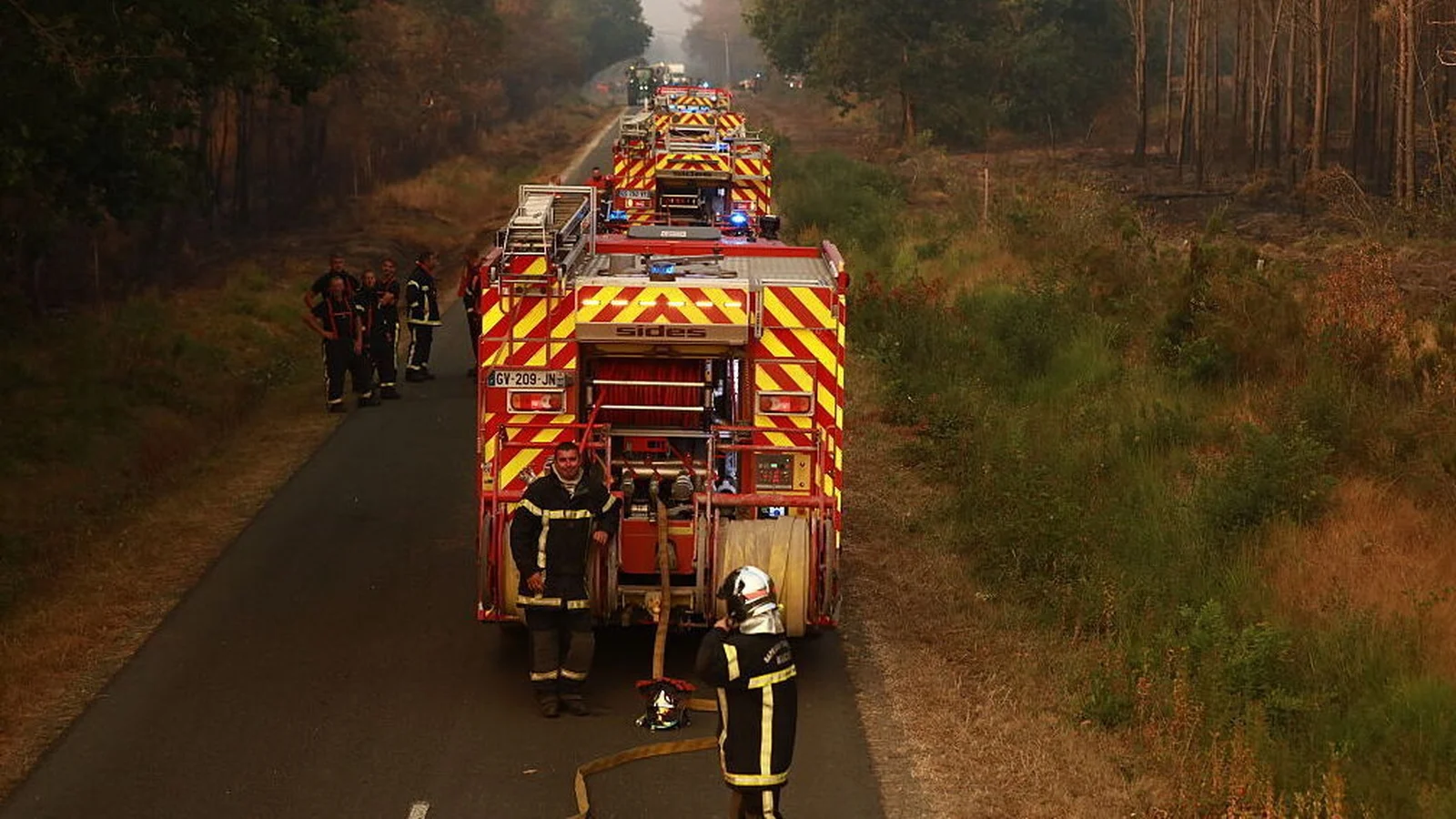
As firefighters wage a gruelling battle against a vast wildfire near Bordeaux, France is now staring down its fourth major heatwave of the year — a fresh blow as the landscape dries further and the risk of new flare-ups rises.
A full week has passed since the blaze began carving a destructive path through the Gironde region in south west France.
Yesterday, several serious flare-ups prompted authorities to order precautionary evacuations for thousands more residents and holiday-makers, with officials warning that further evacuations may still be needed.
Authorities say the fire has been stabilised, even after 14 significant flare-ups yesterday and more reported overnight.
Even so, containment remains out of reach. The fire is still sprawling and unpredictable — a mismatch firefighters have described as a David and Goliath situation. Over the past week, 126 firefighters have been confirmed injured.
Officials are also watching the weather with growing concern.
An orange heatwave alert is due to take effect from midday in Bordeaux, where temperatures could climb to 40 degrees, marking the area’s fourth heatwave in a summer already shaped by drought and fire.
Across France and Spain, wildfires have triggered unprecedented evacuations of tens of thousands of people, tearing through regions already strained by a blisteringly hot, dry season.
Heavy machinery clears trees to create a firebreak near Martignas-sur-Jalle, outside Bordeaux
Residents return home in Spain as ‘progress’ made against wildfire
In Spain, thousands of people forced from their homes by major wildfires began returning today, after the government said it was making headway against some of the most severe forest fires in the country’s modern history.
Evacuation orders were lifted yesterday in more than a dozen municipalities in the Madrid and Avila areas — the epicentre of the blazes that displaced tens of thousands.
“24,000 evacuated individuals have been able to return to their homes, and another 20,000 have been released from confinement in the Community of Madrid,” government delegate Francisco Martin Aguirre said on X late last night.
“Work continues to consolidate the progress made throughout the day in tackling the fire. The return of evacuees is proceeding without incident.”
Drone footage shows charred landscape of Spain’s La Vilavella
Spain’s efforts have been complicated by high winds and the arrival of another heatwave, as fires consumed roughly 77,000 hectares (190,000 acres) — almost the size of New York City.
Interior Minister Fernando Grande-Marlaska said firefighters were containing the blazes, but that today’s priority would be to stabilise the situation and fully extinguish remaining flames.
Earlier restrictions also eased in the eastern province of Castellon near Valencia, where Vall d’Uixo lifted a confinement order for residents yesterday morning.
Wildfire response must evolve with climate change – EU
The European Union needs to strengthen and better fund its approach to wildfires — with more emphasis on forest management and stronger public education on fire risk — as climate change reshapes the threat, the bloc’s crisis-response chief said while France and Spain battle deadly blazes.
“Climate change is accelerating. So our response must evolve just as quickly,” Hadja Lahbib, the EU’s Crisis Management Commissioner, said.
“We must prepare for risks before disasters strike, and not simply react afterwards.”
Ms Lahbib argued that simply buying additional firefighting equipment will not be enough. She said countries should channel more EU funding into forest management practices that reduce wildfire risk, and should do more to educate citizens about “what behaviour they absolutely must avoid” to limit ignition hazards.
About 90% of wildfires are caused by human activity, including campfires and discarded cigarettes.
Still, the EU’s role in wildfire management is limited, with national governments holding primary responsibility.
Brussels can coordinate extra resources pooled from European countries when a member state requests emergency assistance.
The EU also maintains its own “RescEU” reserve fleet of 22 firefighting aircraft and five helicopters, contracted from member countries.
By yesterday, the EU had coordinated the deployment of seven planes and four helicopters to France, along with six planes and three ground forest firefighting teams to Spain.
Climate change is also increasing the strain on that system.
Before this summer began, the EU positioned more than 770 firefighters across high-risk countries — a record deployment — reflecting how human-caused climate change is intensifying the heat and drought that allow wildfires to spread faster and burn for longer periods.
EU officials have said they are preparing for fires to still be burning in November this year.
“The scale and intensity of these disasters mean we will need to confirm strengthening our collective capacity,” Ms Lahbib said, adding that the Commission had proposed more than doubling crisis-response funding in the next EU budget, to €10.7 billion.
But EU countries negotiating the budget have reduced that figure to€9.1 billion, according to their latest compromise proposal.
Separately, the EU is buying a permanent firefighting fleet of its own, with 12 Canadair firefighting planes and five helicopters scheduled for delivery between 2027 and 2030.