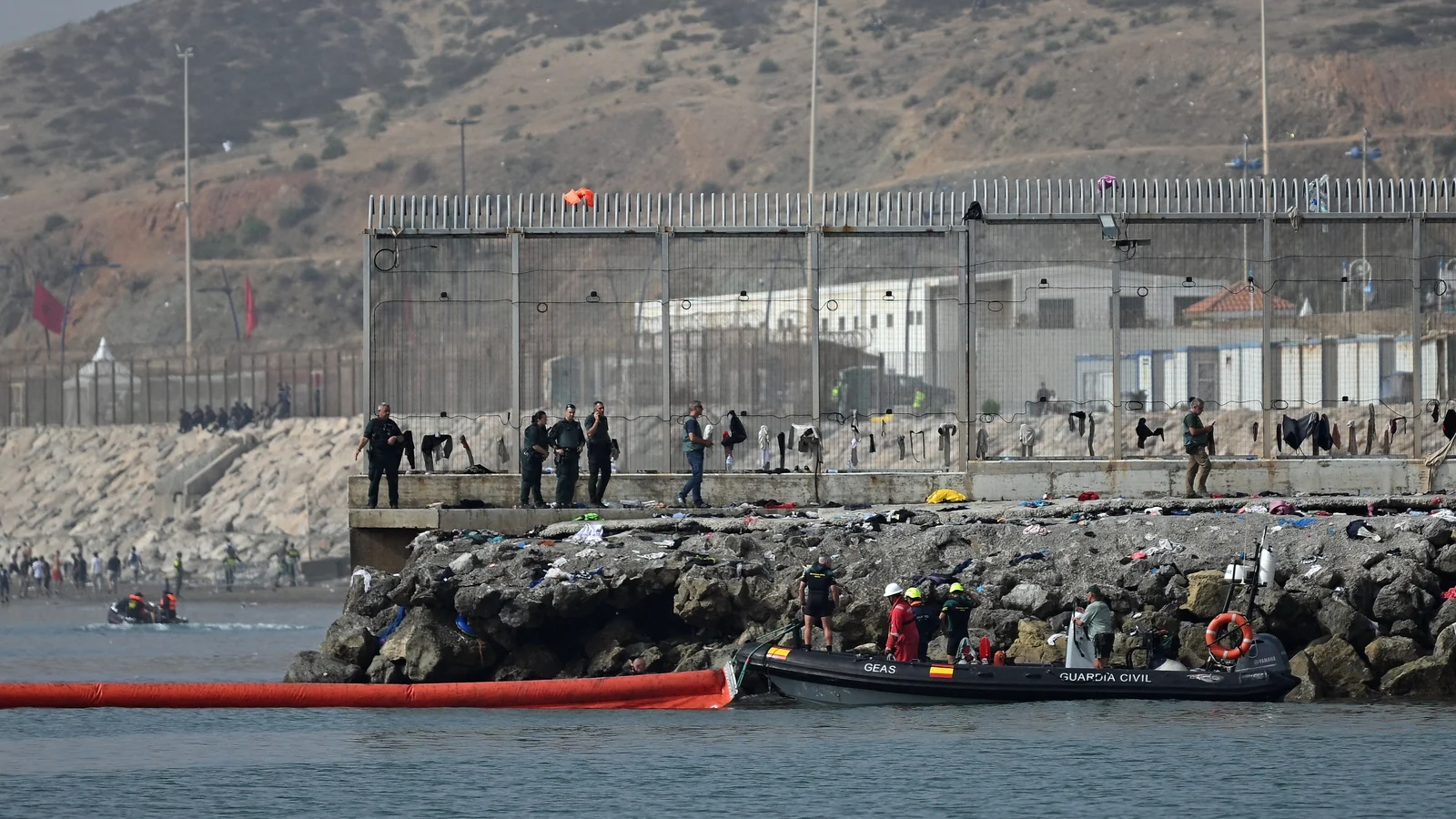
A dramatic overnight lull has descended on Spain’s North African enclave of Ceuta after days of chaos, as authorities moved to seal off a key sea entry point with a new 500-metre floating barrier off the border with Morocco.
Spain said the number of migrant crossings into Ceuta stopped during the night as police and soldiers increased their presence along the frontier. The move follows an unprecedented surge in which around 60,000 people crossed from Morocco into Ceuta by land and sea from Thursday, at one of the European Union’s only land borders with Africa.
At least 67 people died attempting the crossing, Spain’s Interior Minister Fernando Grande-Marlaska said.
Spanish officials said more than 48,000 migrants were returned to Morocco within 48 hours without major incident.
On the ground, Reuters video showed Spanish soldiers and police patrolling a largely deserted Tarajal beach, with thick fog hanging over the shoreline.
Watch: Spain installs floating sea barrier in Ceuta
The government said Civil Guard officers began placing the barrier at 7.50am local time on the Tarajal breakwater, a stretch that has become one of the principal routes used by people trying to enter the small Spanish territory.
Officials described the new system as a pneumatic barrier coupled with a line of anchored naval buoys. It is intended to sit 30 to 70 centimetres above the water while extending as much as one metre below the surface. A channel between the barriers will remain open so Civil Guard vessels can continue patrols, the statement added.
Officials said at least 67 bodies have been recovered on the Spanish side of the frontier. Some migrants drowned, while others were crushed as they tried to climb the breakwater and the border fence.
Many of those who made the journey were pushed by economic hardship and pulled by social media rumours encouraging attempts to reach Europe.
Around 60,000 people crossed into Ceuta from Morocco in 24 hours
EU governments call for emergency meeting
Ceuta and Spain’s other North African territory, Melilla, sit on Morocco’s Mediterranean coast and periodically face attempted crossings by migrants seeking to reach Europe.
The latest influx has exposed divisions across the EU, with several governments urging Spain to ensure the situation was contained.
Senior EU officials are due to hold a high-level crisis meeting today in response.
The gathering of the EU’s integrated political crisis response team, alongside a separate meeting of EU ambassadors planned for Monday, was requested by Ireland in its capacity as holder of the EU presidency.
Seeking both meetings signals a sharp increase in concern about developments in Ceuta, and about the potential consequences for Spain and the EU’s wider migration framework.
In a social media post yesterday evening, Minister for Justice O’Callaghan said he requested today’s meeting to support Spanish officials as they respond to what unfolded in Ceuta over recent days.
I will remain in close contact with the Spanish Government, Member States and the EU institutions as the situation evolves.
— Jim O’Callaghan TD (@OCallaghanJim) July 31, 2026Schengen pressureMadrid said the people who entered Ceuta irregularly could not travel onwards to mainland Spain or elsewhere in the Schengen zone.
In a statement, Spain’s foreign ministry said travellers leaving Ceuta by air or sea are subject to police identity checks, adding a second layer of control beyond the land border with Morocco.
Spain, unlike many European countries, has taken a comparatively more open approach to migration, including a programme that would grant residency to more than half a million undocumented people.
However, Madrid rejected claims that the regularisation plan prompted the rush into Ceuta. It said applicants must prove they were resident in Spain before 1 January 2026 and demonstrate five continuous months of residence at the time of application.
Spain’s Prime Minister Pedro Sanchez, who travelled to Ceuta yesterday, called the mass crossings a violation of Spain’s territorial sovereignty and said returns were being accelerated in cooperation with Morocco.
We need your consent to load this rte-player contentWe use rte-player to manage extra content that can set cookies on your device and collect data about your activity. Please review their details and accept them to load the content.Manage Preferences