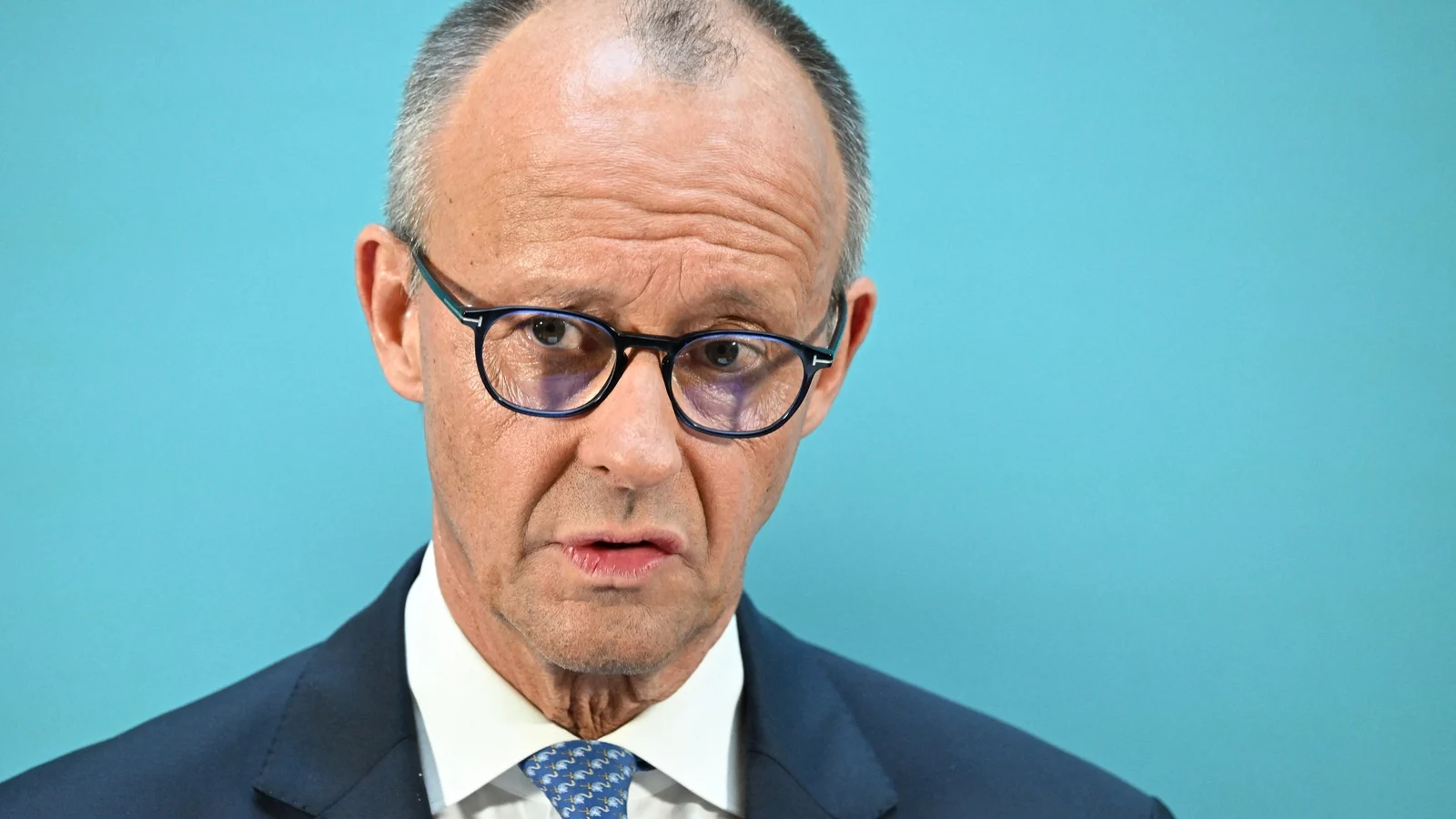
A slickly produced fake video claiming Chancellor Friedrich Merz is preparing to resign has set off alarms in Berlin, with German security services now pointing to a Russia-linked influence operation as the likely source, according to a security source.
The clip, circulated online, mimics the branding of German public broadcaster Deutsche Welle and the business daily Handelsblatt. It asserts that leaked documents from Merz’s conservative CDU party show he intends to step down next week in response to weak poll numbers.
Both media outlets have said the video is entirely fabricated.
Mr Merz’s office said in a statement the allegations were “completely invented” and designed to “confusing and unnerving people”. His CDU party rejected the claims as “nonsense”.
A security source said the “creator is probably Storm 1516”, an operation linked to Russian military intelligence.
The same group is suspected of having pushed disinformation during the last general election in February 2025, which brought Mr Merz to power at the head of a coalition with the centre-left Social Democrats (SPD).
France’s Viginum agency, which monitors foreign disinformation efforts, has said Storm-1516 conducted at least 77 disinformation operations targeting Western countries between late 2023 and March 2025.
Germany’s domestic intelligence agency said the new video “shows that the creators closely follow political developments in Germany and use these opportunistically”.
In its false narrative, the video claims Mr Merz plans to make way for Hendrik Wuest, the CDU state premier of North Rhein-Westphalia.
That storyline echoes earlier reporting in Germany: media outlets speculated about such a possibility earlier this year, and questions about Mr Merz’s future could return after state elections in eastern Germany next month, where the CDU is expected to fare poorly.
Even so, the clip includes a glaring error, referring to a “general federal election in September” despite the fact that no such nationwide vote is scheduled.
The episode reflects a well-worn disinformation playbook, in which invented claims are packaged to look like reporting from trusted news organisations.
German authorities have already accused Moscow of running a broader campaign of disinformation and sabotage intended to erode Germany’s support for Ukraine.
And earlier this week, a drone carrying “professional explosives” was discovered near a Ukrainian cargo plane at Germany’s Leipzig-Halle airport.
German officials have, however, stopped short of assigning responsibility for what they described as “a hybrid attack” scenario.