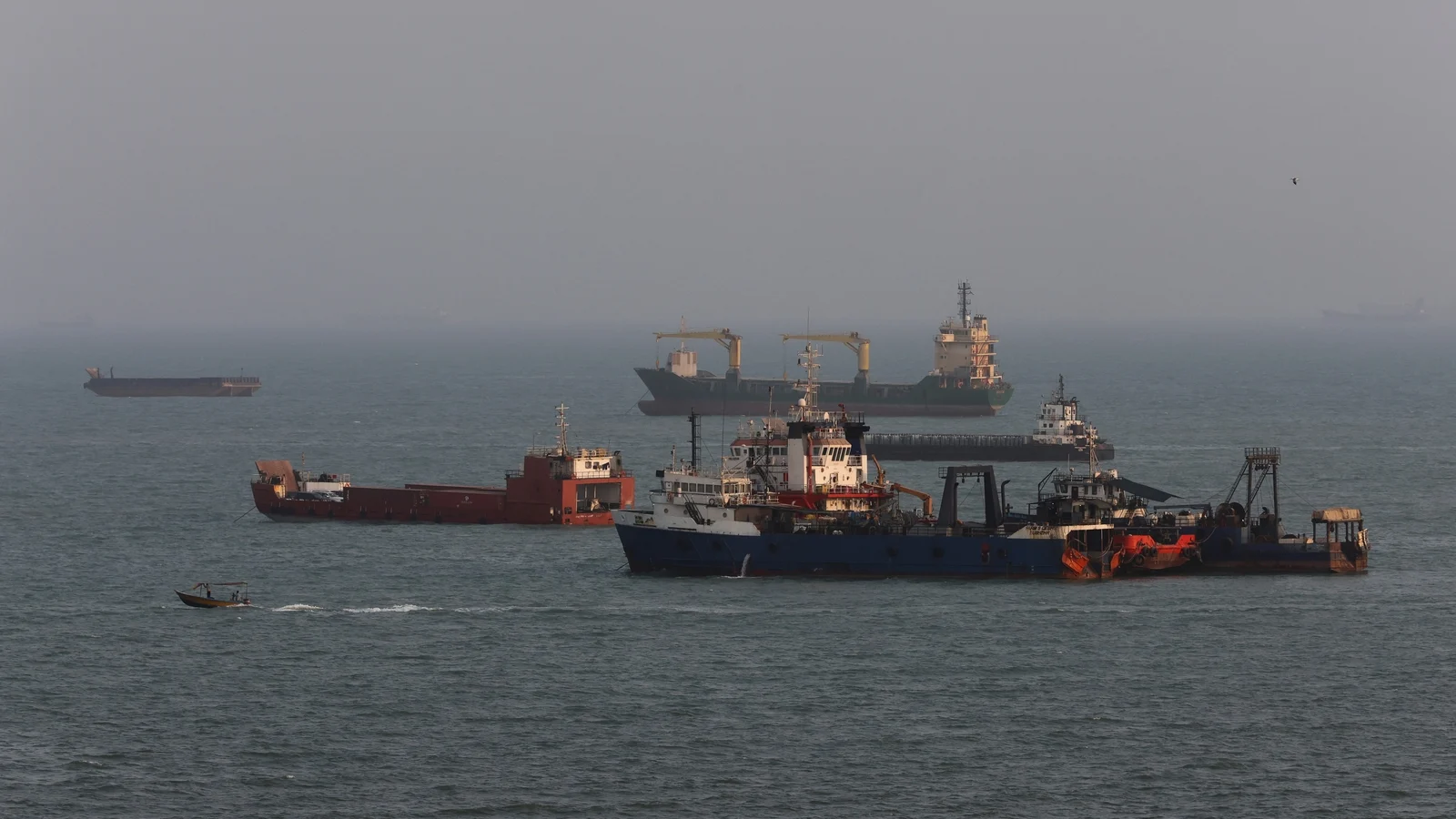
Fresh violence along two of the world’s most critical maritime corridors underscored how far the Iran war remains from resolution, as Washington and Yemen’s Iran-aligned Houthis described separate incidents involving commercial shipping and Tehran warned the Strait of Hormuz would stay shut unless the United States meets its terms.
The reported attacks — one in the Gulf of Oman on approaches to Hormuz and another at the southern mouth of the Red Sea — hit at chokepoints central to global energy trade, arriving even as US President Donald Trump has repeatedly insisted a deal is close.
Markets reflected the souring mood. Oil prices were broadly steady while global equities slipped as hopes for a swift end to the fighting faded.
Brent crude futures settled at $88.88 per barrel by late afternoon, and US crude fell 0.2% to $83.05.
In the Bab el-Mandeb Strait at the southern end of the Red Sea, Yemen’s Transport Ministry said four crew members were killed in what it described as a suspected Houthi strike on a small cargo vessel.
Yemen’s Coast Guard reported that two Yemeni rescuers from an anti-Houthi military group also died.
Those deaths aboard the Egyptian-owned Tihamah would mark the first fatalities on shipping attributed to Yemen’s Iran-aligned Houthis since the Iran war began.
The Houthi-run Saba news agency said the group — which last month announced it would impose a naval blockade on Saudi Arabia in the Red Sea — attacked a Saudi vessel carrying military equipment in the Bab el-Mandeb Strait.
Saba did not identify the ship, and there was no immediate response from Saudi Arabia.
Mohsen Rezaei said the waterway will remain closed unless the US accepts Iran’s conditions
Separately, the US military said a US Navy MH-60 helicopter fired two Hellfire missiles to disable the steering gear of a Panama-flagged cargo ship.
The vessel, US Central Command said, had ignored repeated warnings to stop violating a naval blockade on Iranian ports.
Maritime sources told Reuters the ship was struck off Pakistan while sailing into the Gulf of Oman.
The latest incidents come as both Tehran and Washington have sharpened their language over the past two days.
Iran’s top security official, Mohsen Rezaei, said the Strait of Hormuz — a key global shipping lane — would remain closed unless the United States agrees to Iran’s conditions for ending the war: releasing Iran’s frozen assets and halting conflicts across the region, including in Lebanon and Gaza.
His remarks followed a fresh demand from Mr Trump on Monday that Iran should pay compensation for people killed in 50 years of wars, attacks and protests.
Since the conflict began, Mr Trump has alternated between warnings of escalation and declarations that peace is within reach.
US President Donald Trump described Iran as ‘very devious negotiators’
In an interview released late on Monday, he suggested the uncertainty could last, saying he might simply “bop along” and allow Tehran to fail economically, or strike them “really, really hard”.
“I’m sort of negotiating,” Mr Trump told Real America’s Voice.
“They’re very devious negotiators,” he said.
After a visit to Ohio yesterday, Mr Trump told reporters: “Iran is going fine, going just absolutely fine.”
“We totally control the Strait of Hormuz … Nobody else, only us,” he said.
He added: “At some point, maybe they’ll do something and then they get blown away.
“But right now, we’re in a very good position.
“We have a country that has been the bully of the Middle East for 50 years, really 51 if you think about it … and they’re no longer the bully of the Middle East.”
Asked about an episode last month in which he switched planes in Turkey amid concerns tied to reports of a potential Iranian assassination threat, Mr Trump suggested a different aircraft may have been more vulnerable.
“That would be the plane I think that they would be more likely to go for,” he said after The Washington Post reported he secretly took a military flight instead of Air Force One, with an operation that involved him beingmoved between aircraft in a catering truck.
The Stait of Hormiz handled a fifth of global oil and liquefied natural gas flow before the war
Mr Rezaei’s comments — delivered after his appointment on Sunday as second-in-command of the body that coordinates Iran’s security and foreign policy — were the clearest signal yet that Tehran does not intend to reopen the Strait of Hormuz to commercial traffic in the near term.
Before the war, the narrow passage carried about a fifth of the world’s oil and liquefied natural gas flows.
“As long as America does not change its behaviour and does not accept Iran’s conditions, the Strait of Hormuz will not be opened,” Mr Rezaei said, according to the semi-official Tasnim news agency.
Washington offered no immediate comment on the latest Iranian statement.
Thousands of people have been killed since the United States and Israel launched attacks on Iran on 28 February.
Iran has hit US assets and infrastructure in countries including Oman, Jordan, Kuwait, Israel, the United Arab Emirates and Saudi Arabia.
Adding to fears of further escalation, Mohammad Reza Naqdi, an adviser to the commander of Iran’s Revolutionary Guards, said on Iranian state TV that the corps was working to gain the capability to conduct operations “on enemy soil”.
“We need to be able to move the operations to the enemy’s soil, whenever this is needed and ordered,” he said.
“This is the characteristic of the offensive doctrine that has to be attained,” he added.