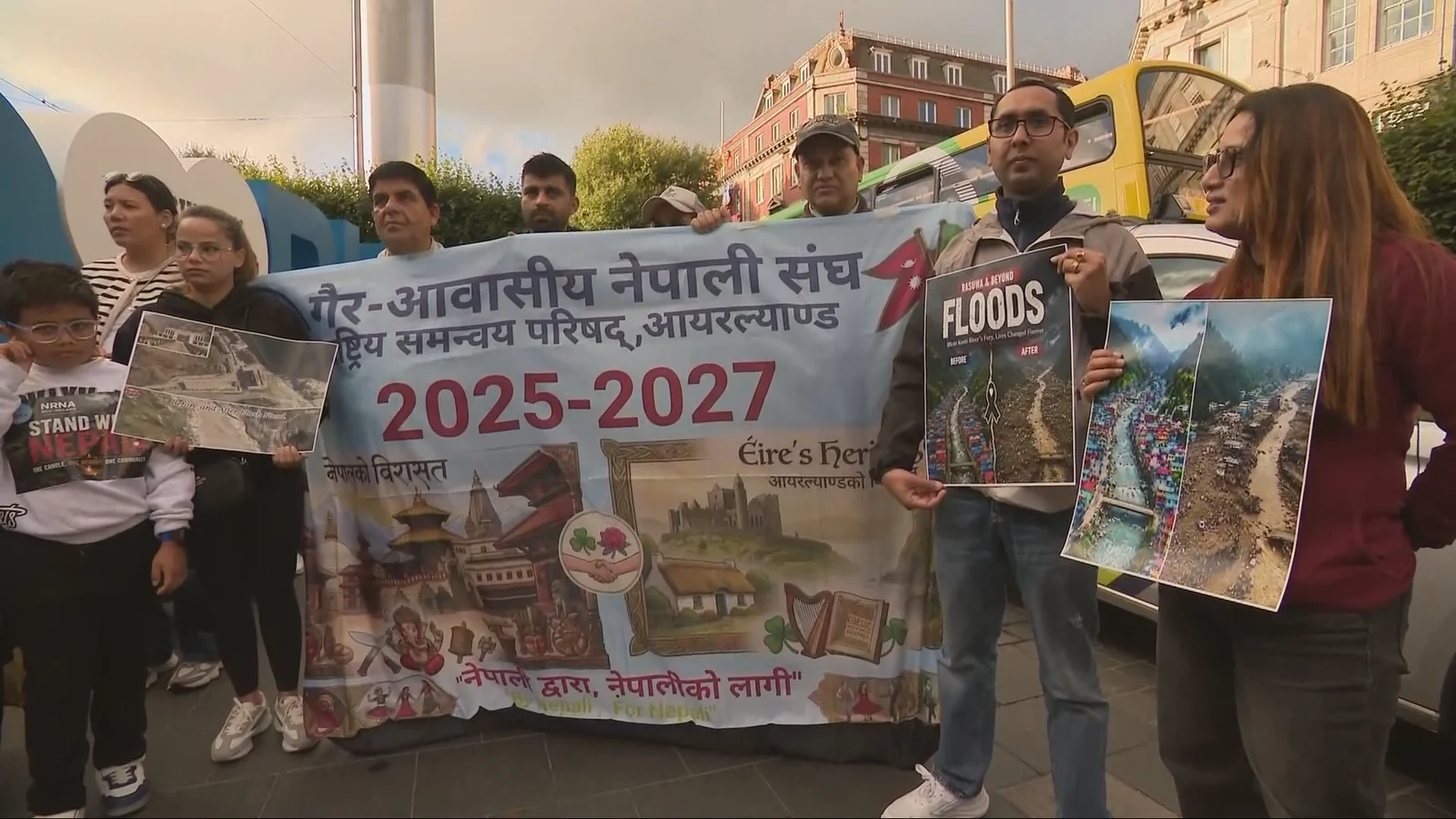
Flickering candles lit up Dublin’s O’Connell Street as Ireland’s Nepalese community gathered in grief — and in support — after catastrophic flooding tore through parts of Nepal.
Around 100 people attended a candle lit vigil at the Spire, organised by the Non-Resident Nepali Association of Ireland to honour those who have died and to raise funds for rescue and relief operations.
Avishek Bogati, a vice president of the association, comes from one of the areas struck by the deluge that hit on Wednesday after a glacier collapsed.
He told RTÉ News that “my uncle is also still missing”.
The vigil in Dublin was just one of several events planned around Ireland
Mr Bogati said uncertainty is still widespread as families wait for news.
“Nobody knows how many people are missing and how many people have died.
“Maybe after two weeks or after a month they will figure it out.”
He said his mother was airlifted by a military helicopter and brought to Kathmandu.
His village, he added, is among several left in ruins.
“There are three villages and 90% of the people are missing, 90% missing,” he said, adding “they still don’t have any information”.
Ireland is home to around 3,000 Nepalese people, most living in the Greater Dublin Area, with others based in counties Galway, Limerick and Cork.
Hundreds are employed on dairy farms, drawing on skills they previously developed while working in Gulf states.
The gathering in Dublin is one of a number of solidarity events planned nationwide.
Prajaya Neupane, a Nepali living in Co Limerick, said a fundraiser will also take place tomorrow night at Hunters Sports Bar in the city, offering food and drinks.
He said all proceeds will be sent to support those affected by the disaster in Nepal.
‘Something unprecedented’ – Nepalese man on flash floods
Mahesh Kushwaha originally thought the incident was a monsoon flood
Separately, a Nepalese man who recently returned to Dublin from Nepal said that while Kathmandu is already struggling under pressure, the wider response has provided some hope.
Mahesh Kushwaha, a PhD candidate at DCU, said he initially assumed the flooding was linked to the monsoon — an annual threat he described as both regular and worrying.
But as videos began circulating, he said he quickly understood the true magnitude.
“It was massive, it was something unprecedented,” he said.
Authorities said the death toll in Nepal and Tibet from last week’s floods has hit 797 with more than 3,000 missing.
At least 781 people died in Nepal, its disaster authority said, with 2,502 people missing as rescue efforts continue for a fifth day.
Chinese state media earlier confirmed 16 dead in Tibet and 546 people missing following the disaster, taking the overall toll to 797 dead and 3,048 unaccounted for.
Nepalese man says the situation in Nepal is ‘pretty dire’
Mr Kushwaha said conditions on the ground remain “pretty dire”, with bridges swept away and homes buried by debris.
“It’s really difficult to even get the rescue efforts and teams up in the worst affected areas,” he said.
Even once rain eases and water levels become less dangerous, he warned it will take a “lot of time” to reach those still missing or trapped in the hardest-hit locations.
He said his family are from the southern part of the country — “pretty far” from the flooded areas.
Speaking on RTÉ’s This Week programme, he said: “So, I do not have any of my immediate family or friends directly affected by it.
“But I personally know three to four people who are still missing in the flood from my village, which is quiet far from the affected areas.”
He said work patterns tied to the border economy mean people often travel into the regions now impacted — including to drive trucks or take jobs as civil engineers, among other roles.
Mr Kushwaha said the new government responded quickly, and described it as “quiet uplifting to see”.
He said the prime minister and the home minister were “on the ground”, adding “they’re working with the people”.
While some social media posts have framed this as a stunt, he said: “As a whole the government is seen positively right now, especially with regards to the rescue efforts.”
Mahesh Kushwaha said the response to the floods ‘has been quite uplifting’
He said hospitals in Kathmandu are receiving both survivors and the dead.
“Kathmandu’s infrastructures are already being overwhelmed … especially by the dead bodies,” he said.
“We don’t have specialised storages for those bodies.”
Mr Kushwaha said: “The overwhelming response from the people as well as from the international community has been quite uplifting.
This, he said, is “because we have seen billions of dollars being pulled in for rescue efforts”.
He said the Nepali diaspora has also mobilised to support relief efforts.
“But still, it’s so devastating,” he said.
Mr Mr Kushwaha said Nepal is one of the “smallest contributors in the world when it comes to carbon emissions”.
But he added the nation is “among the most vulnerable countries when it comes to climate change”.
“People are slowly seeing that these events are not just natural disasters out of nowhere it’s being linked to climate change,” he added.