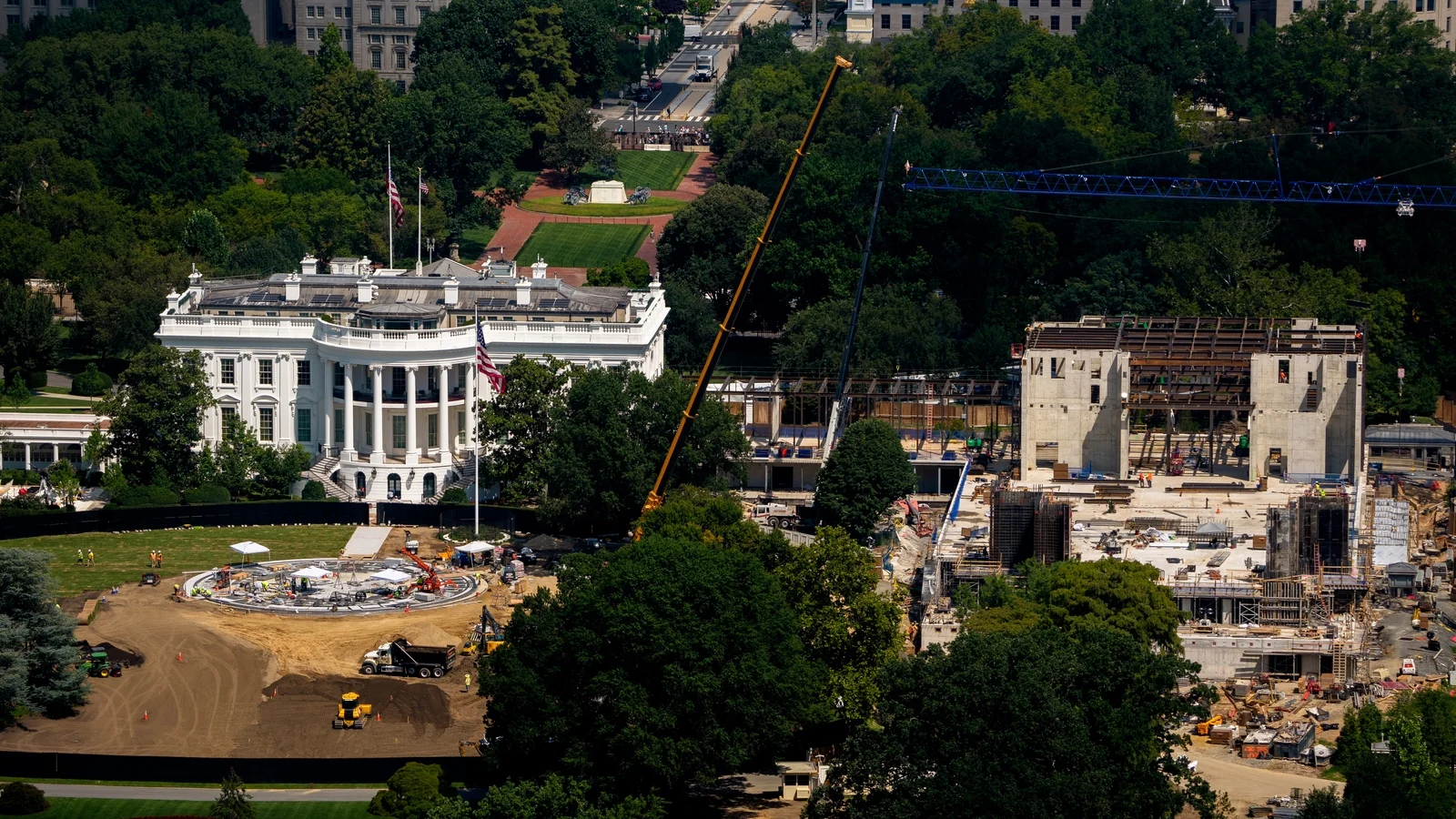
The US Supreme Court has handed President Donald Trump a significant legal win, clearing the way for construction of his planned White House ballroom to keep moving after opponents sought to stop the project.
In a 5-4 vote, the conservative-leaning court lifted a lower-court order that had required work to be paused. Chief Justice John Roberts broke with the majority, joining the court’s three liberal justices in dissent.
Earlier this month, Mr Roberts had issued a temporary order that allowed construction to continue while the full court considered the dispute.
Mr Trump celebrated the decision, declaring it eliminated remaining obstacles and predicting the project would finish by mid-2028.
“I am pleased to report that the United States Supreme Court has just ruled in favour of the Ballroom/Military Complex being built without any further contingency, doubt, or threat,” he said on his Truth Social network.
US President Donald Trump spoke during a dinner with ballroom donors in the East Room of the White House in October
The plan has ignited a political and legal storm in Washington, where critics argue Mr Trump acted unlawfully by ordering the demolition of the entire White House East Wing on his own authority.
With the high court’s ruling, construction is set to proceed even as a lawsuit from the National Trust for Historic Preservation continues in the lower courts — a process that could stretch for months or years.
The National Trust did not immediately comment.
The Supreme Court said the government was likely to prevail in the underlying case because the National Trust may not have had the legal right to bring the challenge in the first place.
The lawsuit is tied to a claim by one of the organisation’s members, Washington resident Alison Hoagland, who argues that viewing the completed ballroom would harm her “aesthetic, cultural, and historical interests” because of its size.
“This Court has not found standing in circumstances like these before. To the contrary, we have repeatedly held that mere offense, disagreement, or distaste does not qualify as a concrete and particularised injury,” under the US constitution, the five justices wrote in their ruling.
A model of the White House and ballroom is displayed
“Perhaps nearly any government action or project offends someone’s sensibilities,” they added.
At the same time, the majority underscored that it was not issuing a final decision on whether the ballroom itself is legal, only allowing work to continue while the lower courts hear arguments and reach a conclusion.
In dissent, the minority described the project as “likely unlawful,” writing that “Congress has not passed any law resembling ‘express authority'” for the administration to carry it out — despite a law they said requires such authority.
They also said Ms Hoagland’s allegations “suffices for standing.”
Although the ballroom has dominated public attention, it is part of a broader effort that also includes a military bunker.
A district court, followed by an appellate court, had stopped work on the ballroom while permitting construction of the military facility to go forward.
Mr Trump has repeatedly pitched the ballroom as essential for hosting galas and state dinners, while also pointing to national security concerns as the rationale for the bunker.