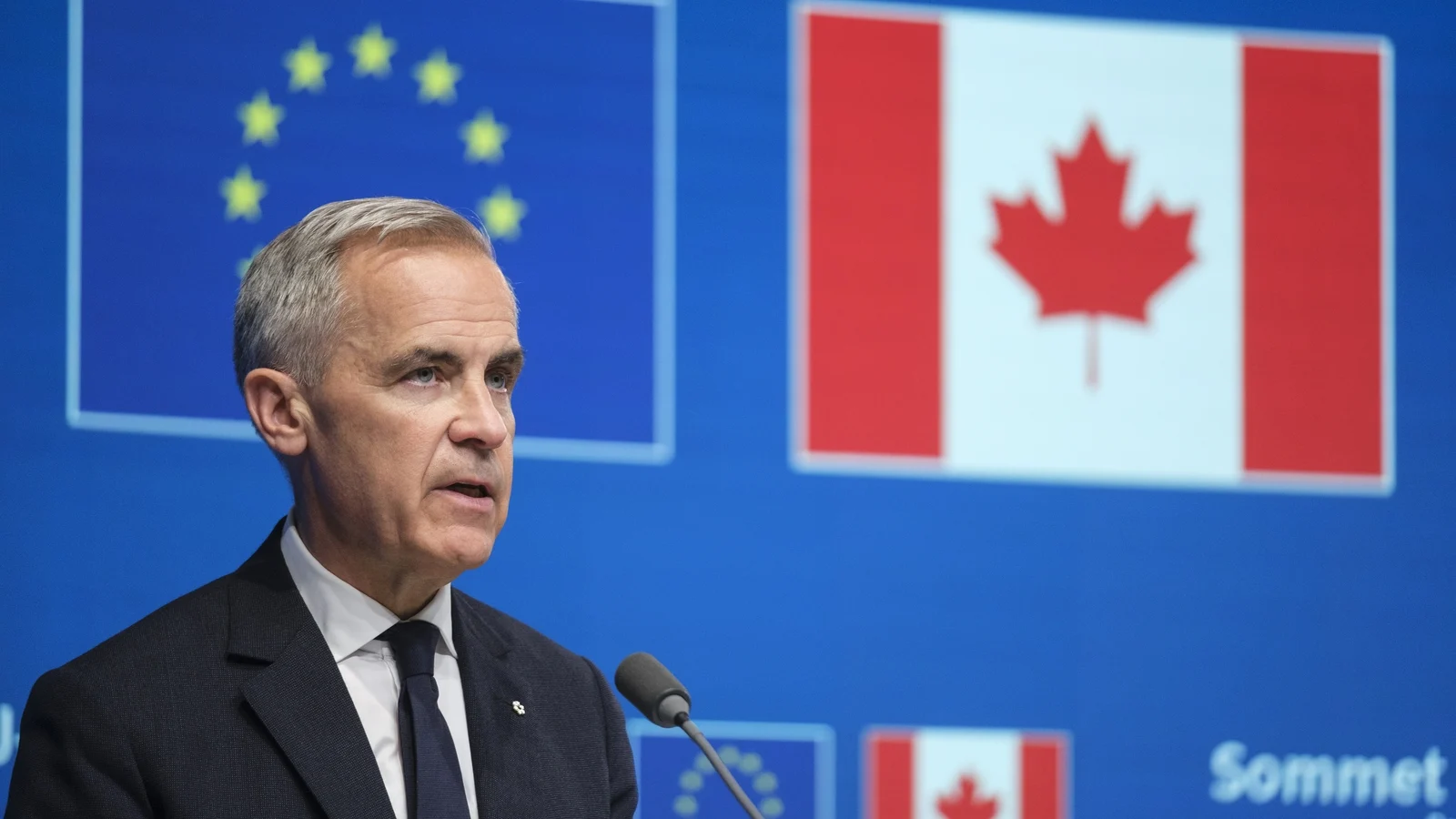
Canada wants to deepen its ties with Europe through what Prime Minister Mark Carney calls a “unique alliance” with the European Union — but he says Ottawa is not seeking to join the bloc.
The clarification follows a Wall Street Journal report that Mr Carney was exploring whether Canada could secure an “associate member” relationship with the EU.
According to the newspaper, the EU — despite a history of sticking closely to its membership rules — is open to the idea of offering Canada an as-yet undefined status of associate membership, citing unnamed officials in both Canada and the EU.
Carney says Canada seeks ‘unique alliance’ with EU
“We’re not looking to become a member of the European Union,” Mr Carney said.
“What we are looking – and will begin discussions for – is a unique alliance between Canada and the European Union,” he told reporters at the Toronto International Film Festival.
He argued the two sides are aligned on fundamentals. “We share the same values, we have the same priorities and we have very complementary strengths,” he said.
Mr Carney’s office confirmed on Saturday he will travel to France and Britain this week.
During the trip, he will address the European Parliament in Strasbourg and attend EU President Ursula von der Leyen’s State of the European Union address.
The Globe and Mail separately reported that it was the EU — not Mr Carney — that raised the notion of “associate membership,” citing an anonymous source who said any talk of a title for the relationship is premature.
Spokespeople at the European Commission did not respond to requests for comment.
The push for closer coordination comes as Canada’s escalating trade war with the United States adds urgency to Ottawa’s pivot toward other trading partners.
Canada the ‘worst country to deal with’, says Trump
Ottawa’s relationship with Washington has worsened markedly since President Donald Trump returned to the White House last year, with disputes over trade and other issues spilling into a tariff battle affecting tens of billions of dollars in cross-border commerce.
Mr Trump renewed his attacks yesterday, describing Canada as “the worst country to deal with,” while also saying he believed the country was “dying to make a deal.”
“They’ve ripped off our country for years,” he told reporters aboard Air Force One.
The US president again said he intends to impose new tariffs on cars, trucks and auto parts from Canada starting 1 January.
Against that backdrop, Canada and the EU are discussing arrangements that would allow Canadian goods, services and workers tied to strategic supply chains — including energy, AI, defence and critical minerals — to move freely, effectively pushing the EU’s border outward, the Wall Street Journal reported.
The two sides are also in talks on major connectivity and infrastructure projects, including laying underwater cables, jointly building data centres, cloud storage and new satellite networks, as well as developing routes and facilities to ship Canadian energy to the EU, the newspaper said.
Mr Carney has held regular discussions with several EU leaders — most notably French President Emmanuel Macron — about the possibility of allowing Canadians to live and work in the EU without visas, the WSJ said, citing two unnamed officials familiar with the matter.
Mr Macron’s press office did not respond to a request for comment.
Mr Macron’s office separately confirmed he will meet Mr Carney on 20 September in the French territory of Saint Pierre and Miquelon, a small archipelago off Canada’s Atlantic coast.
Still, efforts to tighten links between Canada and the EU could run into familiar obstacles, with past attempts to implement even a more limited trade pact encountering fierce resistance in parts of Europe.
More than a decade after that deal was reached — and nine years after it provisionally entered into force — several EU countries have still not ratified it.