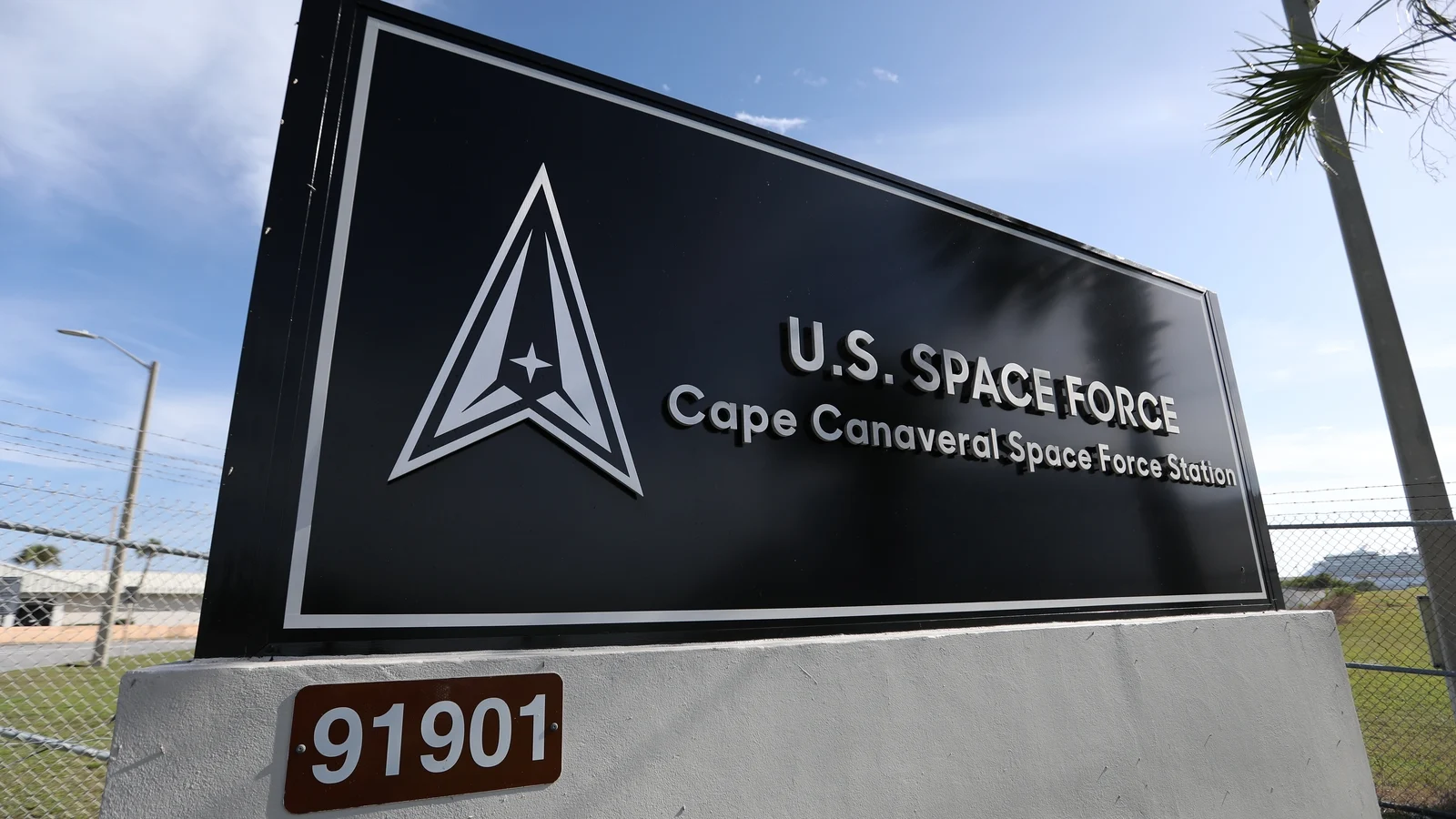
A rare US admission that it has weapons stationed in orbit has jolted the increasingly contested realm above Earth, drawing sharp rebukes from China and Russia and renewing fears of an accelerating arms race in space.
China cautioned against turning the heavens into a “battlefield,” while Russia said outer space must remain “free from any weapon” after Washington, for the first time, publicly confirmed it has arms deployed on-orbit.
Analysts said the disclosure largely confirmed what had long been understood in security circles, but warned the timing could inflame tensions with Beijing and intensify competition over military capabilities in space.
The development underscores a new phase in major powers’ pursuit of space-based military advantages—propelled by fast-moving technology yet constrained by only a partial and aging legal framework.
“The US has on-orbit space control weapons capable of defending the Joint Force against hostile adversary action,” a US Space Force spokesperson said in a statement that offered no details about the weapons.
Beijing pushed back immediately. China’s foreign ministry said it opposed what it described as the “weaponisation of outer space, turning it into a battlefield, as well as an arms race there”.
“We urge the US side to stop expanding its military capabilities and preparing for war in outer space,” ministry spokesman Guo Jiakun told a news briefing.
Moscow delivered a parallel message, pressing for a weapons-free domain beyond the atmosphere.
“We are counting on broad international consolidation to continue working toward the complete demilitarisation of space,” said Kremlin spokesman Dmitry Peskov.
What are the US capabilities?
The US statement did not specify what systems are already in orbit, nor how many weapons are deployed.
It described “space control” as covering efforts to contest and dominate the space environment using both destructive and non-destructive tools. “Space control encapsulates the mission areas required to contest and control the space domain – employing kinetic and non-kinetic means to affect adversary capabilities,” the statement said.
“These capabilities can be employed for offensive and defensive purposes,” it added.
Non-kinetic options could include lasers designed to blind satellites, or electromagnetic or cyber methods to jam or disrupt satellite data links.
Why does the US want weapons in space?
US officials have long argued that the country’s satellites—and the military and civilian systems that depend on them—face growing threats, particularly from Russia and China, Washington’s two main geopolitical rivals.
China “develops and operates space and counterspace capabilities as part of a military modernisation strategy,” according to the US Space Force.
Russia, the Space Force said, “views space as a warfighting domain and believes space supremacy will be a decisive factor in future conflicts”.
The contest to militarise space, however, is not new. It has shadowed human activity in orbit since the earliest days of the space race.
After the Soviet Union launched Sputnik—the first probe in space—in 1957, the US and Russia began exploring methods to both arm satellites and destroy them.
More recently, India in March 2019 said it had destroyed a low-orbiting satellite, joining Russia, China and the US in demonstrating such capabilities through a missile test and signalling it belonged among the world’s most advanced space powers.
How might China react?
Song Zhongping, an independent military commentator based in Hong Kong and a former Chinese army instructor, said Washington’s confirmation was “no surprise at all,” arguing the existence of such weapons “has long been an open secret”.
“The only difference is that the US used to keep it ambiguous, whereas now it has gone public, which shows that Washington is no longer trying to hide it,” he said.
Song warned China “will not stand by and do nothing,” pointing out that Beijing already operates its own space station in orbit.
“Whether China deploys weapons in space will depend entirely on whether the United States moves in that direction,” he said.
The Wall Street Journal reported that China supplied Iran with satellite imagery that enabled Tehran to precisely target military facilities and kill US service members in Jordan in July—an allegation China has denied.
Can weapons in outer space be regulated?
For decades, the central nightmare scenario involved nuclear arms in orbit. That risk helped spur the 1967 Outer Space Treaty, signed by the superpowers and other nations, which banned weapons of mass destruction in orbit.
But in the years since, Russia, the United States, China and India have pursued ways to fight in space that fall outside the treaty’s specific prohibitions—most notably by developing means to disable or destroy satellites critical for military communications, surveillance and navigation.
“There is a regulatory vacuum because Article 4 of the 1967 treaty only forbids weapons of mass destruction and nuclear weapons in orbit,” said space law expert Laetitia Cesari.
She said the issue would likely feature at the next UN disarmament meeting in November.
“Moscow and Beijing have been wanting to work for about twenty years on a treaty to prevent the placement of weapons in space,” while “Western states are trying instead to work on the notion of responsible behaviour,” Ms Cesari said.
The US announcement, she added, “will likely give impetus to the restrictive approach that Moscow and Beijing are pushing for,” potentially sharpening the debate over how—if at all—space weapons should be constrained.