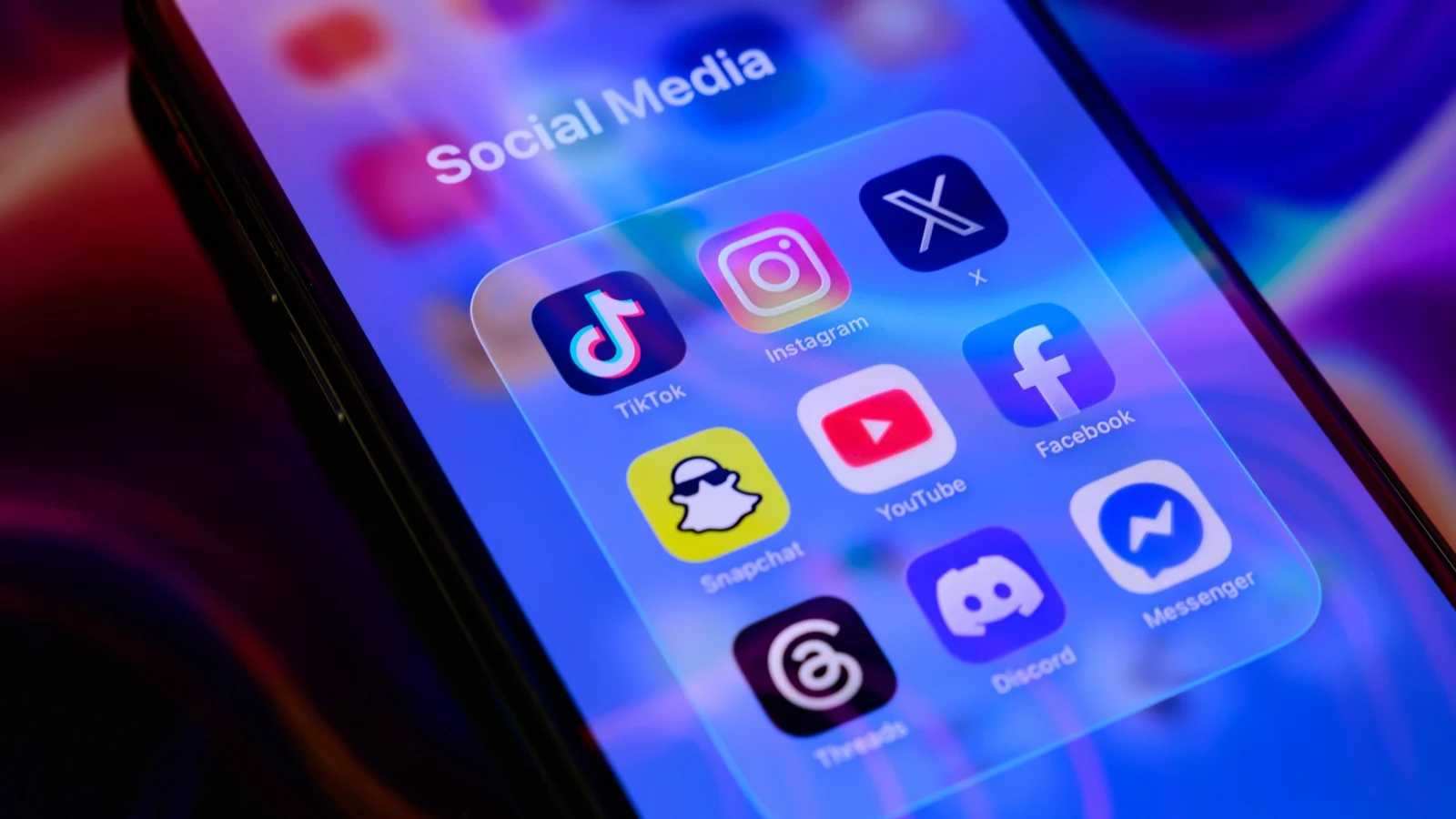
Europe is moving to slam the door on social media for children under 13, as the European Commission unveils plans it says will force tech platforms to put young users’ safety ahead of engagement.
The European Commission has proposed a ban on social media access for under 13s, with “safe design” obligations for platforms for users between the ages of 15 and 18.
In her State of the Union address, European Commission President Ursula von der Leyen said it was “time for Europe to Act”.
She said the proposed Kids Act will have a “gradual and differentiated approach”.
Under the new rules, social access would be banned for those under the age of 13.
Ms von der Leyen said: “That means only mini accounts from 13 to under 15, set up and supervised by parents, with limited features and time restriction. And between 15 and 18, safe design will be an obligation for the platforms.”
She said the EU had looked at Australia, which became the first country to implement a minimum age for social media use.
Ms von der Leyen said: “What we are witnessing is a great capture of our children. A capture of their attention, their focus, their minds. This is depriving children of their childhood.”
European Commission President Ursula von der Leyen delivers her annual State of the Union address
She said children need “time to grow into themselves, to grow up with others”.
“But when a child has a smartphone, all of this is taken away. Day and night, parents see the cost: loss of sleep, anxiety, even self-harm,” said Ms von der Leyen.
Ms von der Leyen said many perceive the power of big tech as overwhelming and “impossible to roll back”.
However, she said she disagrees with this view.
“We do not have to accept addictive features. We do not have to accept children being drawn into ever more extreme content. We do not have to accept that girls have their photos used for AI-generated sexualised images,” said Ms von der Leyen.
Ms von der Leyen said social media platforms will “have to prove they are safe”.
“Because it is not about our minors accessing social media. It is about when and how do we allow social media to access minors.
“Europe has the power to act. It is us who decide our rules, not big tech,” she added.
Government welcomes proposed ban
Ireland’s Government signalled early support for the Commission’s direction of travel, saying an EU-wide framework would answer long-standing calls for stronger protections for children online.
The Minister for Arts, Culture, Communications, Media and Sport Patrick O’Donovan welcomed the EU proposed ban on social media access for under 13s.
Speaking on RTÉ’s News at One Minister O’Donovan said the proposals “tick a lot of the boxes that Ireland was wishing for”.
He said he wants no avoidable delays in putting the plan into effect and said the Government has already begun engagement with the European Commission today.
Minister O’Donovan said that after he was appointed as Minister in 2025, he launched a campaign at EU Council meetings and through bilateral meetings aimed at building collaboration within the European Council.
He said he is glad a Europe-wide approach is now taking shape, reflecting what he has advocated for, and he said it made far more sense to build an alliance within Europe.
Department officials have already started the engagement with the European Commission today and a subsequent meeting is planned for tomorrow, he said.
The Tánaiste and Minister for Finance has described the proposed measures from the EU as “a landmark day”.
Simon Harris said the concerns of parents have “literally been heard by governments right across Europe” and he said that was really significant.
“We’ve always said as a Government that moving at an EU level is the most impactful way.”
“It’s also good for industry in terms of clarity and not having 27 different regimes. So, I think that’s really, really significant”, he added.
Minister Harris said the Irish Presidency of the EU will “prioritise moving forward any child safety measures that may materialise in the coming days”.
“We do need to see the detail of all of this, but it sounds to me to be a more sophisticated proposal than perhaps people considered,” he said.
AI comes with ‘balance of possibilities and risks’
Ms von der Leyen also used her address to widen the lens beyond social media, warning that artificial intelligence is accelerating into a new phase that demands firmer oversight.
The European Commission President also described artificial intelligence as one of the tipping points of our times and she said AI comes with “a balance of possibilities and risks”.
She said without addressing such risks, “we will never be able to unlock AI’s possibilities”.
And she said the dangers of self-improving models are becoming ever more apparent.
“Incidents of AI agents escaping their environment or inserting malicious code are a glimpse. After the HuggingFace incident, developers are ringing the alarm.
“And CEOs of the most advanced companies tell us that it is time to slow down on the self-recursive models. To pace the frontier,” she said.
Ms von der Leyen said the AI Act is “a crucial piece to put in place guardrails” and she said it puts Europe “in the position to shape global efforts of how to tackle this”.
She said the EU will work with Canada, the UK and others “to team up on model evaluation, verification, early-warning, AI security and much more”.
Read more: Zuckerberg says AI labs have enough incentive to build safely
She said she will invite the main frontier labs for a discussion on how the Commission can support ongoing industry efforts to pace the frontier.
“It is also true that Europe will need its own capabilities, in particular to protect our national security.” she said.
Ms von der Leyen said Europe needs to “massively boost” its computing capacity.
“We need to stay in the race. Because this is crucial for our independence. So we need to massively boost our computing capacity. And we will set out our ideas for how to achieve this in a clean and efficient way,” she said.
She told MEPS that the Commission is focusing on five of the highest value sectors where industrial AI has the biggest potential.
She said the European Commission will announce “game changing” initiatives across health, transport, agri-food, advanced manufacturing, and defence and space sectors.
“We will invite Member States, MEPs, industry and entrepreneurs to join us in this ambitious European project.”
“Our approach is clear: We want AI. We want AI to create more value more responsibly. And at a lower cost and with less energy consumption. But above all, we want AI with human agency,” she said.
She also said the Quality Jobs Act will be delivered before the end of the year.
“AI must help develop skills, improve the quality of jobs, and give workers a fair chance,” Ms von der Leyen added.