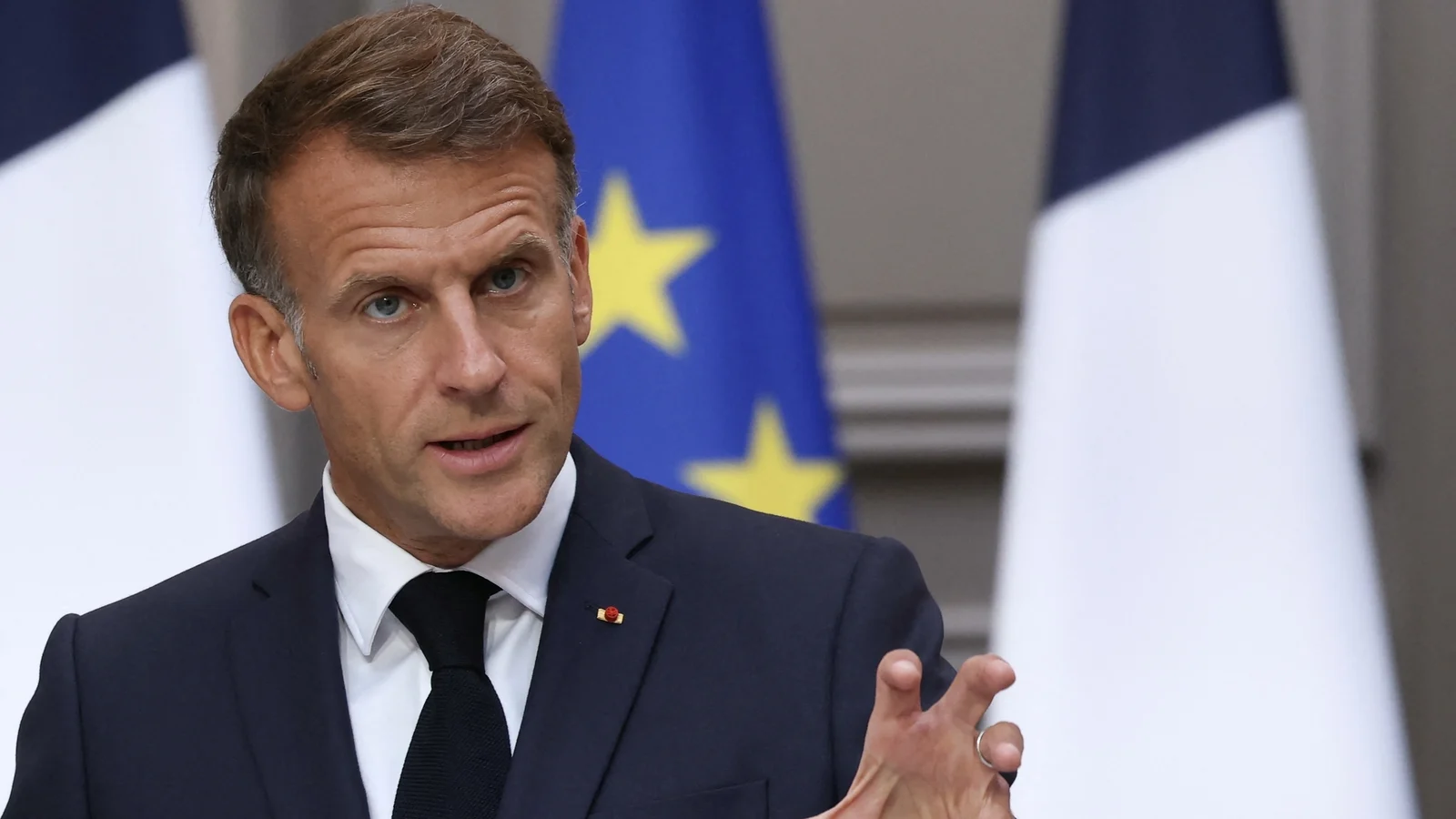
Warning that Moscow’s covert tactics are spreading across the continent, French President Emmanuel Macron said Russia’s “shadow” operations are intensifying in Europe and announced new steps to shield France’s most vital sites from what he called escalating “hybrid attacks”.
“The Russian hybrid threat against Europeans and against France has intensified,” he said after a meeting with French political leaders, before he heads to the UN General Assembly next week.
Macron said France’s interior minister has already met with regional prefects to heighten “vigilance in response to the Russian hybrid attacks”, following his own talks with presidential hopefuls and party leaders ahead of next year’s election.
He said he had ordered “the government to prepare a plan to protect our critical infrastructure” and the “most sensitive” defence industry and technology sites against drone and cyber-attacks.
The French president said that despite the Russian threats France would continue to support Ukraine following Russia’s full-scale invasion of the pro-Western country in February 2022.
He also vowed that France would respond to Russia’s shadow attacks.
“This will not go unanswered,” Mr Macron said, without elaborating.
He argued the aim of these operations is to frighten European societies and weaken the coalition backing Kyiv.
“The intention behind it is to intimidate us and to derail the effort to support the Ukrainians. The consequence will be the opposite,” he added.
“We are not intimidated, because we know that what is at stake today in Ukraine is our security.”
Zelensky welcomes leaders to regional summit
In Ukraine, President Volodymyr Zelensky welcomed leaders and representatives from seven regional nations for discussions on closer co-operation, as overnight Russian strikes across several regions ignited fires and left multiple people dead or injured.
The inaugural summit of the so-called Carpathian Eight brings together Ukraine, Romania, Serbia, Poland, Slovakia, the Czech Republic, Austria and Hungary, with the European Union also involved.
The talks come as US-mediated efforts to end Russia’s full-scale invasion have lost momentum, with disputes over potential territorial concessions in eastern Ukraine among the key sticking points. Ukraine has also been pressing partners for security guarantees as part of any deal.
The Carpathian Eight brings together Ukraine, Romania, Serbia, Poland, Slovakia, the Czech Republic, Austria and Hungary
The gathering also coincides with the start of three days of voting in Russia’s first wartime parliamentary election — a contest featuring virtually no opposition to President Vladimir Putin’s party and widely expected to cement the Kremlin’s political grip.
Several delegations in western Ukraine’s Ivano-Frankivsk region come from countries that have been among Kyiv’s most reliable backers, including Poland and Romania.
Others attending — including Hungary, Serbia and Slovakia — have declined to provide Ukraine with direct military aid.
Mr Zelensky wrote on Telegram that the summit was a “significant beginning” of a movement intended to “further strengthen ties between our countries and create another strong element of co-operation at the EU level”.
He said participants would co-ordinate on security, energy, logistics, cross-border economic ties and assistance for local communities — practical areas that have taken on urgency as the war strains infrastructure and supply routes.
The meeting at the western Ukrainian ski resort of Bukovel comes amid rising concern across Europe that Russia is stepping up hybrid threats, including sabotage, cyberattacks, disinformation and possible drone incursions into Nato territory.
Polish prime minister Donald Tusk, speaking before leaving for Ukraine, warned that Moscow is preparing hybrid strikes using drones or rockets against European countries supporting Kyiv, including Poland.
In recent weeks, officials in Poland, Germany and Denmark have accused Russia of involvement in incidents ranging from drone incursions to sabotage, arson, surveillance of defence facilities and an alleged plan to use an explosives-laden drone to attack an airport.
European Commission president Ursula von der Leyen said on Wednesday that the EU needs a Nato-like mechanism to better respond to hybrid attacks blamed on Russia, and to develop “a consensus on how to respond to certain incidents- that fall below armed aggression but clearly threaten our national security”.
A fire in Ukraine last night caused widespread destruction at the market in Zaporizhzhia
After a phone call with Ms von der Leyen, Mr Zelensky said on Telegram that Ukraine has received a €3.3 billion tranche from an EU financial support package intended to bolster Ukraine’s defence capabilities, including the purchase of missiles and drones.
Mr Zelensky added that Ukraine was also preparing for a meeting with Ms von der Leyen at the United Nations General Assembly in New York next week, with talks set to focus on the country’s financial stability.
Strikes overnight
Russian strikes overnight in the Zhytomyr region west of Kyiv killed two people and injured two others, Ukraine’s State Emergency Service said in a Telegram statement.
The attacks set warehouse and production buildings ablaze.
Rescuers had to pull back during repeated air raid alerts before firefighters were later able to bring the fires under control.
In Ukraine’s Kharkiv region, one person was killed and six were injured when Russian forces struck an electric train, the emergency service said. The drone attack hit a railway station in the Novovodolazka community and sparked a fire in two suburban-train carriages.
Watch: Large blaze at market in Ukraine following Russian attack
In Zaporizhzhia, another Russian drone strike levelled a shopping complex, injuring one person and setting off a fire, according to the service.
Russia’s Defence Ministry said its air defences intercepted and destroyed 629 Ukrainian drones overnight across 14 Russian regions, as well as illegally annexed Crimea and the Azov and the Black seas.
Moscow mayor Sergei Sobyanin said more than 350 drones were headed towards Moscow, with most destroyed far from the capital and 64 shot down as they approached the city.
In Russia’s southern Rostov region near the Ukrainian border, local authorities said an attack damaged houses and residential buildings. Rostov governor Yuri Slyusar said there were no casualties.
The Russian military said it carried out overnight drone strikes on Ukraine’s ports, vessels and a logistics centre it said was operating for the military.
According to the Russian Defence Ministry, Russian forces hit a bulk carrier in the Ukrainian port of Chornomorsk and struck a Nova Poshta logistics facility 3.7 miles north-west of Odesa, which it said was used to store and distribute military cargo from Europe.
Russia seizes assets of Nestle, French firms over West’s Ukraine support
Russian authorities have seized the businesses and assets of Swiss food giant Nestle and three French groups — a step the Kremlin defended today as a justified response against companies tied to “unfriendly countries” backing Ukraine.
A decree signed by President Putin transferred the Russian operations of Nestle, French retailer Auchan and the former Leroy Merlin DIY chain, now known as Lemana Pro, to a company called LEV Management.
The decree, issued late yesterday, also covers the Russian subsidiaries of French logistics group FM Logistic.
Investigative outlet Novaya Gazeta Europe reported that LEV Management was created only at the end of 2025, and is headed by a Russian interior ministry general. It had no known business activity.
The action marks the latest Russian move against Western businesses in response to sweeping sanctions imposed over its war against Ukraine, now in its fifth year.
After the invasion, many Western companies rapidly sold their operations and holdings in Russia — or at least ring-fenced them — as sanctions made trade in many goods difficult.
Other firms stayed on, citing concerns for employees or citizen’s well-being, while often sharply reducing the scale of their work.
Russia has since made it harder for companies to exit, by requiring presidential authorisation for deals or by seizing assets outright.