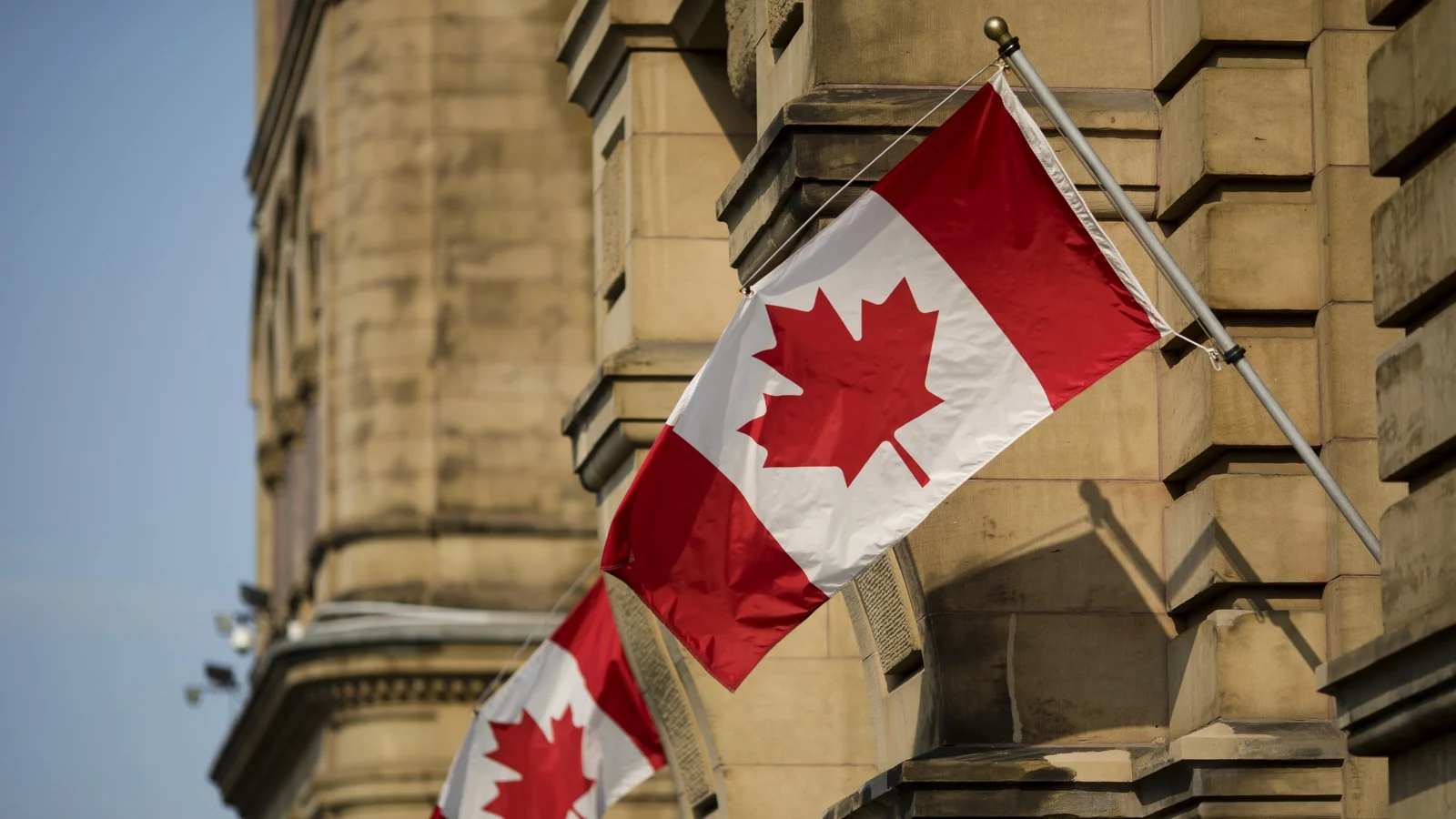
One unexpected line in Ursula von der Leyen’s State of the Union address has sent Brussels scrambling: an invitation for Canada to become “the first associate member” of the European Union — an idea that appears to have caught even EU capitals off guard.
“First we’d heard of it,” remarked one EU diplomat. “It was a surprise,” said a second diplomat, “but not a negative surprise.”
On Thursday, Canada’s Prime Minister Mark Carney struck a welcoming tone in Strasbourg, telling the chamber that “Canada welcomes this ambition”. He avoided the phrase “associate membership” and later stressed that Canada has no ambition to join the bloc.
As MEPs, member states and think-tanks tried to decode what, exactly, had been put on the table, the European Commission insisted the ground had been prepared. The Commission’s deputy chief spokesperson Olof Gill told RTÉ’s Six One news: “All member states were consulted, all were aware.”
What is not in doubt is the trajectory of EU-Canada ties. The relationship has become a prominent feature of Europe’s response to overlapping geopolitical shocks. Brussels and Ottawa held their 20th summit meeting in Brussels last year, with a follow-up summit scheduled for Montreal at the end of October.
But was ‘associate membership’ explicitly explained beforehand?
On 9 September, European Commission officials and a team from the cabinet of European Council president Antonio Costa briefed 27 EU ambassadors on preparations for the Montreal summit.
Last Friday, President von der Leyen hosted the same ambassadors for lunch on the 13th floor of the Commission headquarters. On neither occasion, it’s understood, was “associate” membership mentioned.
That left the most basic question hanging in the air: what does it mean?
Article 217 of the Lisbon Treaty provides for the EU negotiating “…an association involving reciprocal rights and obligations” with non-EU countries or international organisations.
Association agreements exist — one example is the EU-Israel Association Agreement — but they do not confer anything resembling “associate member” status.
The term has surfaced before in European politics. German Chancellor Friedrich Merz had floated the idea of offering Ukraine associate membership as a bridge while Kyiv endured the long process of accession to full membership. The proposal landed badly in both Kyiv and EU capitals.
“‘Associate member’ has no treaty basis,” says Corain Stratulat of the European Policy Centre (EPC).
“‘The first’ implies a series. Canada is being offered, without an official request, the same label member states received coolly when Merz proposed it for Ukraine.”
On the Six One News, Mr Gill moved to dial down the legal focus, describing “associate” membership as a “concept”.
“We don’t need to start talking about the precise legality at this point,” he told Tommy Meskill.
“In a complicated geopolitical moment, in a time when there’s great geopolitical uncertainty, the European Union and Canada have committed to forging closer ties together for the benefit of our peoples, to strengthen our economies, and to generally make the world a better place. That can only be a welcome thing.”
Olof Gill said that ‘associate’ membership was a ‘concept’
According to Mr Gill, discussions on what the relationship might involve “in detail” would form part of the run-up to Montreal.
“But we’re talking here about a big bold idea, and I think it’s something that’s going to be warmly welcomed across the EU and indeed in Canada,” he said.
MEPs certainly responded warmly: Ms von der Leyen’s reference to Canada drew prolonged applause. Still, translating a “big bold idea” into a workable framework carries political and practical risks on both sides of the Atlantic.
The EU-Canada relationship already rests on the Comprehensive Economic and Trade Agreement (CETA), concluded in 2014 and provisionally applied since 2017.
CETA reduced tariffs on 98% of goods and widened access on services and public procurement, helping make the EU Canada’s second-biggest trading partner. Trade in goods reached €75.6 billion in 2024, up from €46 billion in 2016.
Yet CETA remains unfinished business in parts of Europe. Ten countries, including Ireland, have not ratified it.
In Ireland, the Supreme Court narrowly found in 2022 that the investor-state dispute settlement element of CETA — which allows investors to take action against a state via binding arbitration — would breach Article 34 of the Irish Constitution by infringing judicial sovereignty.
The Government is now amending the 2010 Arbitration Act to bring the state into compliance with CETA and other EU trade agreements containing similar investment dispute provisions (Chile, Mexico, Singapore and Vietnam).
The Government argues full ratification “is still necessary to secure the full benefits” of CETA; Belgium, Bulgaria, Cyprus, France, Greece, Hungary, Italy, Poland, and Slovenia have also yet to ratify.
France illustrates how domestic politics can stall trade deals. The National Assembly backed CETA in 2019, but the Senate rejected it, sending it back to the lower house — where President Emmanuel Macron has since lost his majority.
With the far-right Rassemblement Nationale (RN) opposed and leader Marine Le Pen expected to win next year’s presidential election, France does not look likely to ratify any time soon.
The context, too, has shifted sharply since 2017, when CETA first began provisional application.
Canada is a main producer of energy, so we have hard interest-based reasons to work together.
In her address, Ms von der Leyen argued Europe is nearing tipping points on climate change, AI and what officials describe as a crippling trade deficit with China — €1 billion per day — all while facing a tougher international environment.
She pointed to a second Trump administration that has launched costly tariff wars against both Canada and the EU, further destabilised the Middle East and undermined the global rules-based order. Russia’s war of aggression against Ukraine continues, she warned, and its hybrid war on European soil is escalating.
“Europe will always lead when it comes to defending the rules-based system,” she told MEPs. “But we can no longer rely on it as the only way to secure our interests, or assume that its rules will shelter us from the complex threats that we face. In this new world, we must urgently reimagine our partnerships.”
With both the EU and Canada rattled by President Donald Trump’s predatory designs on their territory, supporters of deeper cooperation argue the logic is no longer optional: each side needs the other’s assets and leverage.
Nor is the idea entirely new.
Ursula Von der Leyen said that the rules-based system can no longer be relied on
Last year, the EU and Canada signed the EU-Canada Security and Defence Partnership, a wide-ranging framework that will allow Ottawa to take part in the EU’s €150 billion SAFE programme aimed at boosting defence procurement via low-interest loans. It also deepens cooperation on cybersecurity, counterterrorism, violent extremism and hybrid threats.
Officials are also working on a Digital Trade Agreement that would enable Canada to participate in the EU’s AI gigafactories, link high-performance computing infrastructure, and expand research cooperation in AI and quantum computing.
In Strasbourg, Mr Carney told MEPs Canada has deposits of more than 34 critical minerals, adding that the country is among the top producers of the 10 most essential to the energy transition.
“Canada has not only raw materials itself,” says a senior EU source, “but also the ability to refine them. Canada is a main producer of energy, so we have hard interest-based reasons to work together.”
National governments are also tightening their own links with Ottawa. Germany and Canada signed a strategic partnership in July covering security and defence, technology, AI, supply chains and critical minerals, following similar agreements with France and Denmark.
Defence cooperation, however, is emerging as a particular focal point.
“The EU stands to gain more from a closer relationship than one might think,” says Anand Sundar, a special advisor to the European Council on Foreign Relations (ECFR).
“Canada is an underrated military power. The 2% of its GDP that it currently spends on defence is already more than the 14 smallest EU defence budgets combined. Compared to the EU’s biggest defence spenders, it ranks behind only Germany, France, Italy and Poland. And its budget is set to increase significantly as Canada moves to spend 4% by 2030 and C$500 billion (€310 billion) over the next decade.”
Mr Carney has signalled Canada will reduce investment in the US defence industry while increasing spending in Europe.
German shipbuilder ThyssenKrupp Marine Systems is building 12 submarines for the Royal Canadian Navy, and Ottawa is planning to buy Swedish Gripen fighter jets instead of American F-35s. Canada’s heavy polar icebreaker is being constructed in Helsinki in partnership with Quebec’s Chantier Davie.
Keeping Trump happy a challenge
Yet expanding ties across trade, technology and defence without provoking Washington will be a delicate exercise.
In North Carolina on Thursday, the US president mocked the idea of Canada’s associate membership as “laughable”, then threatened to spike tariffs on EU goods — or halt trade altogether — if he deemed the move a “hostile” act.
The breakdown in US-Canada trade negotiations may have accelerated Mr Carney’s pivot towards Europe, but his outreach predates the latest rupture.
Even before his Davos speech in January, where he urged “middle powers” to stick together against Great Power threats, Mr Carney had been invited to attend Wednesday’s State of the Union address.
The Wall Street Journal has reported that Mr Carney has been seeking “associate member” status for months, using contacts from his time as head of the Bank of England to privately button-hole EU leaders.
He appointed a special envoy, John Hannaford — a former Canadian cabinet secretary — to run technical teams exploring how far the relationship might go short of membership.
Some EU leaders close to Mr Trump, including Italy’s Giorgia Meloni, were initially wary of steps that could be read as a provocation. But the crisis triggered by Mr Trump’s threats to seize Greenland (Danish territory) and the Iran War pushed Europe towards a greater sense of urgency about partnership.
Italian Prime Minister Giorgia Meloni was among EU leaders keen to keep Donald Trump happy
Contacts between Mr Carney and EU leaders intensified. After Davos in January, he became the first non-European leader to attend the European Political Community (EPC) summit in Armenia in May. (He may attend the next EPC in Dublin in November.)
There were further meetings at the G7 summit in Evian in June, followed by a bilateral with President Macron in Paris, and again at the NATO summit in Ankara in July.
By late summer, talk of a deeper arrangement was beginning to look more concrete.
“The EU treaties are pretty clear in our minds,” says the senior EU source, “but we can bring Canada as close as possible to the Union without it being a member state.”
Still, if Mr Trump is looking for evidence of hostility, critics warn it may prove difficult for Brussels and Ottawa to persuade US audiences that an “Alliance for the Future” is not, in effect, a strategic snub.
Beyond tariffs, the EU and Canada also share growing antipathy to the dominance of US big tech firms.
“The symbolism and significance of this cannot be separated from the deteriorating state of US-Canada relations and Europe’s search for new international geometries to hedge against transatlantic uncertainty,” says Dr Ian Lesser, distinguished fellow at the German Marshall Fund (GMF).
“With his Davos speech and more recent remarks, Carney has emerged as a leading critic of US policy and its consequences for the global order. He says what many European leaders would like to say but do not, and he says it as an establishment figure. His presence and the Canadian dimension were not afterthoughts. They were central to Von der Leyen’s message.”
Historic nature of Von der Leyen’s offer should not be overlooked
That is why von der Leyen’s overture — made publicly, from the EU’s main political stage — is being treated by many as more than a rhetorical flourish.
Mr Carney appears determined to shift Canada’s economic dependence away from the United States, which took €396 billion in Canadian goods exports in 2025, toward the European Union, which received €26.65 billion in 2024, according to Canadian trade figures.
That ambition makes the legal shape of an Alliance for the Future more than a technicality.
Canada’s export model remains closely aligned to the US market, meaning food safety standards tend to match US rules rather than EU requirements. Irish beef producers’ fears that CETA would devastate their sector, for instance, have not materialised — Canada’s beef exports to Europe are negligible because of the EU ban on growth hormones.
“The supply chain is deeply embedded in the US,” says another EU diplomat.
We need a strongly integrated partnership, but what does that actually mean?
Domestic politics also loom. Mr Carney, who had been trailing in the polls, rose to the leadership largely as a result of Mr Trump’s striking hostility toward Canada. Voters may decide it is wiser to endure the Trump presidency rather than reorient the country across the Atlantic at speed.
For now, how close Canada could move to the EU and its single market of 452 million people remains uncertain.
“There is a certain predisposed opinion towards Canada [in Europe],” says Fabian Zuleeg, chief executive of the European Policy Centre (EPC), “this idea that maybe Canada could be an EU member has had, in some ways, quite a surprising resonance in many European countries.
“What it would look like is the more difficult part of this. Yes, we need a strongly integrated partnership, but what does that actually mean?”
Mr Carney, for his part, avoided explicitly selling the partnership as a route to greater single-market access. Instead, he highlighted deeper trade in “non-agricultural goods and services”.
He also reached for a story designed to tug at Europe’s historical memory: the Canadian First World War lieutenant Leslie Miller, who collected acorns from the battlefield at Vimy Ridge in 1917 and later raised an oak forest in Ontario — with grafts returned to be planted back in Vimy a century later.
Mark Carney expressed desire in deepening trade in ‘non-agricultural goods and services’
He told MEPs: “Europe brings so many things: market power, research depth, advanced manufacturing, the ability and the will to set standards that the world frequently adopts, a defense industrial base that’s being rebuilt at speed.
“Canada brings energy at huge scale and in every form that the transition requires. We have one of the world’s largest endowments of critical minerals, deep capabilities in space, AI, and quantum, amongst the strongest banking systems and the most expert pension capital. We have unique Arctic geography and privileged access to both Atlantic and Pacific networks. And where our strengths differ, they complement. Where they overlap, they create scale.”
Whether such rhetoric will cut through to EU voters — and politicians — preparing for hard-right momentum in next year’s elections in France, Italy, Poland and Spain is unclear, and may help explain the rush to put new ideas in motion.
Questions will also follow about why the EU, after years of brushing aside creative arrangements short of membership, is now embracing a more flexible model.
Together, Canada and the European Union can anchor our ground to hold our values while forming a protective canopy under which our citizens can thrive.
In the UK, von der Leyen’s phrase “associate membership” was quickly seized upon by both pro- and anti-Brexit voices — framed either as a trap Britain should avoid or as a possible route back towards full membership. Britain’s post-Brexit trade deal with the EU is widely seen as most closely resembling CETA.
“In principle, the new models of cooperation open to Canada, with its level of economic and political integration into the EU, are also up for grabs for the UK,” says Joël Reland, senior research fellow at UK in a Changing Europe.
“[However], that model of membership is not likely to create a shortcut back into the single market. At least to begin with, the focus seems likely to be on looser cooperation and initiatives rather than a structured set of rights and obligations à la Norway or Switzerland.”
This, says Mr Reland, may be something more to Andy Burnham’s liking than that of his predecessor Keir Starmer.
“None of this means UK associate membership is now there for the taking. While the UK might resemble Canada legally, it does not do so politically. Canada carries a lot less baggage. It did not initiate a dramatic divorce a decade ago, before starting to plead for special access to the single market from outside. If the UK wants a closer relationship it can seek to join the EU or the EEA – Canada, as a non-European state, cannot.”
Asked whether a similar concept could apply to the UK, Mr Gill replied: “This is only a concept right now. What I can say for certain is that this concept, as we’re developing it, is only going to apply to non-European countries. So, let’s see what we can work with as regards Canada, and then we can deal with the rest in the future.”
For now, that leaves von der Leyen’s pitch as a high-stakes experiment — a bold bet that both Ottawa and Brussels can deepen integration without triggering political backlash at home or blowback from Washington.
Returning to his oak-tree metaphor, Mr Carney ended with a final image of interdependence: “Beneath the forest floor, the roots of an oak intertwine with those of its neighbors, exchanging nutrients, adding strength to strength, creating a resilient, self-sustaining ecosystem.
“Together, Canada and the European Union can anchor our ground to hold our values while forming a protective canopy under which our citizens can thrive.”
He, and President von der Leyen, will no doubt hope those citizens are listening.