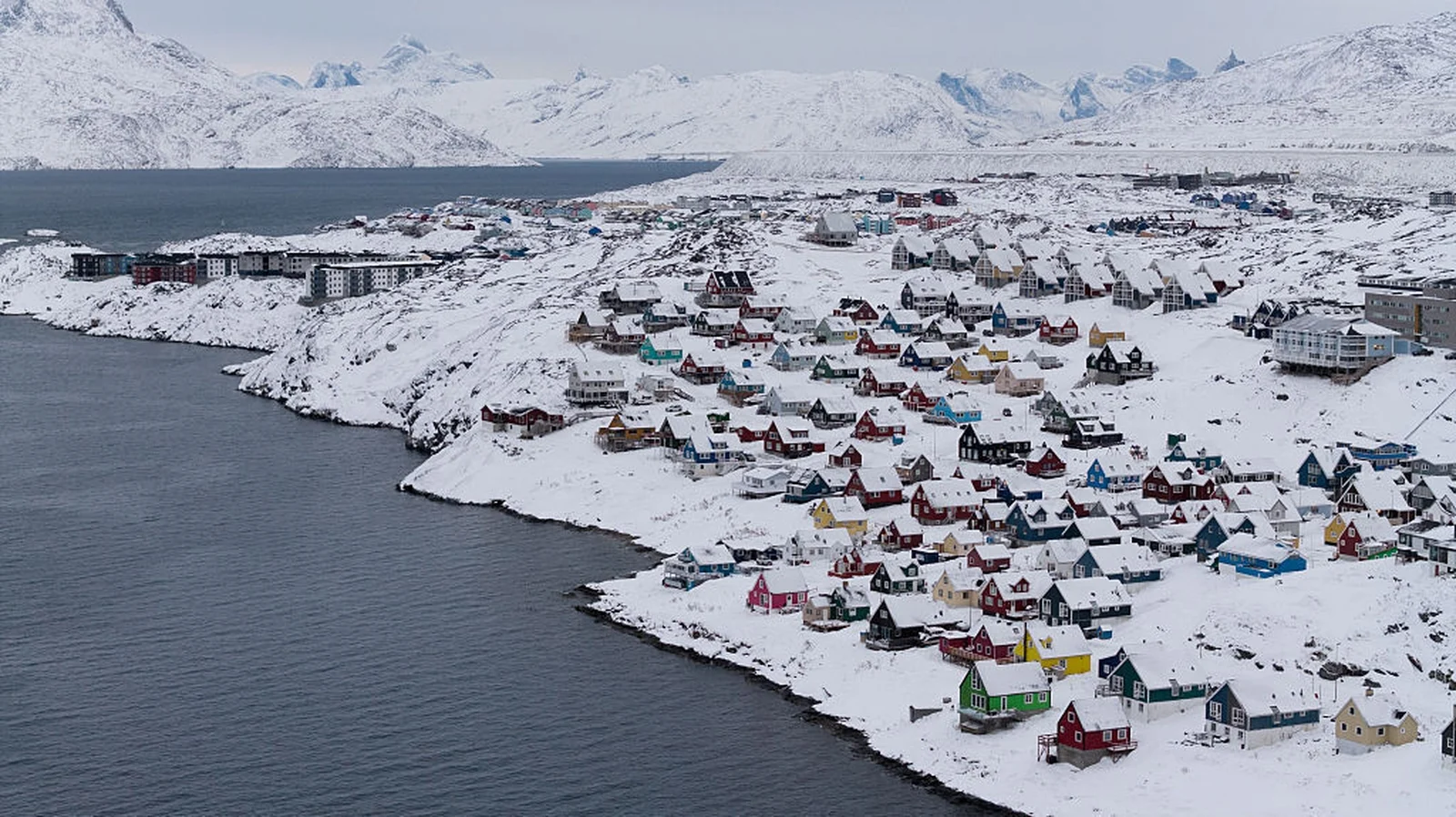
A sweeping new accord on Greenland has been greeted in Copenhagen as a long-awaited attempt to end months of geopolitical turbulence, after US President Donald Trump announced what he called a “binding” deal that would give Washington “permanent control” over the island’s security and block Russian and Chinese bases from the Arctic territory.
Since returning to the White House in January 2025, Mr Trump has repeatedly argued that the United States needed control of Greenland for strategic reasons, a stance that rattled NATO ally Denmark and triggered sharp resistance within the alliance.
Denmark and Greenland — an autonomous Danish territory — both welcomed the agreement and said they intend to sign it on the sidelines of the UN General Assembly in New York next week.
Danish Foreign Minister Lars Lokke Rasmussen said today the potential signing meant “next week could be a good week”.
“A long period of uncertainty will hopefully be replaced by a binding agreement that strengthens security in the Arctic and North Atlantic,” the foreign minister wrote in a social media post.
He said the deal respected Denmark’s “red lines” and called it “important” given what he described as a changed security environment.
Even so, the precise terms remain unclear, and Denmark says its sovereignty is unchanged.
At the height of the crisis, Donald Trump did not rule out using force to seize Greenland
In a statement, Danish Prime Minister Mette Frederiksen characterised the arrangement as “an agreement which at the same time recognises the sovereignty and territorial integrity of the Kingdom and the Greenlandic people’s right to self-determination”.
“I am pleased to announce that the United States of America has entered into an Agreement with The Kingdom of Denmark, and Greenland, that gives the United States permanent control over security, and all other needs, in Greenland,” Mr Trump wrote on his Truth Social network.
“From now on, no US adversary can EVER have a base in Greenland, have a military presence in Greenland, or make sensitive investments in Greenland, without our express written approval.”
The 80-year-old described it as an “‘Infinite Life’ Agreement, there is no end!” and said the United States would immediately begin expanding to a large military presence on the territory.
Mr Trump has repeatedly pointed to Russia and China as seeking an opening in Greenland, framing the island as a strategic prize as competition intensifies in a warming Arctic. The US State Department underscored that the agreement is designed to shut that door.
“This agreement guarantees that China and Russia cannot have a base in Greenland, they cannot send troops to Greenland, and the necessary mechanisms are in place to prevent investment in sensitive sectors,” a State Department official said.
At the Davos economic forum in January, Mr Trump said he had reached a deal with NATO Secretary General Mark Rutte on Greenland’s future, but the details of that understanding have remained vague.
Ms Frederiksen said yesterday she was “pleased that there is a prospect of a good agreement for Greenland, the Kingdom of Denmark and the United States,” adding that it was “good for NATO and Europe”.
Greenland Prime Minister Jens-Frederik Nielsen said the agreement with the US would “strengthens” the island’s security.
Danish Prime Minister Mette Frederiksen has welcomed the deal
Mr Trump did not explain how the new arrangement would operate in practice, and it was not clear whether it is connected to — or significantly different from — the earlier Rutte understanding.
Several media outlets have reported that the United States wants to establish three new military bases in southern Greenland, alongside the existing Pituffik base in the north of the territory.
A 1951 defence pact, updated in 2004, already permits Washington to increase troop deployments and expand military installations on the island, provided Denmark and Greenland are informed in advance.
At the height of the crisis, Mr Trump would not rule out using force to seize the territory of 57,000 inhabitants, a threat that fuelled unease across the EU and NATO.
Tensions have eased somewhat since then, and in what appeared to be an effort to reassure Mr Trump, NATO launched a new mission aimed at strengthening Arctic security.