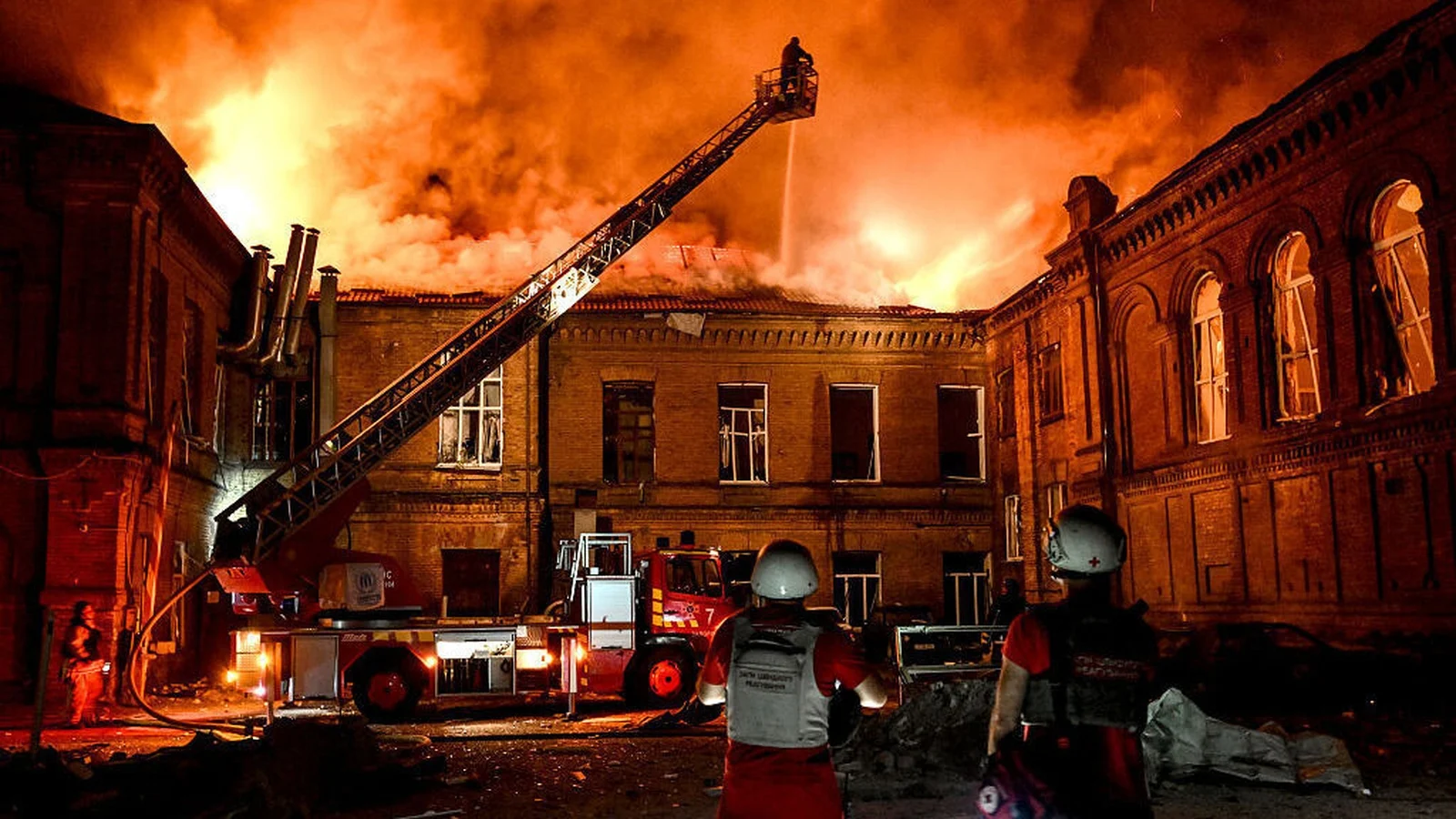
Russia unleashed a sweeping overnight assault on Ukraine’s industrial core, leaving four people dead and knocking out electricity for tens of thousands in the country’s north, Ukrainian officials reported.
Strikes hit industrial enterprises in Dnipro, Kryvyi Rih and Pavlohrad in the southeastern Dnipropetrovsk region at the same time, regional governor Oleksandr Hanzha said in a Telegram post.
According to Mr Hanzha, Russia used a mix of missiles, drones and artillery to target four districts in the region. The attacks killed four people and wounded six in Dnipro, where he said a business and warehouse facilities suffered severe damage.
More than four and a half years into the war, with much of the front line fighting largely bogged down, both Moscow and Kyiv have increasingly aimed at economic targets — including businesses, ports and logistics hubs — in recent months in an effort to undermine the other side’s ability to sustain its war effort.
Ukraine’s air force said the overnight barrage included an unspecified number of Oniks anti-ship missiles and ballistic missiles, alongside four cruise missiles and 212 drones.
Mr Hanzha said businesses were also damaged in Pavlohrad and Kryvyi Rih, the hometown of Ukrainian President Volodymyr Zelensky.
In northern Ukraine, a Russian strike on an energy facility in a neighbouring region cut power to nearly 100,000 consumers in the Chernihiv region, according to a regional electricity distribution company.
Further west, Russia launched what officials described as a “massive” attack on the central Poltava region, striking an industrial enterprise and a critical infrastructure site, Governor Vitalii Diakivnych said.
Across the border, Ukrainian drones struck civilian targets in Russia’s Samara region on the Volga River, the local governor said, killing one person and injuring four. The region contains strategically important sites, including oil refineries.
Russia’s defence ministry said its air defence units destroyed 297 drones across various Russian regions overnight.
Macron discusses Ukraine with Trump and Zelensky
Mr Zelensky said he met French President Emmanuel Macron yesterday after Mr Macron held talks with US President Donald Trump, and that the conversation focused “primarily about security and the winter support package for Ukraine”.
I met with @EmmanuelMacron. We spoke primarily about security and the winter support package for Ukraine. We are also ready to secure additional SAMP/T air defense systems and missiles for them using the financial resources available through the EU loan.
We continue working on… pic.twitter.com/jYGDu124gz
Mr Macron said he had raised the issue of providing Kyiv with defensive weapons systems during his discussion with Mr Trump.
He said the leaders talked about “the need to help our Ukrainian friends faster and more strongly in terms of (missile) interceptors, because that is … a defensive measure.”
In a post on X, Mr Macron said they also addressed “the prospect of an energy truce and a moratorium in the Black Sea.”
“It is clear that today we need to help Ukraine’s energy system,” he said.
Mr Macron added that Mr Trump was “very amenable and we were able to go into detail on these two conflicts [Ukraine and the Middle East], which are obviously important for peace in the world and for our security.”
Kallas calls for continued sanctions on Russia
EU foreign policy chief Kaja Kallas urged member states to keep sanctions on Russia in place over the war in Ukraine as governments seek to secure an extension.
“Sanctions are a core pillar of our response to Russia’s war” because they cut off funding, she told reporters in New York after a meeting of European Union foreign affairs ministers.
European Commission Vice President Kaja Kallas was speaking ahead of the United Nations General Assembly in New York
Ms Kallas said officials want to conclude talks on rolling over the sanctions quickly and move to extend them without delay.
“We need to have this stability,” she said on the sidelines of the United Nations General Assembly, arguing the measures must remain in force for a longer period.
She said the EU’s stance remains unchanged: “That’s why we are also working on a new package of sanctions.”
At the same time, negotiations continue as some member states push to remove certain individuals from the EU blacklist.
EU countries failed yesterday to finalise an agreement that included lifting sanctions on Russian oligarchs Alisher Usmanov and Mikhail Fridman.
France and Slovakia pushed for Alisher Usmanov to be removed from the blacklist
Talks are set to continue in Brussels as countries work to extend sanctions on almost 3,000 other individuals and entities linked to the war.
The bloc of 27 has been racing to seal a deal before a deadline later today to prolong the broader sanctions regime.
France and Slovakia pressed for Russian-Uzbek billionaire Mr Usmanov to be removed from the blacklist.
Luxembourg, seizing on France’s position, insisted that if Mr Usmanov’s sanctions were lifted, then the same should apply to Mr Fridman.
Several diplomats had earlier said member states reached a provisional compromise to delist both men.
But the agreement did not secure final approval, with one diplomat saying Latvia raised a last-minute objection.
Ukraine reacted angrily to the prospect of the EU lifting sanctions on the two high-profile Russian businessmen.
Other EU countries, including Poland and the Baltic states, also strongly resisted any easing of measures, saying pressure on Russia should instead intensify.
Yesterday, Ms Kallas said Europe is seeing “a fast proliferation of sabotage attacks and airspace violations.”
“Moscow is trying to scare Europe into winding down its support for Ukraine,” she said. “As Russia is willing to take greater risks, we also need to impose greater costs.”