Ukraine woke to another punishing wave of Russian drones and missiles, with strikes killing six agricultural workers in the east and two people in Kyiv as the long-range battle between the two sides accelerates.
The barrage set off air raid sirens and forced residents to rush for shelter, coming as both Kyiv and Moscow appeared at the United Nations and promised no let-up in their attacks — a signal that any near-term path to peace in Europe’s worst conflict since World War II remains remote.
President Volodymyr Zelensky, in New York to press for additional Western military support and tougher sanctions on the Kremlin, said Russia was intentionally hitting civilian infrastructure.
Russian attacks have “reached a new level of intensity”, killing at least 200 civilians across Ukraine so far this month and wounding 1,234 others, according to preliminary United Nations figures.
“What stands out is the frequency of the attacks and the striking range of civilian facilities being impacted: places where people live, work, shop and receive essential services,” said Danielle Bell, head of the UN Human Rights Monitoring Mission in Ukraine (HRMMU).
The HRMMU also said Ukraine has stepped up strikes inside Russia, with civilian casualties rising there as well — calling the development an “escalatory trend” that was illegal under international humanitarian law.
In the Russian-occupied Lugansk region, the governor said three people were killed in Ukrainian drone strikes.
In Kyiv, the surge in assaults is again pushing residents to think ahead to winter contingencies, amid fears that Russia could once more cripple the energy system needed to heat homes in bitter sub-zero temperatures.
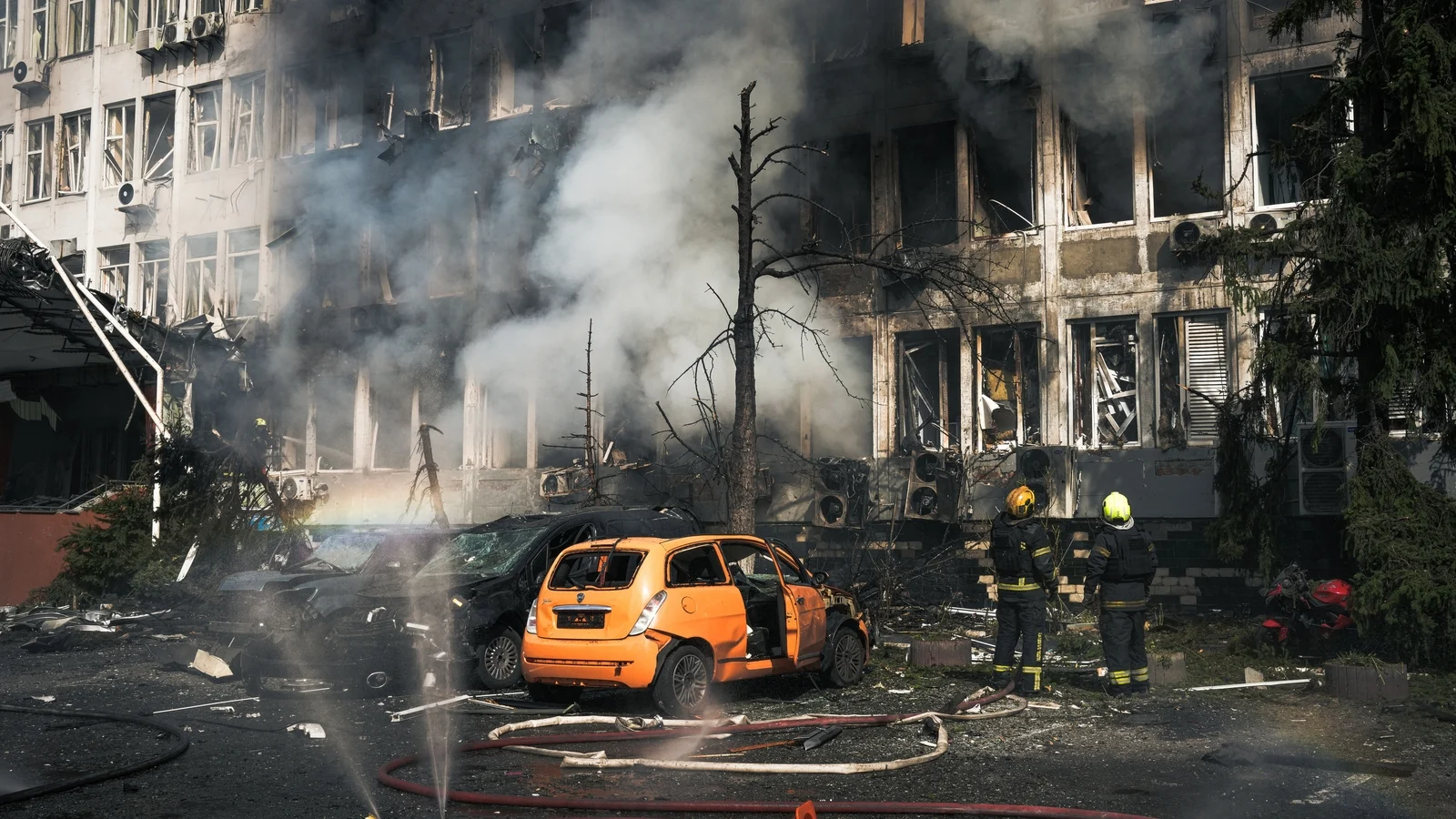
After the pre-dawn attacks, burnt-out cars and smouldering building debris were visible in the city. Authorities said the volley included powerful ballistic missiles.
Prime Minister Sergiy Koretsky said at least two people were killed across the capital.
In the Kharkiv region, prosecutors released photos from inside a wrecked warehouse, showing what appeared to be heaps of apples scattered across the floor and a large hole torn through the roof.
The storage facility in the Chuguiv district, southeast of Kharkiv, was hit while staff were sorting vegetables, the regional prosecutor’s office said.
Volodymyr Zelensky delivers a speech during the United Nations General Assembly in New York
Drone-missile hybrid
Ukraine suspects Russia deployed a compact, low-cost hybrid weapon known as a “Banderol”, which blends features of a cruise missile and an attack drone — a system Moscow has previously used on a large scale, notably to saturate Ukrainian air defences.
Around Ukraine’s Black Sea port of Odesa, officials said Russian strikes ignited a fire at a shopping mall and also hit homes and businesses.
The new wave followed a day of Russian attacks that killed at least seven people in Ukraine and set off fires in Kyiv.
Kyiv, a city of about three million, has faced especially intense drone assaults in recent days, with strikes hitting petrol stations, warehouses and the rail network.
Nova Post, a postal and courier company, said one of its branches was destroyed and its sorting depot was damaged in today’s strikes.
AFP analysis of data from the ACLED armed conflict monitor found more Russian strikes on the Kyiv region in the first 18 days of September than in any full month since the war began, with the lone exception of March 2022.
In New York, Zelensky met NATO Secretary General Mark Rutte to brief him on the latest security situation, renewing his appeal for US-made interceptors to counter ballistic missiles and for tighter sanctions on Russia.
US Secretary of State Marco Rubio has urged both sides to avoid targeting the other’s energy sector. He also invited Russian President Vladimir Putin to attend the G20 summit in the United States in December.
The Kremlin said it would weigh the invitation, while the European Union said it would use the summit to continue condemning Russia’s war on Ukraine.
Polish minister says Starlink station fire was sabotage
Poland has said previously it has been paying for Ukraine’s Starlink subscription
A fire that tore through the power system and backup generator at a Starlink station in Poland last night was sabotage intended to disrupt internet services — including those used by Ukraine’s military — a government minister said.
Poland has maintained heightened vigilance for sabotage since Russia invaded neighbouring Ukraine in 2022. Moscow has repeatedly denied involvement in such incidents.
“The fire engulfed the power station and the generator; it is clear that this act of sabotage was deliberately designed to disable the station – effectively cutting off the internet connection … and disrupting internet access for various institutions, including the Ukrainian military,” said Polish Deputy Prime Minister Krzysztof Gawkowski.
He said the central Poland station had returned to normal operations. Ukraine has not publicly said whether the fire caused any disruption on its side.
Gawkowski said authorities had not determined who set the fire, but added that “many signs suggest this aligns with Russia’s new doctrine of attack”.
“While everything is operational today, we must recognise, as Prime Minister (Donald) Tusk recently noted, that this is an element of hybrid warfare,” he said.
Elon Musk activated Starlink services over Ukraine in 2022 after Kyiv appealed for help in the early days of Russia’s full-scale invasion. Poland has previously said it pays for Ukraine’s Starlink subscription.
Although Musk later clashed with Ukrainian officials over his views on the war, Ukraine’s military depends on tens of thousands of Starlink terminals for battlefield communications and some drone operations.
Musk also agreed this year to disable thousands of Russian “grey-market” Starlinks in Ukraine, creating difficulties for Russian forces.
Ukraine is now seeking to use the terminals as well for attacks on Russian territory.
Additional reporting: Michael Zholob