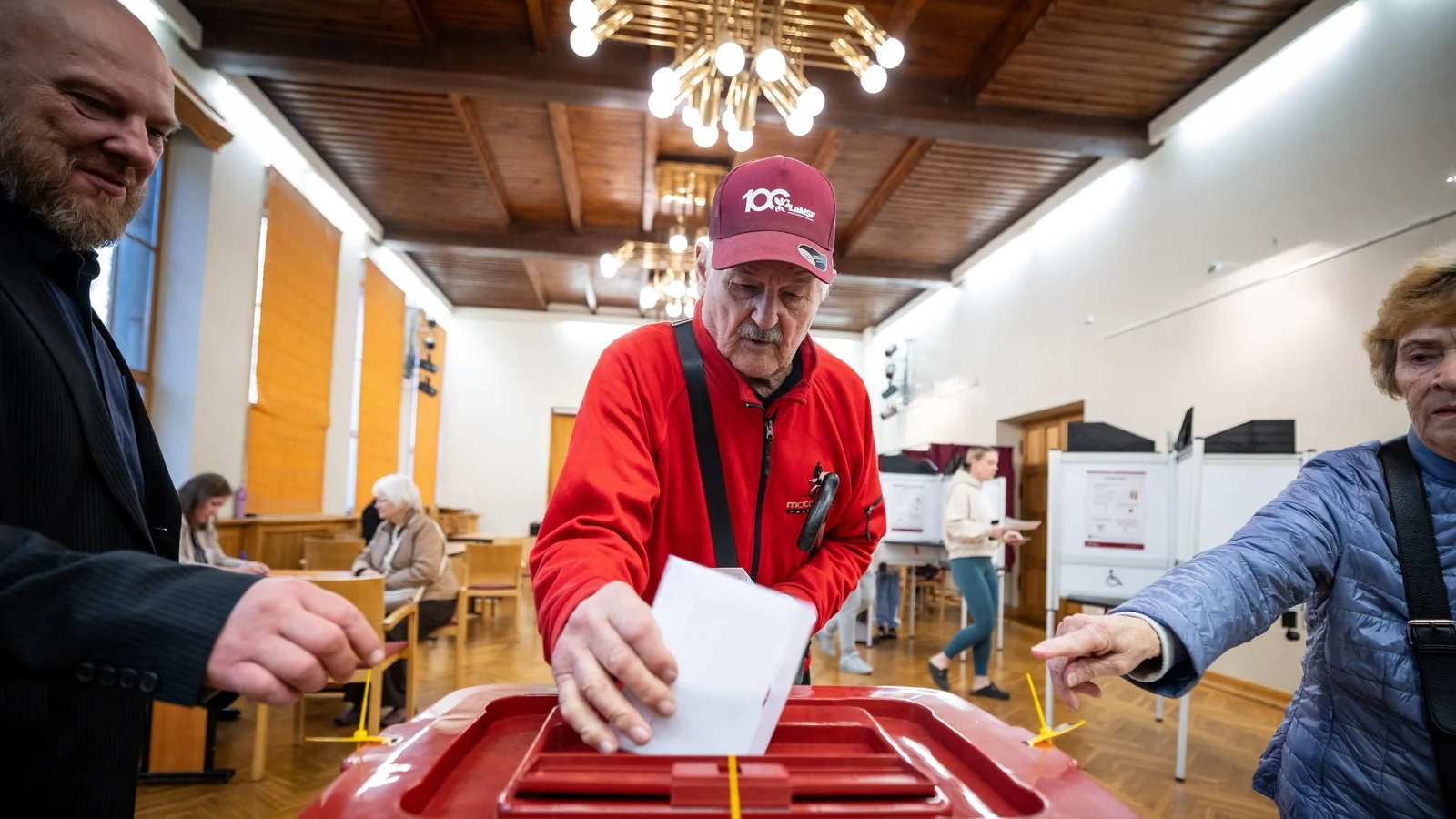
Latvia headed to the polls on Saturday in a parliamentary election that appears set to keep power with pro-Ukrainian Prime Minister Andris Kulbergs, even as a splintered political landscape threatens to turn government-building into a protracted negotiation.
The vote is taking place under a cloud of heightened anxiety across the Baltics. In Latvia — a member of both NATO and the European Union — official warnings about potential Russian aggression, along with a rising number of airspace incursions linked to Moscow’s war in Ukraine, have left many voters on edge.
Moscow rejects claims it is preparing to attack NATO, calling such accusations baseless. Western officials, meanwhile, have said Russia lacks the capability to launch a direct assault. Still, security has loomed large throughout Latvia’s campaign season.
Opinion polling shows Mr Kulbergs’ centrist United List leading with roughly 14% support, but only narrowly, with the openly pro-Russian Sovereign Power close behind.
Mr Kulbergs, a businessman and amateur rally driver, became prime minister in May after the previous coalition collapsed amid criticism of its response to incidents in which stray military drones flew into Latvia undetected.
Although the drones were Ukrainian, officials have blamed Russia for causing them to veer off their intended flight paths.
“We have to give Ukraine everything necessary right now (so) that they can have the upper hand and win”, Mr Kulbergs said in an interview last month.
On the campaign trail, he has also pledged to bolster Latvia’s anti-drone capabilities and to keep defence spending at 5% of gross domestic product — among the highest levels in NATO.
His pro-Kremlin opponents argue, however, that Latvia should halt assistance to Ukraine and redirect attention to cost-of-living pressures, a message aimed in part at the country’s Russian-speaking minority.
“Our voters want peace, to stop looking for shelters, to no longer experience the air alerts”, party leader Julia Stepanenko said.
“The war must not be encouraged in any way, including by financing it… Ukraine must win, but through peace talks”.
Polling stations opened at 8am local time and are due to close at 8pm. Initial results are expected within hours, with the final outcome likely to come into focus after midnight. Voters are choosing 100 members of the Saeima, or parliament, for a four-year term.
Surveys indicate at least two other forces could enter the legislature: Latvia First, a populist MAGA-style grouping, and the Progressives, a left-leaning party with strong appeal among younger voters.
Whether Mr Kulbergs can assemble a workable coalition may hinge on the size of his party’s showing and on how many competitors clear the 5% threshold required to win seats.
That arithmetic could also push him toward talks with Latvia First leader Ainars Slesers, a businessman who appears to have moved toward a more anti-Ukraine posture in recent months, seeking support from both camps.
“His message is that (the party) condemns Russia’s invasion and stands with Ukraine, but that supporting Ukraine comes at the expense of Latvia’s economy,” said Roberts Kits, researcher for the Latvian Strategy and Economic Research Institute, in a note.
Latvia, home to 1.9 million people, sits between the Baltic Sea — with EU and NATO partners Estonia to the north and Lithuania to the south — and Russia and Belarus along its eastern flank.