Bačka Topola — a modest town about an hour and 40 minutes north of Belgrade — is hardly the setting you would pick for a fraught international showdown, yet it is where the Republic of Ireland and Israel meet tonight in their second fixture.
The drive to the settlement of roughly 12,000 people runs through a pancake-flat stretch of Serbia, with small villages scattered across the landscape.
Football is not what usually draws attention here. In Serbia, Bačka Topola tends to be associated more with a nearby stud farm and a scenic lake than with headline sports.
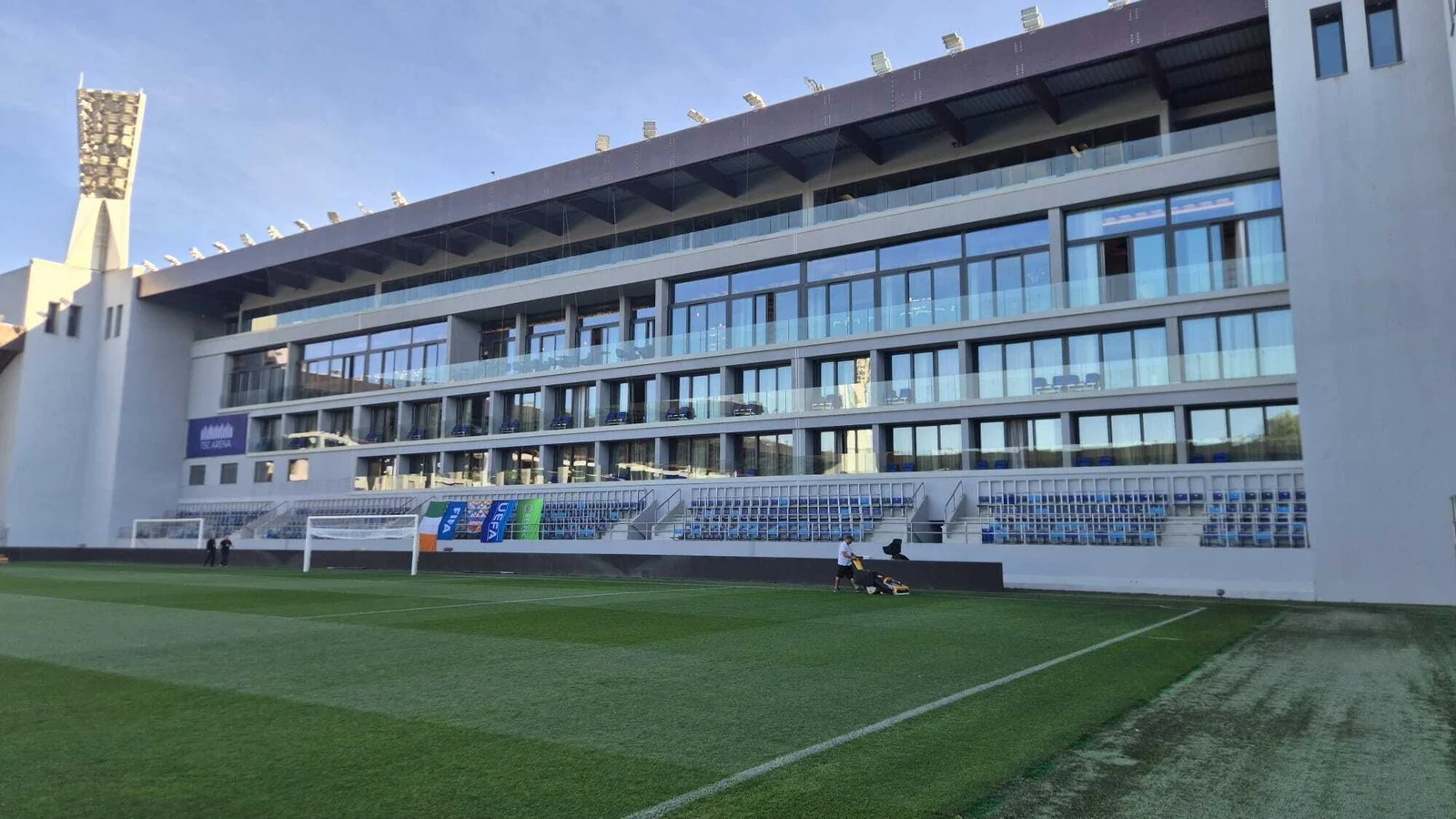
Still, the town boasts a modern, compact venue: the TSC Arena, a 4,500-seat stadium that stands out against the quiet streets around it.
It is the home ground of Serbian second division side FK TSC, and in recent seasons it has also served as the European “home” base for Israeli club Maccabi Tel Aviv.
That recent link offers a clue as to why the FAI selected this out-of-the-way location for a behind-closed-doors match that is formally designated as the Republic’s home fixture.
Arriving yesterday, the town centre felt subdued, with a number of shops along the main street shuttered.
As with last week’s game against Israel in Debrecen, Hungary, there was a sense that this did not resemble a typical Republic of Ireland occasion on the road.
There were no green jerseys.
No familiar Olé, Olé, Olé echoed down the street.
The most visible gathering was at the Gradska Kafana pub on the main road, where men sat in small groups, talking over pints of local beer.
“About this game, I hear nothing,” said barman Milan Guzina.
The Gradska Kafana pub on the main street of the town
Another resident, Tomislav Savic, said news of the match had only reached him that morning.
“It will be very good for our economy and our town,” Mr Savic said, adding that he expected “guests” to arrive for the occasion.
He was then politely told that tonight’s game is closed to the public and that, in reality, few — if any — supporters were likely to travel to Bačka Topola.
Even so, he said anyone who did come would find “good, kind people and lots of beer”.
Tomislav Savic said he only heard about that match that morning
On the main street, the unusual nature of the fixture was underscored when Republic of Ireland and Real Betis striker Troy Parrott casually walked past, heading into a café to join teammates.
Jake O’Brien was easy to pick out, towering at the front of another cluster of players, with Caoimhín Kelleher, Liam Scales and Conor Coventry following shortly after.
The scene captured the strangeness: international footballers drifting through a town that appeared largely unaware of what was about to happen.
Not everyone locally was surprised, however, that Bačka Topola was handed such a match.
One man, who did not want to be identified, said it was logical for FK TSC’s stadium to stage the game because the arena is due to be used as one of the venues at next year’s UEFA under-21 European Championship, co-hosted by Serbia and Albania.
Second international match to be played in Bačka Topola
Tonight’s contest marks only the second international held in Bačka Topola.
Serbia played Saudi Arabia in a friendly at the same stadium last February and won 2-1.
The town walk came just hours after a Republic of Ireland press conference ended suddenly after only 14 minutes.
An Israeli journalist alleged that Irish players called Israeli players “monkeys” during last weekend’s match in Hungary.
FAI press officer Kieran Crowley described the claim as “completely untrue” and brought the press conference to a halt.
The same journalist then attempted to enter a separate Irish media briefing elsewhere in the stadium, but was not permitted to attend.
Heimir Hallgrimsson addressing the Irish press in Serbia
The confrontation reflected the strained mood that has hung over both fixtures between the teams.
Republic manager Heimir Hallgrímsson and Israel manager Ran Ben-Shimon both said at their respective media engagements that they wanted attention kept on football.
But the political arguments that have framed these games have been difficult to disentangle from what has unfolded on the pitch.
It remains unclear whether any supporters will appear in Bačka Topola tonight.
Although designated as the Republic’s home game against Israel, it will be played without fans in the stands.
For the Irish players — who faced Austria at the Aviva Stadium in Dublin on Thursday in front of more than 45,000 supporters — another match in an empty venue will be a stark contrast.
And as kick-off approaches, much of Bačka Topola looks set to carry on as normal, with many residents seemingly unaware that their town is hosting what is being described as one of the most controversial fixtures in the history of Irish soccer.