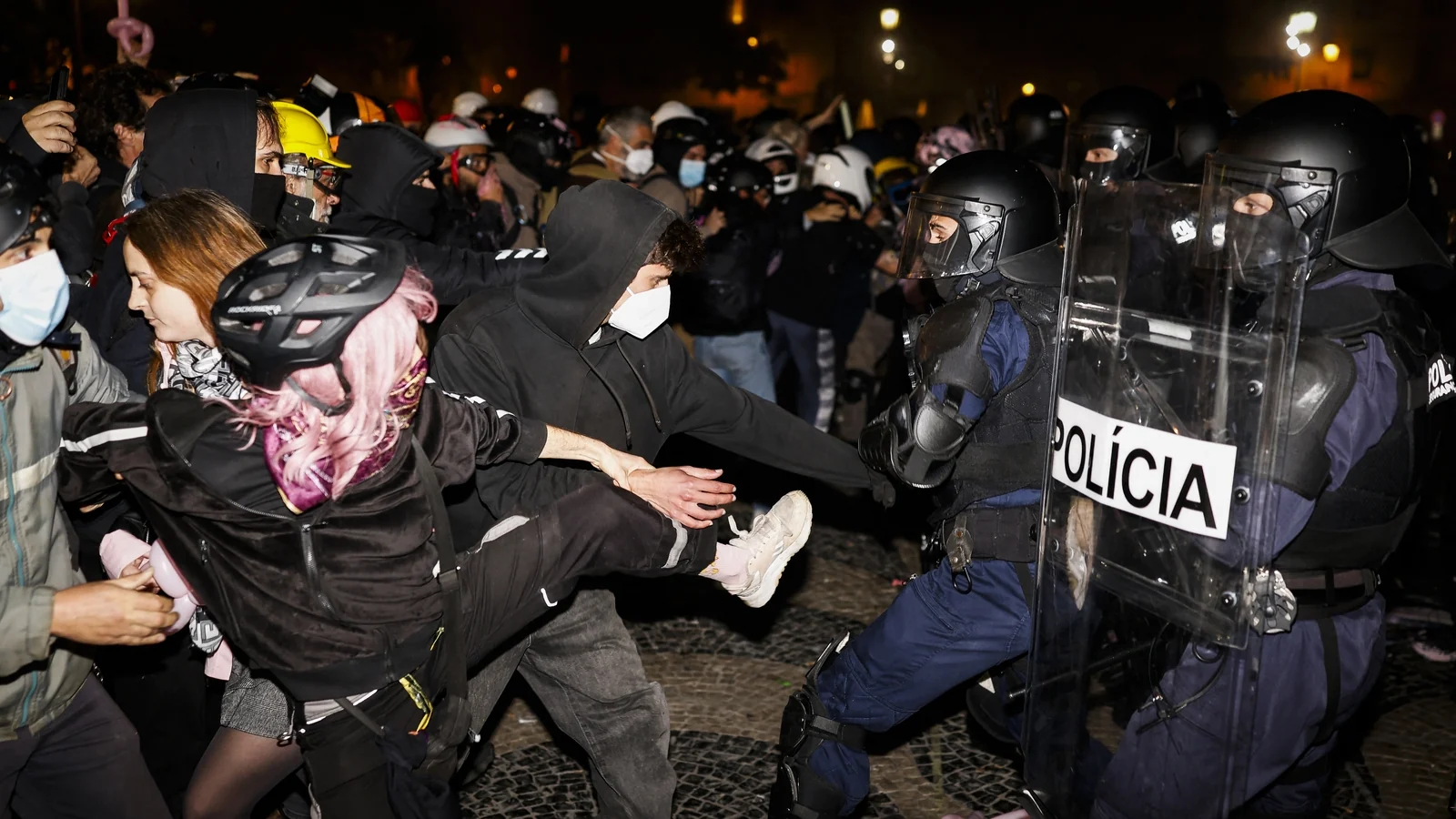
Before dawn broke over Portugal, riot police swept into protest camps in Lisbon and Porto, igniting violent clashes that left dozens hurt and 13 people under arrest as anger over the country’s housing crisis boiled over once again.
Tensions erupted around 4.30am when dozens of officers moved to clear an encampment in Lisbon’s Rossio Square and a smaller site in Porto’s Dom Joao I Square.
As police advanced to remove tents, protesters chanted “smells like a dictatorship”. Police, for their part, said some demonstrators threw bottles and paint at officers during the operation.
In a statement, police said they detained six people in Lisbon and seven in Porto for refusing orders to disperse. Authorities reported 13 officers injured, with eight taken to hospital.
Police in Porto also said three plain-clothes officers who had been monitoring the protest were assaulted after a group identified them.
The statement did not specify how many civilians were hurt, saying only that an unspecified number were injured during an operation carried out “with rigour, balance and respect for citizens’ rights”.
An encampment was set up in Rossio Square following an earlier demonstration
Acampada Lisboa, the activist group behind the Lisbon camp, said more than 30 protesters were injured, including 10 who needed hospital treatment, and it called a new rally in the capital for this afternoon.
The camps had gone up late yesterday after peaceful marches through both cities protesting soaring housing costs.
Police have repeatedly taken down similar camps that have appeared across Lisbon and Porto in recent weeks.
Demonstrators are urging the minority centre-right government to drop plans to ease evictions and lift rent caps on new leases, warning the changes would drive prices higher and leave tenants more exposed.
Organisers say the tactics draw inspiration from neighbouring Spain, where protest tents have been in place for weeks in central Madrid and other cities.
Shops looted as Gen Z-led protests in Germany escalate
In Germany, protests led by young demonstrators spread across the country’s biggest cities yesterday, with looting reported in Frankfurt as marchers demanded better education and relief from rising living costs.
The demonstrations came amid a broader year of unrest across Europe. In Serbia, student-led activism helped unseat the country’s longtime leader at the ballot box, while in France protests have slipped into rioting and looting.
The German rallies were organised by Gen Z Regelt — “Gen Z takes charge” in German — and took place in 34 cities including Berlin, Frankfurt and Munich.
The campaign group says it opposes compulsory military service and is pressing for increased investment in education as many young Germans grapple with rising expenses.
In Frankfurt, Germany’s financial hub, at least two stores were looted after parts of the protest turned violent. Several additional shops were damaged and police worked to regain control, according to a witness.
Gen Z Regelt is protesting compulsory military service and wants greater investment in education
By yesterday afternoon, official figures indicated turnout fell short of the 182,000 participants organisers had originally anticipated.
German authorities said the demonstrations — which coincided with Halloween festivities — were largely peaceful, though they warned extremist groups were attempting to exploit the movement.
In Hamburg, some barricades were set alight.
“We are here… to fight for peace and freedom, rather than for war and coercion,” Gen Z regelt spokesperson Lina Friedrich said in Berlin.
“What matters most to us is better support for the health and education systems. We are against compulsory military service and we are in favour of a fairer distribution of the burden.”
Luxury shops board up windows
Germany’s federal interior ministry has said elements of the far-left as well as some groups tied to foreign extremist movements have joined efforts to rally support.
“We all have those images from France in our minds – looting, burning houses, burning police vehicles, and attacks onpolice officers,” said Roman Poseck, interior minister for the state of Hesse, whose capital is Frankfurt.
“France must not be held up as a model in this regard.”
Across German cities, some businesses boarded up windows and planned early closures ahead of the demonstrations amid fears of unrest, including along Berlin’s luxury Kurfuerstendamm shopping boulevard.
Demonstrations coincided with Halloween festivities
Organisers have centred their message on what they describe as mounting pressure on younger generations in Europe’s largest economy.
“The government has offered no response to our concerns other than to continue making cuts and piling further burdens upon us,” said Steve, an 18-year-old due to speak at a rally in Munich, addressing Chancellor Friedrich Merz.
“We will continue to exercise our fundamental right to assemble until you stop ignoring us.”
Germany has struggled to revive economic growth. The country also faces increasing strain on pensions and public services as baby boomers retire and the working-age population declines.
Questions have also surfaced over who is driving the campaign and whether it is truly youth-led, given the wide range of political and civil society groups involved.
Germany’s national school student umbrella organisation, BSK, has distanced itself from the initiative and said it will hold a separate day of protest on 20 November.
Sean Baker, a student at the Technical University of Berlin, said he planned to join the demonstrations to highlight what he described as the dilapidated state of campus buildings.
“When you go inside and enter the rooms, it looks like an abandoned building,” he said. “Yet this is where we’re expected to study on a regular basis.”