A British citizen who tested positive for Ebola in the Democratic Republic of the Congo is being flown back to the UK for specialist care, the government has confirmed, triggering the country’s established response procedures for rare but serious infections.
The patient, believed to be a healthcare worker, is expected to arrive back in the UK later today.
A government spokesperson said: “A British citizen currently in the DRC has tested positive for Ebola.
“The UK has well-established procedures for dealing with cases like this, and those processes have been activated.
“Further information will be shared in due course as appropriate. The risk to the UK public from Ebola remains low.”
Ebola is known for its high fatality rate, with previous outbreaks killing between 25% and 90% of those infected. Illness typically develops between two and 21 days after exposure to an orthoebolavirus.
Initial signs can be non-specific — including fever, aches, pains and fatigue — before potentially worsening to diarrhoea, vomiting and unexplained bleeding.
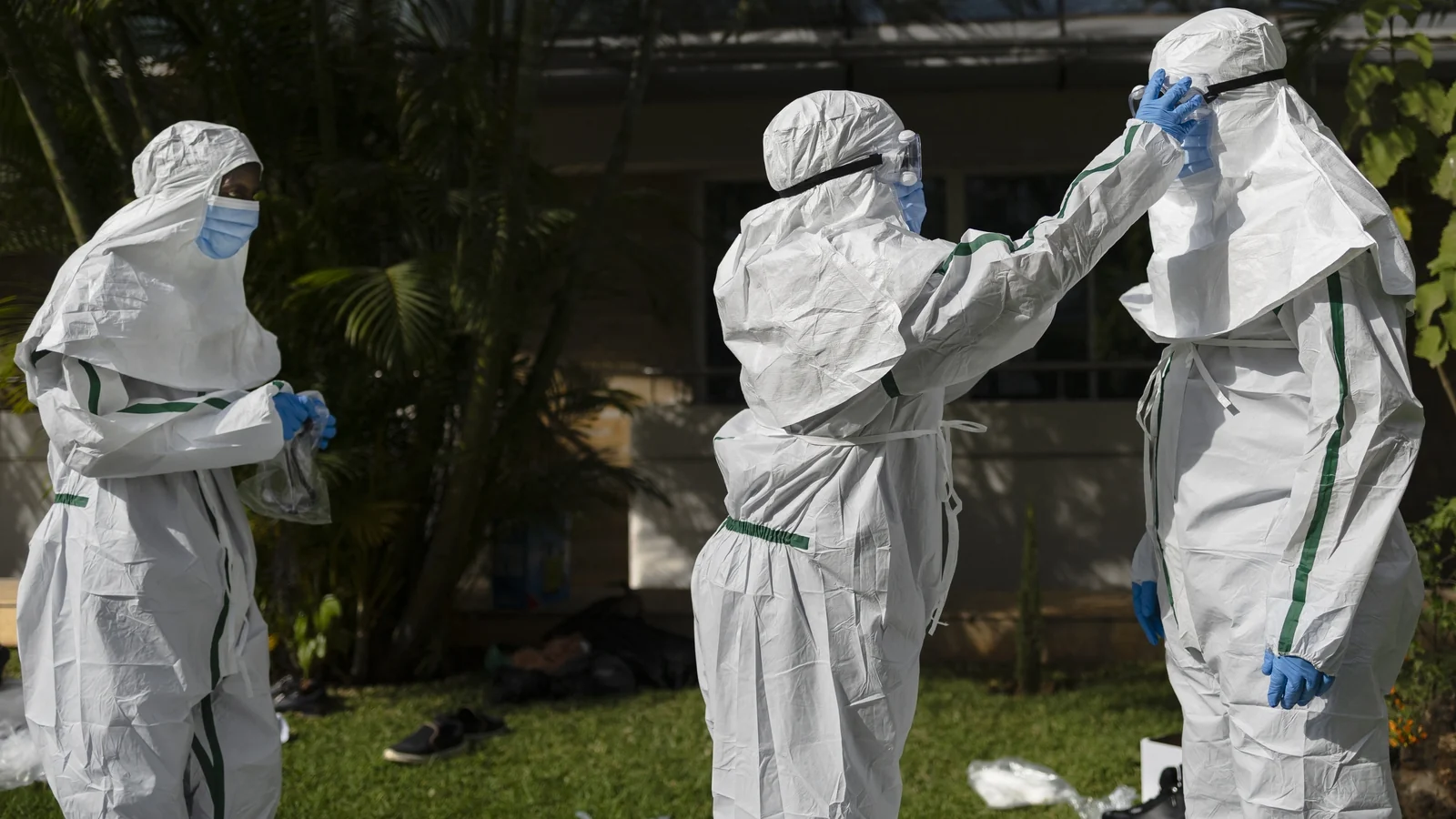
A hygiene specialist decontaminates a doctor in the east of the Democratic Republic of Congo
Only four Ebola cases have previously been confirmed in the UK: one in 1976 linked to a laboratory needle accident, and three involving health workers who had been responding to the West Africa outbreak in 2014 and 2015.
This latest infection is the first time a British national has contracted Ebola connected to the continuing outbreak centred on the DRC, which is caused by Bundibugyo virus.
More than 5,000 deaths have been recorded in the outbreak so far.
The patient is expected to be transferred to the Royal Free Hospital London, one of just two UK hospitals equipped to manage Ebola cases. The other is the Royal Victoria in Newcastle.
At the Royal Free, care is delivered in a high level isolation unit staffed by a specialist team of doctors, nurses and laboratory personnel.
The man will be treated at the Royal Free Hospital in London
That unit has previously treated adult patients with Lassa fever, Ebola and Crimean Congo haemorrhagic fever.
Entry is tightly controlled, and the facility includes a specialist tent with regulated ventilation designed to support treatment by NHS staff.
The hospital says all air leaving the unit is filtered and cleaned, preventing risk to anyone elsewhere in the building or outside.
Professor Emma Thomson, director of the MRC-University of Glasgow Centre for Virus Research, said: “The UK is extremely well prepared to care for patients with Ebola.
“Although Bundibugyo virus, the cause of the current outbreak, can cause severe disease and is highly infectious through direct contact with infected bodily fluids, the Royal Free has state-of-the-art isolation facilities and highly experienced clinical teams.
“Strict protocols are in place to protect healthcare workers and prevent onward transmission. The risk to the wider UK public is extremely low.”
Dr Damien Tully, an expert in infectious disease from the London School of Hygiene & Tropical Medicine, said: “The infection of a British healthcare worker with Ebola is deeply concerning, but it is not entirely unexpected.
“Healthcare workers are on the frontline of these outbreaks, often treating severely ill patients under extremely challenging conditions. Even with rigorous protective measures, accidental exposures can occur.
“This case is a stark reminder of the risks faced by those responding to the outbreak of Ebola disease caused by Bundibugyo virus in the DRC.
“However, it does not suggest that the virus has become more transmissible or that the threat to the UK has increased.
“Unlike respiratory viruses such as Covid-19 and influenza, that can spread through the air, Ebola is transmitted primarily through direct contact with infected bodily fluids, and people are not generally infectious until they develop symptoms.
“This means that identifying and isolating cases, together with appropriate infection prevention measures, can be highly effective in preventing onward transmission.
“For the UK public, the risk from this planned medical evacuation is extremely low.”