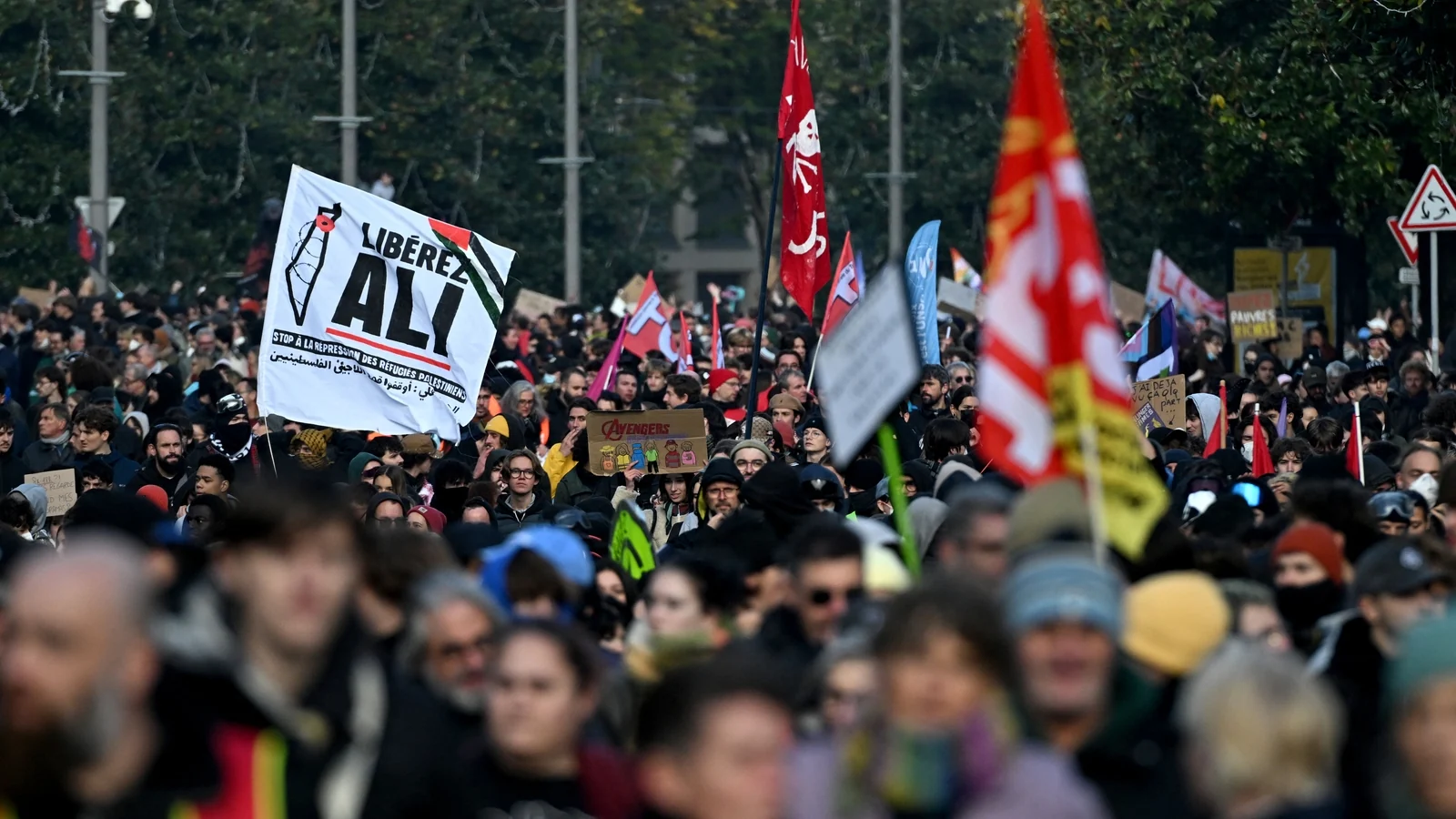
France’s simmering political tensions boiled back onto the streets on Thursday as flag-waving protesters marched through major cities and public-sector workers downed tools, reviving pressure on President Emmanuel Macron just five months before a presidential election.
The latest mobilisation — called by trade unions including the left-wing CGT and supported by student organisations — follows weeks of demonstrations over living costs, strained public services and education that have produced the most serious civil unrest the country has faced in years.
“We need to turn up in big numbers on the streets today,” CGT head Sophie Binet told LCI TV, saying protests were planned in 260 towns and cities across France.
In Paris, French high school students and other demonstrators confronted riot police after blocking a street with rubbish bins earlier in the morning.
Rallies got under way by mid-morning in Marseille and Lyon in the south and in Nantes in western France. Organisers said the main march in Paris was set to leave Place de la Republique at 2pm local time. (1pm Irish time).
Protesters hold placards during a demonstration in Nantes
“High school students, pensioners, students, workers, all together. Unity wins,” read one banner prepared for the protest in Lyon.
In Lyon, some protesters arrived wearing face masks or safety glasses, taking precautions ahead of possible tear gas use by police.
Officials have tried to cool tensions since riots and looting on 17 October took security forces by surprise, damaging shops and public buildings nationwide and intensifying criticism of Macron’s response to the crisis.
Authorities said around 70,000 police would be deployed across the country. France’s domestic intelligence service estimated that between 500,000 and 700,000 people could join demonstrations outside Paris.
Strike action was already linked to a dip in France’s nuclear output early on Thursday, though there were no reports of major disruption on the transport network.
Empty platforms at Lyon Part-Dieu railway station in Lyon during the nationwide day of action
Students air grievances
The education ministry said it expected 17.5% of public primary school teachers to strike.
Students argue that deteriorating school conditions, along with mounting uncertainty about their prospects, continue to drive anger.
“We’re trying to keep mobilising as much as possible. Some people aren’t doing so because they’re afraid. A lot of people are afraid of police violence,” said Irma de Banville, a 19-year-old student in Paris.
The French government has defended the police response while insisting any wrongdoing would be investigated.
Macron held a defence and security meeting on Wednesday ahead of the day’s demonstrations, reflecting how unrest that began with student frustration over school conditions and worries about opportunities for young people has expanded into a wider test for his government.
“The goal in the coming weeks is to get the river that overflowed back into its bed and to launch the presidential election in the calmest possible conditions,” an official close to Mr Macron said, noting there were fewer high schools blockaded this week than earlier in the crisis.
Protests nationwide last Saturday were largely calm, though clashes broke out on the edges of some gatherings. Even so, the mood remains fraught as candidates position themselves ahead of the vote and opposition parties seek to harness public anger over living standards and government policy.
France makes last-minute G7 ministerial location switch
France has moved a G7 foreign ministers’ meeting from Marseille to Paris at the last minute, according to three diplomats and an email seen by Reuters.
The second foreign ministers’ meeting scheduled during France’s G7 presidency was due to take place in the Mediterranean port city from 9 to 10 November. France informed delegations on yesterday that it would now be moved to the French capital.
“The meeting of the G7 Foreign Ministers will ultimately be held on Monday and Tuesday in Paris,” according to the correspondence.
“This change is primarily due to logistical and operational reasons. The scheduling of the G7 and the Paris Peace Forum in a very compressed timeframe requires significant mobilisation of human resources, equipment, security, accommodation and transportation for the delegations.”