Nvidia was rocked on Monday as its shares slid sharply following news of an internal investigation into whether CEO Jensen Huang was the target of a foreign intelligence operation, throwing fresh uncertainty over the future of the face of the AI chip boom.
The probe was launched after a media report said Huang had a close relationship with a Chinese businesswoman accused of passing information to Beijing.
In a message to employees, Huang said he had been unfaithful to his wife, though he did not provide details about the relationship.
Announced yesterday, the investigation has intensified focus on Huang’s standing at Nvidia, the world’s most valuable chipmaker, where he has been both the architect and most visible pitchman of the AI surge.
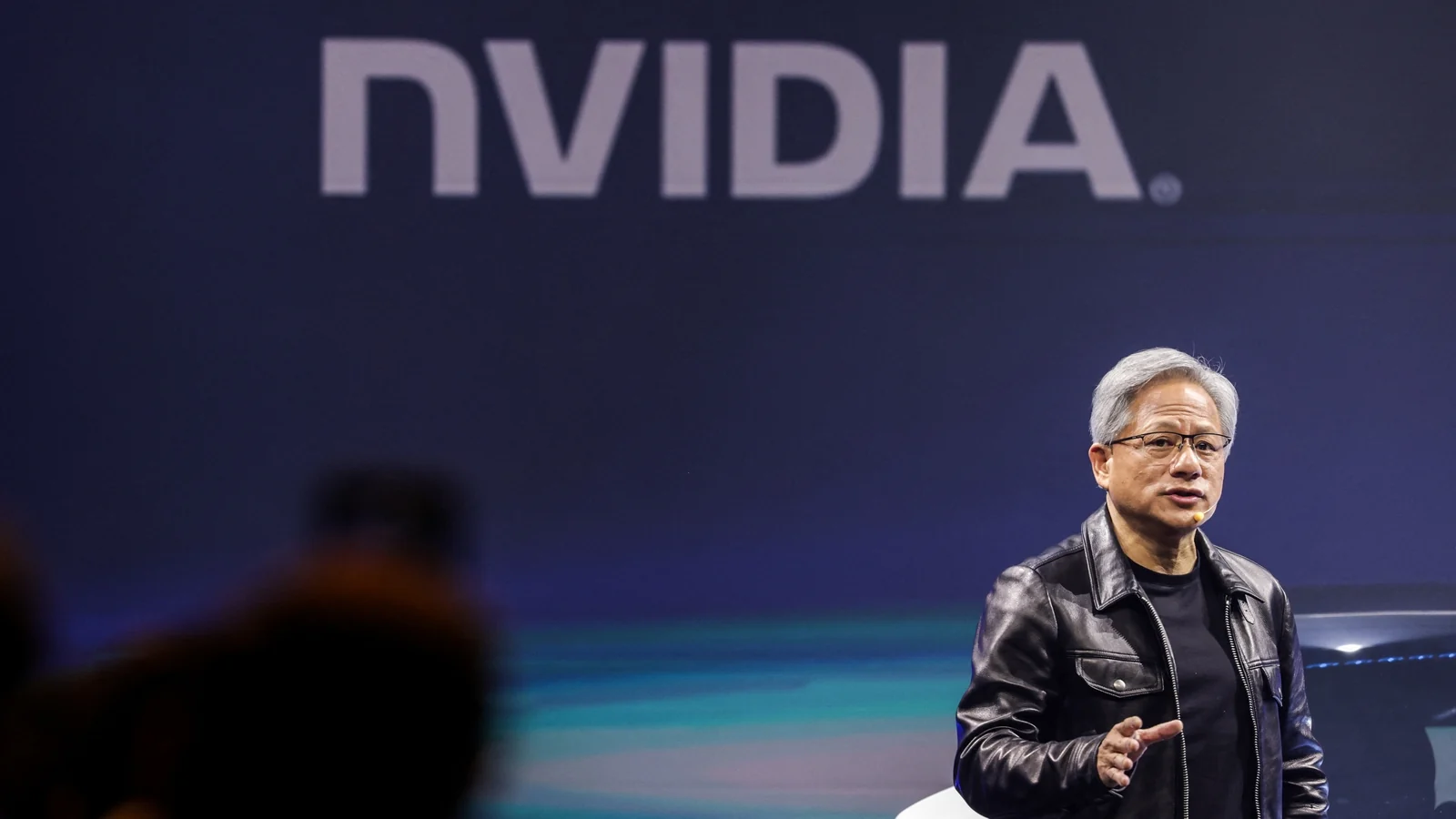
Known for his trademark leather jacket, Huang has cultivated near rock-star status worldwide — especially in Asia — where he routinely mingles with admirers, posing for selfies and signing autographs for enthusiastic fans.
LSEG data shows he is Nvidia’s fifth-largest shareholder, holding roughly 3.6%, and he maintains close control via an unusually flat management setup in which dozens of executives report directly to him.
Unlike Meta Platforms or SpaceX, however, Nvidia does not have dual-class shares that would grant its co-founder majority voting power.
The ripple effects reached South Korea, where Madison Huang — Huang’s daughter and an Nvidia executive — cancelled a scheduled trip to Seoul for an Nvidia conference due to begin today, according to companies that were set to meet with her.
Nvidia’s stock fell about 8% in early trading, adding to last week’s selloff and sending the shares to new multi-month lows. At those levels, the company would shed about $350 billion in value from its last closing price.
“The market’s probably telling you now this does no favours to the stock whatsoever in a time when there’s a lot of conjecture as to the build-out of data centers,” said Chris Weston, head of research at brokerage Pepperstone in Melbourne.
Even so, Weston said he doubted Huang — whom he called the “godfather of AI” — would be forced out.
“If we genuinely thought he was going to step down … the stock would be down – it would be an absolute bloodbath, to be honest,” he said.
The chipmaker’s shares have given up all their gains this year
Nvidia said its board has confidence in Huang. Some analysts said he has no natural successor inside the company if he were to step down.
The New York Times reported last month that Huang had a relationship with Alice Huang — not related to him — a former executive at Singapore-based Megaspeed whom US authorities investigated and concluded was a Chinese intelligence asset.
“The so-called Chinese spy narrative is purely a groundless accusation, slander, and a smear,” Chinese Foreign Ministry spokesperson Guo Jiakun told reporters in Beijing.
Megaspeed did not respond immediately to a request for comment today, a public holiday in Singapore.
Alice Huang did not respond to the New York Times last month when it first reported her relationship with Huang, and Reuters could not determine her location to seek comment today.
Jensen Huang apologised for what happened
Asia partners unaffected
Despite Nvidia’s drop, shares of key Asian chip suppliers recovered today after last week’s AI-stock rout. TSMC ended the session 4.7% higher, while Samsung Electronics and SK Hynix finished up 0.6% and 0.4%, respectively.
Huang’s admission also drew reactions from high-profile voices. Billionaire investor Bill Ackman, founder of Pershing Square Capital Management, wrote on X that the Nvidia CEO was an “incredible human” — but warned that if “indeed this is more than an affair, then it is obviously a real problem”.
“I am hoping for a simple affair, not a risk to our national security,” he said.
Tesla CEO Elon Musk posted, “I agree”, responding to a message by Sequoia partner Shaun Maguire that said Huang “did something incredibly dumb” that was “bad for America” but that “Jensen is irreplaceable for America’s AI leadership”.
US President Donald Trump said yesterday he had not discussed the allegations with Huang, but described him as a fine person. “I hope everything’s fine. He’s done such an incredible job,” he added.
Asked whether he should have acted on intelligence when briefed, Trump replied: “No, I don’t think so. I think he’s an honourable guy. I think he probably has an excuse for it. You have to hear it.”
The New York Times reported that Trump was briefed on the intelligence findings about a year ago and decided not to act on the information.
Nvidia ranks among the world’s most valuable publicly traded companies, alongside Apple and Microsoft. Its chip sales to China have periodically drawn scrutiny from US regulators aiming to curb Beijing’s access to advanced technology.
“The key questions are whether he was aware of any espionage activities and whether any confidential or strategically sensitive information was compromised,” said George Chen, a partner and chairman of digital practice at the Asia Group, a Washington-based consultancy.
“Those questions require evidence rather than speculation.”
Mr Huang has pushed Washington in recent years to ease restrictions on sales of Nvidia chips to China, and he won Mr Trump’s approval this year to sell its H200 chips.
It remains uncertain whether Beijing will permit Chinese firms to buy those processors in large volumes. Nvidia said in a regulatory filing in August that it has sold only a small amount to China because sales are constrained by the Beijing government.
While the H200 is not Nvidia’s most cutting-edge chip, it is still considered advanced. Mr Huang has also lobbied Mr Trump to allow sales of Nvidia’s less-advanced H20 chips, designed to comply with US export restrictions on China.
In China, media coverage has largely zeroed in on Huang’s admission of the affair, while state outlets have mostly mirrored the official government stance.
Some commentators have argued the New York Times report was intended to disrupt improving US-China ties.
“Whenever China-US relations begin to improve, there are often those firing shots from the shadows,” the state-owned Global Times said.
‘I hope everything’s fine. He’s done such an incredible job’, Donald Trump said
Mr Huang, who has led Nvidia for more than three decades, has been central to its transformation into the dominant supplier of AI chips.
“There is clearly risk that Jensen could be removed as CEO depending on the Board investigation and this will add risk to the stock as he is so important to the Nvidia story and strategy globally,” said Dan Ives, partner and senior managing director at Yorkville Ives & Co.
“This is a black eye moment for Jensen and will spark multiple congressional inquiries at a minimum and will create an overhang on the stock,” Mr Ives said, adding that the developments would heighten scrutiny of chip sales to China.
Read more:
Who is the executive accused of spying on Nvidia CEO?
Josh Gilbert, lead analyst at trading platform eToro, said Huang’s influence is embedded across Nvidia’s rise, making any uncertainty about his role consequential for investors.
“While the investigation is likely to dent sentiment, it won’t alter anything long-term unless it leads to a change at the top, at which point it becomes a completely different ballgame,” Mr Gilbert added.
Senior Republicans in the US House of Representatives had already urged Mr Huang to brief Congress this month about the New York Times report.
In a letter dated 4 November, they said the report raised “significant national security concerns regarding (China’s) access to sensitive US technology and information”.
“It is vital that Congress determines the extent to which US national security has been placed at risk,” they added.
US export controls imposed since 2022 have aimed to limit China’s access to advanced Nvidia chips and the equipment required to produce them.
Additional reporting: PA