SpaceX successfully completes the first-ever midair catch of its spaceship
 Caalamka
In a moment that looked like science fiction but played out live on the Texas coast, Elon Musk’s SpaceX has pulled off the first-ever midair “catch” of a spaceship — a breakthrough that underscores the promise of fully reusable rockets and edges spaceflight closer to becoming far less expensive.
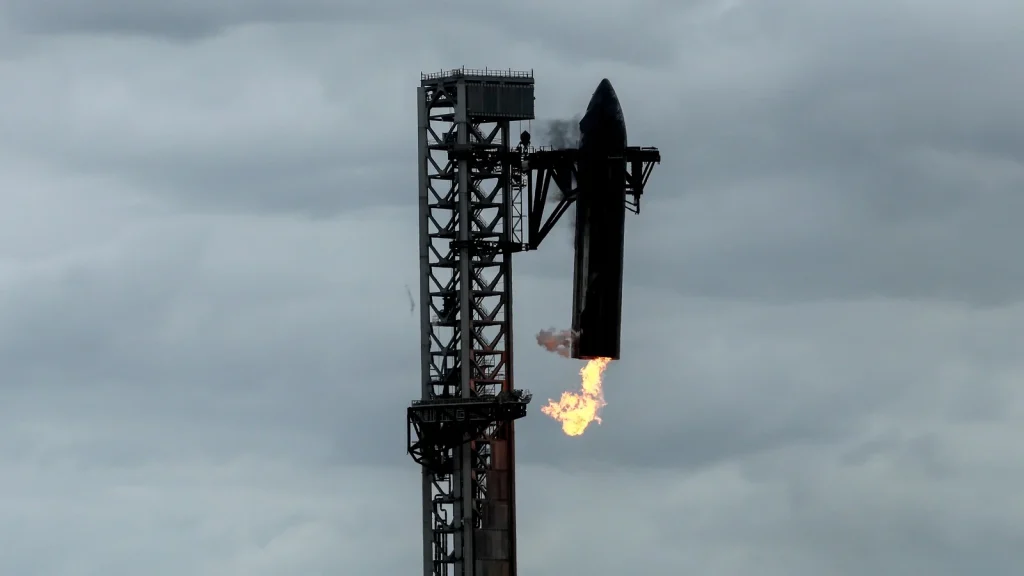
Starship reappeared from a cloudy sky after enduring the punishing heat of atmospheric re-entry, then glided down over Starbase and eased into place between the towering mechanical “chopstick arms” positioned above Launch Pad 2.
The successful recovery represents a major waypoint in the space industry’s long-running quest to build rocket systems that can be flown, recovered and flown again — an approach widely seen as key to slashing costs and enabling more frequent missions.
“That was the Holy Grail of spaceflight, plummeting through fire to be snatched out of the air by steel. We caught a Starship and now, everything changes,” SpaceX spokesman Dan Huot said.
On the Gulf of Mexico beach near Starbase, spectators erupted as the vehicle came into view. SpaceX’s official livestream paired the tense final descent with the 1977 soft rock hit “Baby Come Back,” which played as the ship settled into its landing sequence.
The flight was the 15th test mission for the world’s biggest and most powerful rocket system.
During its 22-hour journey, the Starship spacecraft — the namesake of the system — orbited Earth 14 times and deployed 26 satellites for Mr Musk’s Starlink internet constellation.
SpaceX had previously managed to capture returning booster rockets three times.
But pulling off a “catch” with Starship raised the stakes dramatically, because the spaceship returns far faster and from much higher altitude than boosters do.
Mr Musk praised the SpaceX team and shared videos showing the ship suspended between the chopstick arms, writing that the vehicle “looks great!”
Clayton Swope, an aerospace expert at the Center for Strategic and International Studies, described the mission as a “huge technical achievement and proves the whole idea of Starship as a fully reusable spaceship can work”.
“Let’s see how quickly they can do it again,” he added.
‘Giant swoosh’
Engineers charted Starship’s return route with an eye toward public safety, steering the flight away from populated areas as it crossed the continent, according to senior SpaceX engineer Lars Blackmore.
The vehicle passed over sparsely inhabited desert, threaded past towns, and then executed what Blackmore called a “giant swoosh maneuver” on final approach — looping around communities in Texas’ Rio Grande Valley before lining up from the east for its landing site.
SpaceX has pitched different versions of Starship for different roles: some aimed at lofting internet satellites and data centers into orbit, and others intended to carry people on deep-space journeys to the Moon and Mars.
NASA is counting on Starship to act as a lunar lander for its Artemis mission. On Saturday, Administrator Jared Isaacman said the recovery was “almost magic.”
“Making more believers by the day… one step closer to (the Moon),” he wrote on X.
Mr Musk has cast Starship as the backbone of a fleet of “rapidly reusable” rockets, with a long-term target of hourly launches to deliver payloads such as internet satellites and data centers to space.
Refueling challenge
Mr Musk, the world’s richest person, has already reshaped the launch business with the partially reusable Falcon rockets, which routinely send satellites aloft and ferry astronauts to the International Space Station.
Yet Starship’s development has been slowed by delays as SpaceX confronts new technical hurdles, including a critical, still-unresolved challenge: transferring fuel to the spaceship while in orbit, a capability necessary for missions to the Moon or Mars.
The company must also continue refining its Super Heavy booster. On Friday, it encountered a technical problem during descent that required it to divert to the Gulf of Mexico.
It, too, had been slated for a catch by the “chopstick arms.”
After SpaceX’s high-profile stock market debut in June, which raised about $85.7 billion, the company has been pouring money into expanding production and launch capacity.
During a Friday tour of SpaceX’s million-square-foot (93,000-square-meter) Starbase factory, company officials told journalists it now has the ability to build a spaceship every two weeks and a booster every four weeks.