Determined Pope visits Latin America following surgery recovery
 Caalamka
The Vatican is pressing ahead with Pope Leo XIV’s high-stakes Latin American tour, confirming at the end of October that the apostolic trip would begin on 6 November, in line with a programme published earlier.
The decision came just 13 days after the pontiff underwent surgery at Rome’s Gemelli Hospital to remove a malignant tumour from his right lung.
Questions had swirled over whether shifts in altitude across Uruguay, Argentina and Peru could pose fresh health risks, but doctors ultimately cleared him to travel.
Rather than delay, the Pope was said to be intent on honouring the schedule and returning to a part of the world where he spent two decades serving as a missionary priest and later as a bishop.
Robert Prevost first arrived in Peru in 1985 as an Augustinian missionary, beginning a long chapter that would account for almost half of his priestly life, before Pope Francis summoned him to Rome in 2023 to lead the Vatican’s Dicastery for Bishops.
Latin America remains a cornerstone of the global Church, with about 40% of the world’s 1.4 billion Catholics living in the region, even as Catholic identification there has declined in recent years.
Pope Leo opened the journey in Uruguay, widely regarded as Latin America’s most secular nation, in what marked the first papal visit in 38 years.
Despite only around a third of Uruguayans identifying as Catholic, tickets to papal events were snapped up quickly.
Uruguay has recently become an international transit and export hub for cocaine bound for Europe and Africa, and it also has a high suicide rate — an issue the Pope tied to social isolation.
Pope Leo is greeted by government and church officials on arrival in Uruguay
He urged a shared response involving families, communities and the healthcare system, calling on people to keep drawing near, to keep blessing, and to keep sowing.
From there, the apostolic trip continued to neighbouring Argentina — the homeland of Pope Francis, who never returned after his election in 2013.
Argentina, Latin America’s second-largest country, has a population of 46 million, with 58% saying they are Catholic.
Robert Francis Prevost had travelled to Argentina at least four times between 2001 and 2013 during his tenure as prior-general of the Augustinians.
This week, an estimated 2.5 million people turned out for an open-air Mass in Buenos Aires, with President Javier Milei among those present.
Pilgrims climbed trees, fences and lampposts for a glimpse of the pontiff, who appeared in white-and-sky-blue vestments echoing the Argentine flag.
In his homily, Pope Leo said many Argentine families were enduring their own Calvary — naming illness, poverty, unemployment, discrimination and family breakdown.
“We need to reconcile ourselves with our past and present, in order to build a new future where love has the final word,” he said.
As he prepared to fly on to Peru, he thanked Argentina for welcoming him “with open arms”.
In Peru, the visit took on the feel of a deeply personal return for Pope Leo, who had lived the country’s realities as an Augustinian missionary and later as Bishop of Chiclayo.
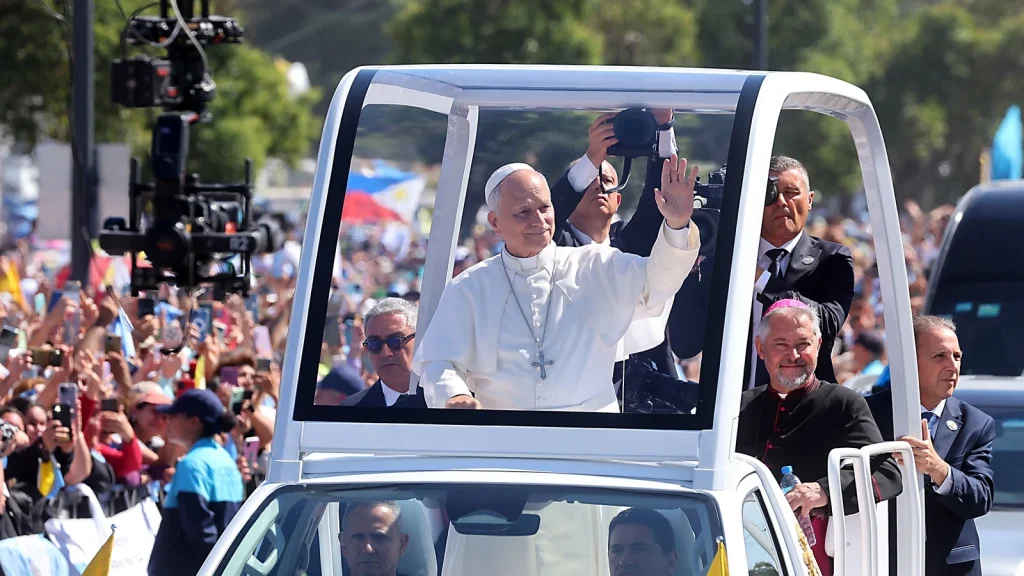
About three million people crowded the miles-long motorcade route into Lima, waving Peruvian and Vatican flags, and some pushed past security barriers in an effort to run alongside the popemobile.
Behind closed doors in Lima, the Pope met Peruvian bishops and confronted the clerical abuse scandals that have shaken the country’s Church, with particular focus on the Sodalitium Christianae Vitae (SCV).
SCV — which received pontifical approval from Pope John Paul II in 1997 — was formally suppressed and dissolved by decree in 2025, after allegations of abuse and corruption involving the group’s founder and leadership.
The pontiff listened to testimony from six survivors of abuse by clergy and SCV members.
Engagement with abuse victims part of Leo’s papacy
Since his election in May last year, Pope Leo has made direct engagement with survivors of clerical abuse a defining element of his papacy.
He has held meetings with the global coalition Ending Clergy Abuse (ECA), met survivors from Belgium, survivors in Lourdes, and saw survivors in Buenos Aires only days before arriving in Peru.
In February, the first abuse survivor to have a private, one-on-one meeting with the Pontiff was David Ryan, who featured in RTÉ’s Blackrock Boys documentary.
Yet as recently as this week, other victims have argued that such encounters still leave hundreds excluded — people who say they continue to seek answers, justice and accountability from the Catholic Church.
The Pope’s decades as a missionary, along with his Peruvian citizenship, helped fuel the scale of the welcome he received this week.
The Latin American journey is his sixth foreign trip and his first since travelling to France in September — the first papal visit there in 18 years. The France visit, seen as an early gauge of his appeal in a staunchly secular Western country, drew crowds that exceeded expectations.
About 300,000 people lined Paris streets to see him, 80,000 young people filled the Stade de France, and as many as 800,000 gathered at the Place de la Concorde for an outdoor Mass — triple the turnout for Pope Benedict’s 2008 visit.
Speaking at UNESCO headquarters in Paris, the pontiff warned that unrestrained artificial intelligence could build a “paradise of machines” and drew praise for denouncing nationalism and war.
While he has maintained Pope Francis’s emphasis on migrants, the poor and the environment, he has also elevated other concerns — notably the rapid advance of AI. His first encyclical, Magnifica humanitas, urged global ethical guardrails to ensure technology protects human dignity rather than displacing it.
When the Chicago-born cardinal appeared on the balcony of St Peter’s in May 2025, observers wondered how the first North American pope would be received.
He has shown he can deliver his message without translators or intermediaries — including when his remarks challenge the White House and US President Donald Trump.
Pope Leo has denounced mass deportations, criticised US intervention in Venezuela, and strongly opposed the war in Iran, prompting Mr Trump to label him on social media as “weak on crime” and “terrible on foreign policy”.
His pontificate is still young, but the trajectory has been hard to miss: vast crowds in France, lung surgery, and a major Latin American tour within six weeks — punctuated by the occasional jab at the US administration.