Students Enter Parliament Following Serbia’s Historic Election Outcome
 Caalamka
Serbia’s political landscape shifted again on Monday as lawmakers returned to parliament for the first time since last month’s election delivered a historic defeat to former president Aleksandar Vučić’s right-wing party, ending its 14-year grip on power.
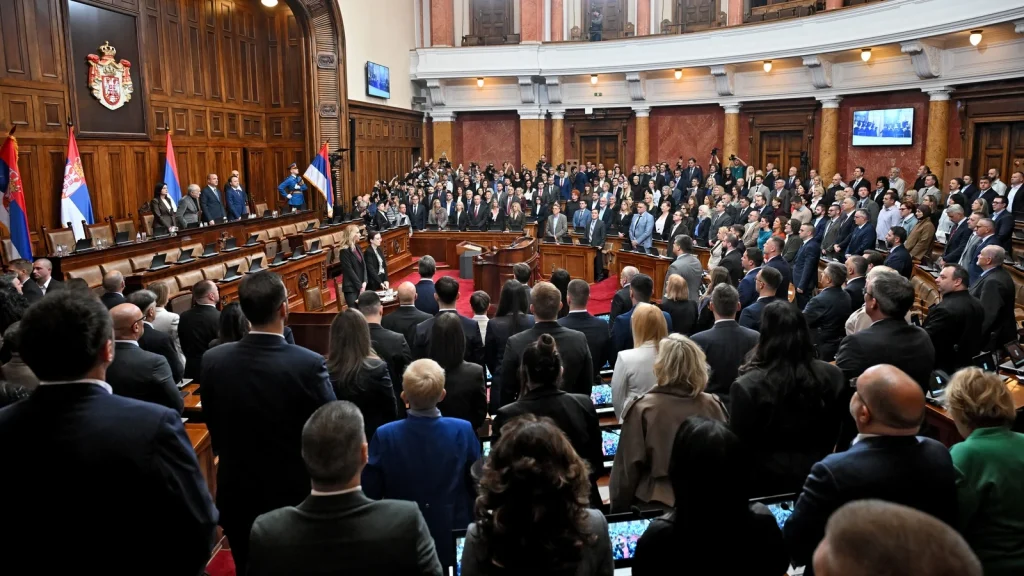
Representatives of the student-backed movement were sworn in as the new parliament convened, following a landslide victory that capped nearly two years of unrest.
Those demonstrations erupted after the 2024 collapse of a railway station canopy in Novi Sad that killed 16 people.
The tragedy, widely blamed on corruption, fuelled Serbia’s largest protests since the fall of president Slobodan Milošević in 2000 and helped propel the student movement to victory on an anti-graft agenda.
At the inaugural session, the movement’s 140 candidates formally took their seats, a milestone that confirms its parliamentary majority and starts the process of forming a new government.
Outside the parliament building, hundreds of supporters gathered to greet the incoming MPs, chanting protest slogans and breaking into applause.
Some in the crowd held banners wishing the new lawmakers luck, while the arrival of candidates from Mr Vučić’s Serbian Progressive Party (SNS) prompted jeers and boos.
One SNS member had yogurt poured on her head by a woman in the crowd as she walked up the steps to the entrance.
Supporters of the student-led movement outside parliament
The Students’ List won 140 seats in the 250-member parliament—enough to govern without partners—while Mr Vučić’s coalition secured 103 seats. Minority parties claimed the remaining seven.
Many of the student-backed MPs are entering national politics for the first time, coming from academic and arts circles rather than established party structures.
“We are preparing very seriously for everything ahead, studying the laws, parliamentary procedures and MPs’ duties,” prominent Student List candidate Mirjana Nikolic said earlier this month.
The scale of the win set off days of loud celebrations in cities across Serbia, underscoring the depth of the political change ushered in at the ballot box.
With parliament now constituted, the new majority has 90 days to nominate a prime minister, present its programme and assemble a government.
The student movement has promised sweeping reforms, including improvements to healthcare, increased investment in education and a pledge to double the defence budget.
It will also face delicate decisions on foreign policy—balancing Serbia’s historically close ties with Russia against its long-stated ambition to join the European Union—and will need to navigate relations with Kosovo, its former province, whose 2008 declaration of independence Serbia does not recognise.
One of the MPs signs the oath of office
The parliamentary session also sets in motion changes at the top of the state: the election of a new parliamentary speaker will mean a new acting president, since the speaker has filled that role after Mr Vučić ended his second presidential term early in September to run for prime minister.
Under the timetable, a snap presidential election must be called by 27 November and held by 27 December.
Both the student movement and Mr Vučić’s SNS are expected to nominate candidates, though the former president himself cannot run again because the constitution limits presidents to two terms.
Instead, Mr Vučić has entered parliament in a new capacity, taking his seat as opposition leader.