Churches to glow red in protest of global Christian persecution
 Caalamka
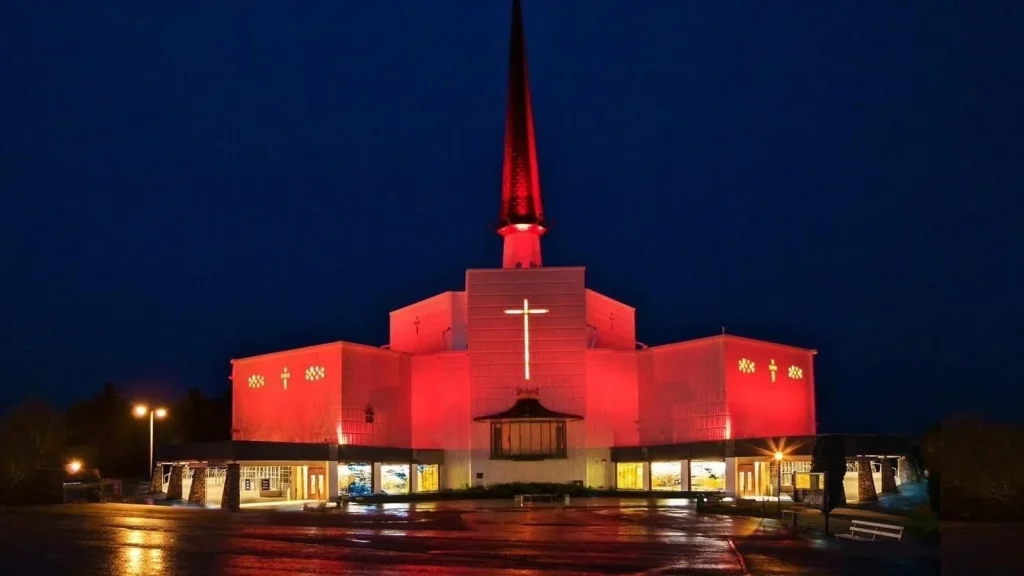
Landmarks across the country will glow red this evening, a striking visual protest meant to jolt attention back to a crisis that campaigners say is deepening: the persecution of Christians worldwide.
More than 413 million Christians live in countries where serious violations of religious freedom take place, while about 220m Christians globally are directly exposed to persecution.
Aid to the Church in Need (ACN) says the trend is being driven by a mix of extremist violence, authoritarian rule and the rise of religious nationalism.
In its latest assessment, the pontifical foundation reports that the situation for Christians deteriorated in more than half of the 18 countries it reviewed.
The study spans August 2024 to June 2026 and focuses on places where violations of religious freedom affecting Christians are viewed as particularly alarming.
Rather than a uniform national picture, the report found that in many cases pressure and violence have escalated in specific regions within countries.
Displacement is highlighted as a central worry. ACN says Christians are caught up in broader waves of people forced from their homes by conflict in Africa and Asia, with some of that upheaval tied to religious motives.
In Nigeria, millions of Christians are among those internally displaced, and sustained extremist violence across parts of sub-Saharan Africa has raised fears that large-scale flight could permanently alter the religious make-up of some areas.
Fr Peter Ewaoche Johnson experienced friends and school peers being kidnapped and killed
One of those watching events in Nigeria closely is Fr Peter Ewaoche Johnson, a Nigerian Catholic priest now serving as a curate in the Archdiocese of Dublin across the Clonskeagh, Kilmacud, and Mount Merrion parishes.
Fr Johnson, who is originally from the Diocese of Otukpo, has previously worked in seminary formation and in advocacy focused on religious persecution and violence in Nigeria.
He said that when tensions first surfaced decades ago, the impact seemed limited, but as the country moved into the 1980’s the violence intensified and government policies gradually shifted.
He recalled periods when he came close to losing his life, and spoke of friends and former schoolmates who were kidnapped and killed. He also said students he taught during his time in seminary later died.
“It’s really blown up now with terrorists now getting involved in the whole thing. So there are so many places in Nigeria that are no longer safe now, with Islamic terrorists, ISIS, then the homegrown Boko Haram, which he says means ‘no to education’.
“It’s just completely out of hand. Many churches have been burned down and destroyed. I have witnessed mass burials. Even the state where I come from, we have to cater for thousands of people who have been displaced, people who hardly have any future now at all.”
He said the scale of suffering feels “overwhelming” and described what he has seen and heard as “awful”.
Fr Johnson arrived in Ireland in 2017 to study at Maynooth. He was later asked to stay for a period as a priest in the Dublin Archdiocese, though he said he still sees his future as returning home once his mission in Ireland is complete.
“I hear what’s going on and it breaks my heart. But yet I am happy to be here because I have a mission here too. I am happy to be ministering to Christians here, and as an individual, I’m safe, at least.
“I’m not afraid that any terrorists will come after me in the night or anything. But even at that, it’s not safety, because your heart is also out there (Nigeria) and it’s your brothers and sisters facing this.”
The European Union has faced criticism over how it addresses Christian persecution, although it has taken recent steps to strengthen its response
ACN’s report places Nigeria within a wider pattern across Africa and Asia, where it says Christians are among those leaving areas where their communities have existed for centuries.
In northern Mozambique, the foundation says an Islamist insurgency has torn through communities in Cabo Delgado since 2017.
It estimates around 1,000 Christians have been killed, with attacks including beheadings, kidnappings and the burning and destruction of churches and homes.
According to the report, Islamist groups control or operate across large parts of Burkina Faso and Mali. It says some Christian communities have been compelled to follow Islamic dress and social rules, while others have faced killings and been driven out.
Elsewhere, ACN notes, the pressure is exerted through different means. In Iran, the report says arrests of Christians almost doubled over a 12-month period.
In Nicaragua, it points to a confrontation between the government and the Catholic Church that resulted in the arrest and exile of clerics, limits on ordinations and the seizure of Church institutions.
The study also flags the growing pull of religious nationalism, particularly in parts of Asia, as another factor tightening conditions for Christian minorities.
The European Union has come under criticism for how it responds to persecution of Christians, though the bloc has recently moved to bolster its approach.
Former EU Commissioner Mairead McGuinness has been appointed as the EU Special Envoy for the Promotion of Freedom of Religion or Belief (FoRB) outside the European Union.
Her appointment followed a year-long vacancy, and ACN notes that, unlike some earlier envoys, she brings direct institutional experience of working with faith communities.
While serving as First Vice-President of the European Parliament from 2017 to 2020, McGuinness oversaw the Parliament’s formal dialogue with churches, religious associations, and humanist groups under Article 17 of the EU treaties.
She will officially this morning’s ACN report in Dublin.