Xi and Putin urge freer trade ahead of Trump summit meeting
 Caalamka
With the world’s biggest powers converging in southern China, President Xi Jinping used a major regional summit to denounce trade protectionism as Russian President Vladimir Putin railed against Western sanctions — all hours before a closely watched trilateral meeting that will include US President Donald Trump.
Xi and Putin addressed the Asia-Pacific Economic Cooperation gathering in Shenzhen, China’s tech powerhouse, as anticipation built for Trump’s arrival from the Philippines, where he had met key regional allies.
Trump touched down in China ahead of a meeting in Shenzhen tomorrow that will also include Putin. Xi personally welcomed the US leader at Bao’an International Airport airport.
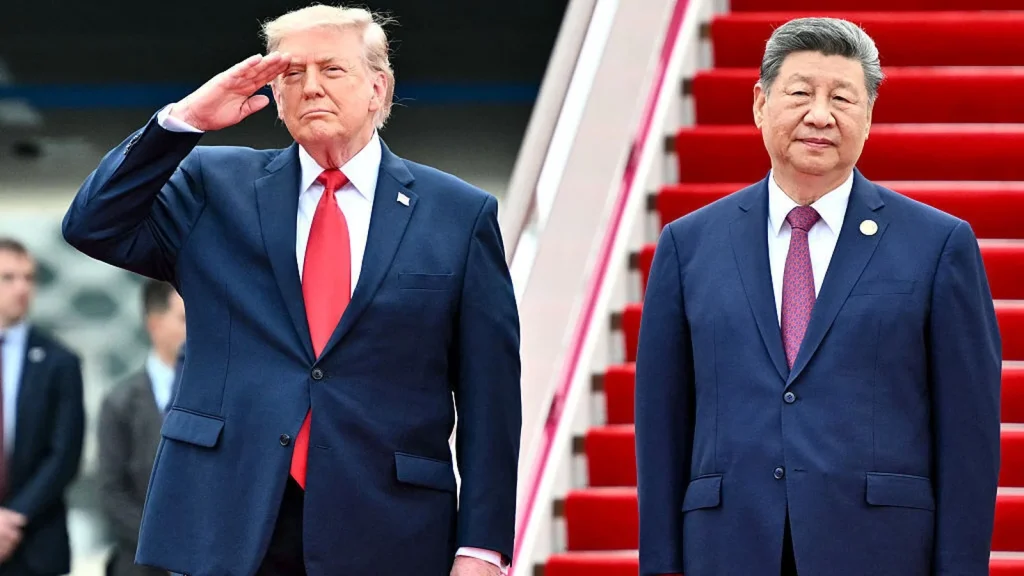
After stepping off Air Force One, Trump saluted while standing beside Xi on a red carpet flanked by greeters waving colourful pom-poms and holding Chinese and American national flags, before the two leaders clasped hands.
“China is a country of etiquette and has a tradition of reciprocating courtesy,” Xi was quoted as saying by state news agency Xinhua.
Xi said he was eager for talks on China-US ties, Asia-Pacific cooperation and broader global issues.
Trump, according to Xinhua, said every meeting with Xi has been “very pleasant,”.
Mr Trump was welcomed by cheerleaders at Bao’an International Airport
The three leaders are expected to meet on the sidelines of APEC tomorrow, with the agenda potentially spanning Russia’s war with Ukraine and the US war in Iran, along with other flashpoints including trade, AI and nuclear weapons.
The looming encounter has prompted comparisons to the 1945 Yalta Conference, when the United States, Britain and the Soviet Union helped shape the post-World War Two order — a historical reference often invoked to warn of great-power bargains that smaller nations must live with.
That parallel has unsettled officials in smaller economies, particularly across Europe and Asia, who worry the interests of lesser powers could be sidelined by the world’s strongest militaries.
In his opening remarks, Xi pressed the case for what he called “free and open trade,” casting China as a steady global partner as the United States — its chief economic competitor — has raised tariffs and pursued a more forceful foreign policy under Trump.
“We must firmly uphold the rules-based multilateral trading system with the World Trade Organization at its core, support free and open trade and investment, maintain the stability and smooth operation of global industrial and supply chains,” Xi told business executives.
High-stakes meeting
Russia’s President Vladimir Putin (L) and Chinese President Xi Jinping will meet US President Donald Trump tomorrow
Putin took the stage after Ukraine destroyed the vital Kerch road bridge linking Crimea to Russia, dealing a major blow to his four-year-old war, and he followed Xi with a speech that labelled Western countries “former hegemons.”
He said Europe was in a “humiliating decline” and argued that sanctions imposed after his invasion of Ukraine had rebounded, strengthening Russia instead of weakening it.
“Experience has shown that the traditional tools of economic dominance and de facto coercion have largely run their course, having lost much of their intimidating power,” Putin said.
“While sanctions, tariffs, and export restrictions may still exert a certain deterrent effect, they are incapable of halting growth – let alone crushing the economies of competitors.”
Later, during a bilateral meeting, Xi and Putin exchanged praise for what they called a partnership operating “steadily and positively on the international stage” and said they would take additional steps to advance a “multipolar world.”
The Kremlin has brushed off the Yalta analogy as “games of political scientists,” but said the trilateral meeting will significantly influence global affairs. Beijing, for its part, said the three-way talks will promote world peace.
Yesterday, Taiwan and Japan reported incursions by Russian aircraft into their airspace.
Putin described the international environment as “turbulent,” while insisting that disputes can be managed by leaders “sitting at the table.”
“I therefore expect big potential benefit from the upcoming trilateral meeting between the leaders of Russia, China and the United States,” he said.
Washington announces fresh restrictions on advanced chip sales
Xi Jinping called for greater international cooperation on AI and free trade
Xi’s message on trade followed a US announcement of tighter limits on China’s access to advanced AI chips, including those made by Nvidia — a move that could put additional strain on an already fragile trade truce. China has said it will retaliate.
Western trading partners have long criticised China for annual trade surpluses exceeding $1 trillion, accusing Beijing of policies that bolster manufacturing while limiting consumer-driven growth.
Beijing argues its approach fits an economy still catching up with the world’s richest nations. But Washington, Brussels and other capitals warn that China’s supply chain dominance can translate into geopolitical leverage and say the policies threaten their industries and jobs.
Trump’s Asia trip is his first since his Republican Party lost midterm elections, and tensions have been compounded by allegations involving Nvidia founder Jensen Huang and a suspected Chinese spy.
Even so, many analysts expect the two sides to avoid dramatic shocks, with Trump and Xi set to follow their Shenzhen talks tomorrow with their fourth meeting of the year at the Group of 20 in Miami in December.
Meeting with North Korean leader?
Before arriving in China, Trump remained in the Philippines, where he met leaders of the Quad — Australia, Japan and India.
He pledged to expand defence cooperation with the Philippines and said he was considering one-on-one discussions with Putin and possibly North Korean leader Kim Jong Un at his next stop in Shenzhen.
Trump said Kim “would like” to meet in China, hours after Beijing said it had no information about a possible encounter.
US Secretary of State Marco Rubio did not confirm a meeting with Kim.
“If we have a problem with North Korea, the only way we’re ever going to solve it is if we engage with them,” Rubio said in Manila.
Trump’s Quad session on the sidelines of the 11-member Association of Southeast Asian Nations (ASEAN) summit marked the grouping’s first such meeting since his January 2025 return to power.
The alliance is widely viewed as a counterweight to China’s growing influence in the region.
Trump’s stop in the Philippines also triggered street demonstrations of about 2,000 people carrying signs that read “Trump out now” and “Reject Pax Silica” — a reference to a US supply chain initiative focused on artificial intelligence and critical minerals. The programme has prompted protests linked to a planned technology hub that critics say could affect water resources and displace Indigenous families.
Protests have been made in the Philippines over ‘Pax Silica’
At a gala dinner last night, Trump praised President Bongbong Marcos’s parents as “great,” despite their exile in disgrace after the 1986 overthrow of Ferdinand Marcos Sr’s dictatorship.
“I knew your parents very well, and they were great,” he told a dinner of ASEAN leaders hosted by Marcos. “You have very good genetics, I can tell you that.”
The United States’ relationship with the Philippines is long and complicated. The Southeast Asian nation is a former US colonial possession, and the continuing presence of US troops remains politically sensitive.
Still, under Marcos, US military access to Philippine bases has broadly expanded, joint patrols in the South China Sea have increased, and thousands of troops from both countries take part in large annual exercises.
The treaty allies also face overlapping security pressures in the Pacific — from Manila’s recurring clashes with China in the contested South China Sea to the persistent risk of conflict over Taiwan, the Philippines’ northern neighbour.
Tariffs, chips and rare earths
As ASEAN leaders wrestled with multiple regional challenges, Trump’s ongoing tariff blitz hung over discussions.
Chinese Premier Li Qiang earlier criticised what he called a “countercurrent of unilateralism and protectionism” while promoting Beijing’s growing trade ties with the bloc.
Brazilian President Luiz Inacio Lula da Silva and Canada’s Mark Carney struck a similar note on trade, each explicitly pointing to the need to reduce reliance on the US market.
But Trump signalled no retreat in his economic fight with Beijing, saying the United States would catch China in rare earths production “within 10 months”.
Hours before Trump arrived in Manila, Washington unveiled new rules governing transfers of advanced AI chips — a step that could also unsettle ASEAN members.
Companies shipping high-end chips to Singapore, Malaysia, Thailand and Indonesia will now need a special licence, with the countries described as posing a “higher-than-normal risk of diversion”.
Singapore said it is exploring options to provide “trusted access” for firms based in the city-state.