How Tuvalu Is Adjusting to Rising Seas Threatening Its Future
 Caalamka
With global leaders gathered at the COP31 climate conference in Turkey this week, Tuvalu is using the spotlight to deliver a blunt message: without collective action, the Pacific nation’s very survival is at stake.
Tuvalu — a country of nine coral islands roughly halfway between Australia and Hawaii — sits on the front line of climate change. Its highest point is just 4.5 metres above sea level.
For the nation’s 11,000 inhabitants, the future is increasingly uncertain, and the fear is not abstract.
Scientists predict that by 2050, much of Tuvalu could fall below today’s high tide mark.
In a sign of growing international attention, Ireland and Tuvalu will co-host an international conference next July focused on transitioning away from fossil fuels.
Reporter Una Kelly travelled to Tuvalu to hear from people confronting the rising ocean and the upheaval it brings.
Gitty Yee remembers a childhood when the shoreline felt like it belonged to everyone, at any hour. Today, she says, the afternoon heat can be punishing — and the coast itself no longer seems fixed.
The 27-year-old climate activist says parts of the country she grew up with have already vanished.
“I feel devastated, because I feel like if I lose my land, I lose my identity. I lose everything that portrays who I am, who I am as a Tuvaluan. And I am no Tuvaluan if I have no land, if I have no country.”
‘I am no Tuvaluan if I have no land, if I have no country,’ says Gitty Yee
Asked what it means to be Tuvaluan, people return to the same themes: respect, community, peacefulness.
One man points to the word alofa — love — describing it as the foundation of a culture built around sharing with one another.
Life, many say, is meant to slow down so people can come together.
Puaseiese Adrienne Pedro, a former Tuvalu journalist, often spends her evenings in the blue lagoon, swimming with family.
“In other countries of the world, time is important, time is your boss,” she says. “Here in Tuvalu, you are your own boss. Everything is relaxed.”
Yet the climate crisis is pressing in, intruding on the rhythm of island life.
Puaseiese Adrienne Pedro is concerned some heritage could be lost in an uncertain future
A view of the blue lagoon
In some areas, the sea is edging closer to homes and schools. During king tides, seawater and rocks push into houses. More powerful cyclones tear down trees and can delay container ships that bring essential food and medicine.
One young woman recalls a grim episode from 2015, when Cyclone Pam swept away graveyards and exposed human remains on the outer island of Nui.
Even the natural patterns that sustained earlier generations are faltering: droughts are happening more often, shrinking drinking-water supplies, while saltwater seeping into the ground makes it harder for native crops to survive.
Kalisi Sogivalu points to the pit where he tries to grow pulaka — a key source of carbohydrates and central to Tuvalu’s food traditions.
“Our way of planting now is being disrupted by the water level,” he says.
“The water table is increasing every year. It’s destroying our crops, and strong winds are destroying our trees like breadfruit, bananas and pawpaw trees.”
Fresh fish cooked on leaves at the roadside
People still fish in the lagoon, but supplies are limited, and more families now depend on imported foods — a reliance made harder as global prices rise.
Store shelves are packed with tins and packets of processed goods. In refrigerated cases, a small number of apples and cabbages sit, looking tired after long journeys.
Mr Sogivalu says the country’s diet has shifted dramatically since he was a boy — and not for the better.
“They’re not fresh, because how many containers have they been transported in, from there to here? And then it arrives to us in four months.
“We’re having a lot of problems with diabetes and obesity. That’s the problem when you’re eating a lot of sugary food.”
In Tuvalu, more than a quarter of the population has diabetes, and more than half of adults are obese.
Facing threats that touch everything from food to housing, some Tuvaluans now ask how their culture can endure as pressures mount.
Each island within Tuvalu has its own customs and dialects.
In traditional meeting halls — open to the breeze on all sides — people perform fatele, lining up in outfits made from local plants and moving with measured grace to the music. Drummers pound rhythms on tin and wooden boxes, accelerating as voices rise and fall in celebration.
Dancers seen performing fatele
Ms Pedro, who has moved from journalism into a role as media adviser to the prime minister, says the prospect of cultural loss feels deeply personal.
“To me, as a mother and a grandmother, it is very personal to me, I mean losing our culture. Because culture gives young people a sense of identity and grounding in a rapidly changing world.”
“Even if our young people study overseas or build lives abroad, we want to still know our songs and our language and customs and that they know their roots as well.”
Like Ireland, Tuvalu has long been shaped by migration. Economic pressures have driven people overseas for generations, and climate change is now adding to those forces.
Violeti Auega, a 36-year-old mother of four from the outer island of Nukulaelae, says she has watched her community shrink in her lifetime.
She says the population there has fallen from 400 to around 200.
Many have moved to Funafuti, Tuvalu’s capital, while others have gone to Australia and New Zealand.
Ms Auega says she does not plan to leave, wanting to remain close to extended family, but she hopes her children will have a “better future away from Tuvalu.”
“I do hope that my children will find an opportunity to move and live somewhere else, away from all this, if worse comes to the worst. But if Tuvalu is still livable, my hope is my children will still stay and support and develop Tuvalu.”
New routes for migration are emerging.
In 2023, Tuvalu and Australia signed the Falepili Union Treaty. Under the agreement, 280 Tuvaluans a year can receive an Australian residential visa, with the same rights to employment, healthcare, housing and education as Australian citizens.
In return, Tuvalu must consult Australia on any defence and security arrangements it enters into with other countries.
International coverage widely described the deal as a first-of-its-kind ‘climate refugee visa’.
But many Tuvaluans bristle at that framing, saying it paints them as helpless victims escaping a doomed homeland and turns their country into a warning label for the rest of the world.
‘Climate refugee is not really a narrative that we like. We’re not refugees,’, says Suilelei Fuitau
Suilelei Fuitau, 27, plans to apply in an upcoming visa ballot, but says her main goal is securing better educational opportunities for her young daughter — not fleeing climate impacts.
“Climate refugee is not really a narrative that we like. We’re not refugees,” she says.
“This was a treaty between my country with a friendly neighbour. So falepili means being a good neighbour. So, we’re not refugees, we’re just there [in Australia] as neighbours and helping each other.”
Ms Yee, who also works in communications for Oxfam Aotearoa, says Tuvalu is not waiting passively for disaster.
“We are fighting the climate crisis; we are fighting something we did not cause in the first place.”
Tuvalu accounts for less than 0.01% of global carbon emissions.
At a climate justice dialogue organised by the Tuvalu Climate Action Network, teenagers on stage repeat a phrase that has become a rallying cry: “We’re not drowning, we’re fighting.”
Alongside grassroots climate justice organisations, they talk about how to carry Tuvaluan voices — and Tuvaluan solutions — onto the international platform.
Blind woman Mine Pili has Irish ancestry
During the event, I speak with Mine Pili.
She traces her Irish ancestry to Jack O’Brien, an Irishman who arrived in Tuvalu around the 1850s — part of why O’Brien remains a common surname in the country.
Ms Pili, who is blind, sits on the board of the Fusi Alofa Association, representing people with disabilities in Tuvalu.
She says she wants disability perspectives included in decision-making at COP-style gatherings.
“It’s a way of looking through new lenses, not just through climate change as an environment issue, but a human issue and justice issue.”
Filiga Taukiei Nelu, speaking for the Tuvalu Women for Change Association, stresses that women’s voices must be central as policies are shaped. She says the climate crisis increases the care burden carried by women.
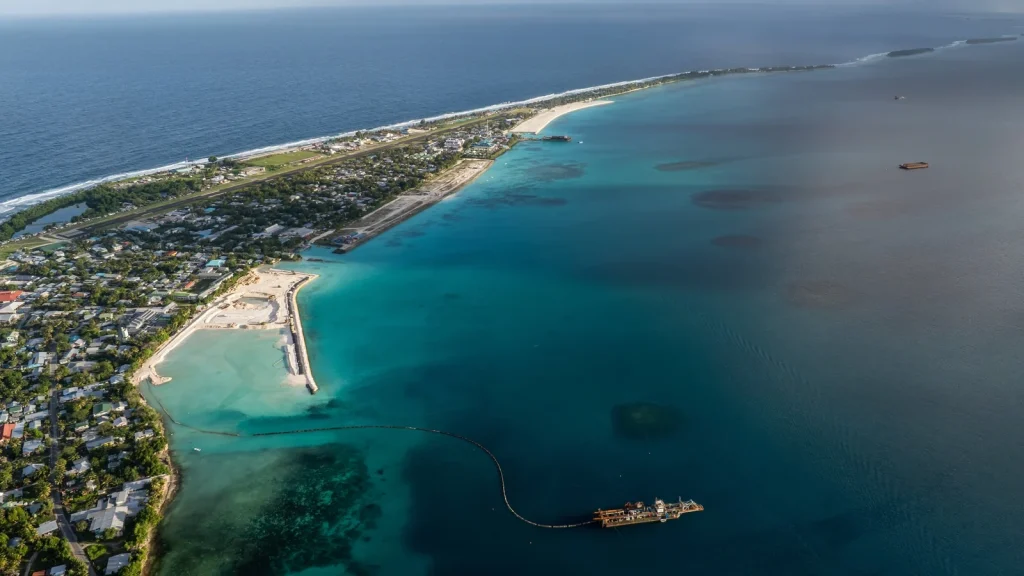
At the same time, Tuvalu’s government is pursuing adaptation projects — and with no hills to retreat to, it is resorting to the most literal option: creating land.
Space is scarce; the airstrip serves as a playground, rugby pitch and volleyball court. When a plane is approaching, a siren sounds and residents — and plenty of dogs — move off the runway.
Tuvalu covers 26sq/km in total. On Funafuti, the capital, buildings are packed onto a thin ribbon of land that narrows at one point to just 20 metres between shorelines.
A view of the land reclamation project in Funafuti
On the lagoon side, dredged sand is being used to build a new protected area.
The Tuvalu Coastal Adaptation Project — funded mostly by the UN’s Green Climate Fund — is designed to create 3.6sq/km of elevated land beyond the reach of storm surges.
A second initiative, called Digital Nation, aims to build an online replica of the islands and assemble a digital archive of language, music and cultural objects.
When Tuvalu announced in 2022 that it was effectively creating a virtual version of the nation, the plan drew significant media attention.
Petaia Meauma Moeaga, the project manager for Digital Nation Tuvalu, says the government intended to deliver a clear signal.
“We are trying to wake up the world, particularly the developed nations.”
Some residents worry the project could be read as surrendering to eventual submersion, but Mr Moeaga rejects that interpretation.
“The government’s main aim is to protect Tuvalu not to sink. But given that aim, we are at the same time, parallelly creating this project to ensure that our cultural values, our cultural projects, our cultural principles are intactly preserved, so that when the worst comes to the worst, Digital Nation has already secured our culture.”
The effort highlights a growing dilemma for small island states: as physical ground becomes precarious, so does the question of how sovereignty itself is protected.
Under current international law, a sovereign state is required to have both a defined territory and a permanent population. If scientific projections are borne out, Tuvalu could no longer be assured of meeting that standard.
Read more:
Listen: Tuvalu and the fight against rising seas
Tuvalu has already moved to address that uncertainty by rewriting its own rules. The constitution has been amended to state that Tuvalu’s maritime zones and statehood are permanent, regardless of what climate change does to the physical territory.
New Zealand and Australia have formally recognised that position, though it does not guarantee worldwide acceptance of Tuvalu’s continuing statehood. The idea of sovereignty and nationhood without physical territory remains unresolved in international law.
Every day at 6.45pm, Tuvalu’s streets fall silent. Traffic stops and people pause for a national devotional period that lasts until 7pm. Families gather indoors, hymns drift through the evening air, and crickets provide a steady chorus.
We need your consent to load this rte-player contentWe use rte-player to manage extra content that can set cookies on your device and collect data about your activity. Please review their details and accept them to load the content.Manage Preferences
Luuni Tinilau, a community elder, says people must be urged to persevere. “No matter how high the sea may come up, our faith in God is unshakeable.”
That combination of resilience and close-knit values, residents say, is what keeps Tuvalu moving forward as it tries to navigate what comes next.
Falepili — the Tuvaluan idea of being a good neighbour — is the principle Ms Yee wants the wider world to embrace, she says, and to see the country as more than a single story about rising seas.
“Tuvalu is more than a sinking island. It’s a country of people with dreams, people with hopes, people with passion,” she tells me.
“Climate change is happening, but people here are coming up with solutions to tackle impacts of a crisis that we never created and caused in the first place. That’s why it’s important that everyone stands with us, because we cannot do this alone. We need collective action.”
This project was supported with a grant from the Simon Cumbers Media Fund