ICJ ruling against Myanmar praised as major milestone for Rohingya rights
 Caalamka
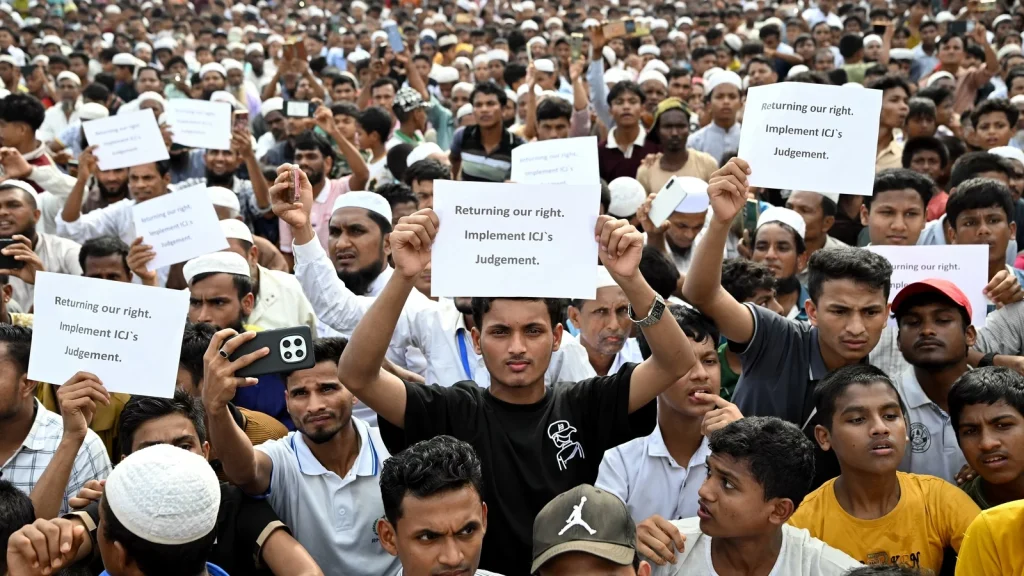
A landmark decision at the International Court of Justice finding that Myanmar committed genocide against the Rohingya has been hailed as a turning point by members of the community, including one man who rebuilt his life in Ireland after fleeing what he describes as decades of persecution.
The court yesterday set out evidence of atrocities carried out against the mostly Muslim Rohingya during a 2017 crackdown in western Rakhine state.
Myanmar’s security forces killed thousands of Rohingya civilians, carried out “widespread sexual violence” against women and used “extreme violence” against children, the court’s president, Judge Yuji Iwasawa, said.
Hichael Rashid, who left Myanmar — formerly known as Burma — 21 years ago and now lives in Carlow, said the ruling marked a historic moment.
Speaking on RTÉ’s Morning Ireland, he called the decision a “milestone” for the Rohingya people and “a long overdue recognition of the collective struggle that we have been seeking for”.
Mr Rashid stressed that the persecution did not begin in 2017. He said “life in Burma has been a living hell because we have been stripped of citizenship by [the] 1982 citizenship law, even though my parents and grandparents were citizens of Burma.”
He said the impact went far beyond legal status, touching every part of daily life.
He added: “And then we have been stripped of everything, basic human rights, freedom of education, healthcare, freedom of moment, access to livelihood and all the things.”
Mr Rashid said discrimination shaped his own future, including being barred from university in 2004 because of his ethnic and religious background.
“When we talk about genocide, it is not made in 2017, but it has [been] in the making for 64 years.”
Read More:
Myanmar committed genocide against Rohingya, ICJ finds
Rohingya crisis remains unresolved as ICJ rules on Myanmar
He said the ICJ’s decision “gives a new breath of life” to the Rohingya community.
Asked whether he could ever return to Myanmar, Mr Rashid said the current regime made that impossible.
“The situation on the ground is completely changed from military control to the militant group, which has similar motives, tactics and goals – that is to depopulate and remove the Rohingya community entirely from the ground.
“And also there is also normalisation of relationship with a former military general who turned into a president by himself. So, it is very difficult,” he said.
Also speaking on the programme, the Director of Myanmar Accountability Project described the ICJ decision as “epoch-making”.
Chris Gunness, whose project works with survivors to assemble criminal cases against members of Myanmar’s military, said significant hurdles remain. But he said the central importance of the ruling is that Rohingya rights have now been affirmed at “the highest level of world justice”.
For Rohingya people, Mr Gunness said, the verdict “demanded the full restitution of their property rights, compensation for their homes that were burnt down and subsequently bulldozed on an industrial scale”.
He added: “The ICJ says that the remains of their loved ones must be found and afforded burial rights in accordance with their cultural practices.
“The courts have said to the one million plus Rohingya living in the disgracefully squalid camps in Bangladesh – and those who fled as boat people across southeast Asia – that they can return to their ancestral homes in dignity and safety.”
Myanmar had always denied genocide, arguing that its actions targeted a military uprising from insurgents after a series of attacks left a dozen security personnel dead.
Responding to the ruling at a press conference in the capital Naypyidaw, a presidential spokeswoman said the decision was unjust.
“Despite efforts from our side, when we look at the result, not all 15 judges agreed with the decision,” she said, pointing to the 9-6 vote.
“So this was not a unanimous decision,” she added. “I would say it is not fair.”
The ICJ ruling rejected Myanmar’s claim that the campaign amounted to counter-insurgency.
“There is no evidence before the court that, in the conduct of the clearance operations, Myanmar distinguished between civilians and alleged (Rohingya) fighters,” the judgment said.
Malaysia to resettle 10,000 Rohingya refugees in Turkey
Malaysia said it will resettle 10,000 Rohingya refugees in Turkey through a structured skills training programme.
The plan would be one of the biggest resettlement initiatives involving the Rohingya and is part of the government’s efforts to address the Rohingya refugee situation in Malaysia in a more” coordinated, effective and humane manner”, Deputy Prime Minister Ahmad Zahid said in a statement.
He said the initiative with Turkey could serve as a model for how countries can work together to manage refugee resettlement.
Malaysia has come under pressure to send Rohingya refugees back to Myanmar amid rising tensions with local communities.
According to UNHCR, Malaysia had about 193,000 registered refugees from Myanmar at the end of February, around two-thirds of them Rohingya.
Malaysia has sent more than 10,000 Myanmar nationals back to their country since January
Additional reporting AFP, Reuters