EU–UK Summit: Straightforward Messages Amid Intricate Political Maneuvering
 Caalamka
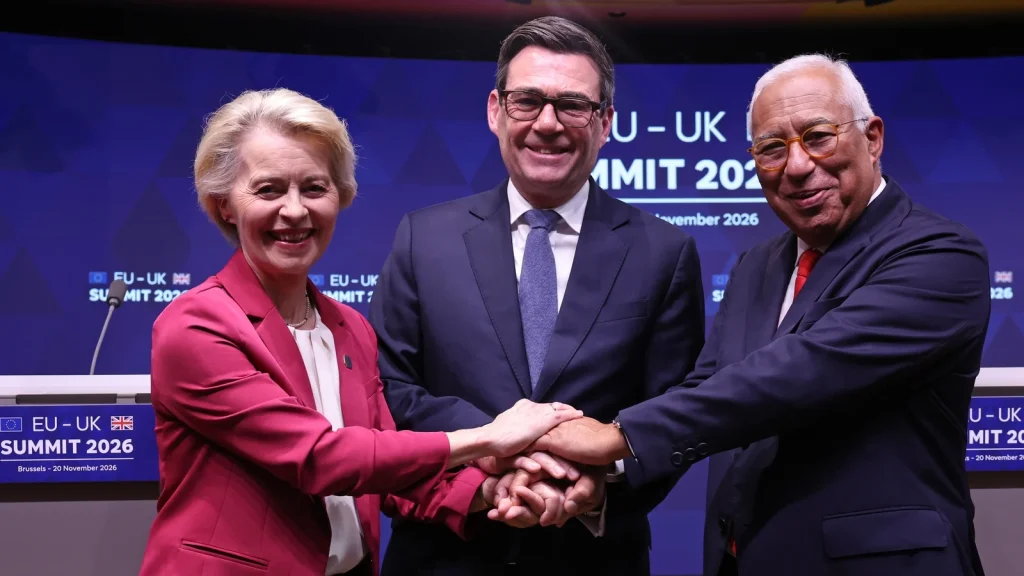
In a crowded, stifling room and with cameras waiting, Andy Burnham set out to sell Britain on a new chapter with Europe — one built, he argued, on cheaper bills, stronger growth and better prospects for a generation that has spent much of the past decade watching opportunities narrow.
Across the table, EU leaders matched the sweeping tone. They talked up joint efforts on new technology — from fresh AI ventures to protecting citizens from malware and malicious actors — and they dangled the prospect of a more comfortable EU-UK relationship that delivers visible gains for ordinary people, not just manufacturers and purveyors of chilled convenience foods.
And who knows, some day they might even rejoin the EU.
Even if they don’t, Council President António Costa assured the British their decisions will be respected, just like the referendum outcome was respected.
Lots of smiles and warm words.
Keep the communication short and simple.
Yet even as both sides leaned into optimism, Brussels managed to reintroduce the kind of complication that has so often haunted EU-UK dealings — leaving, as one might put it, an unpleasant smell hanging in the air.
A simmering argument over university fees threatened — without firm political intervention by heads of government in the weeks ahead — to sour relations just as the mood was improving.
António Costa told the UK prime minister ‘you are always welcome in the European Union’
The post-summit scene was cramped and overheated, the hall filled beyond capacity and dominated by British journalists in town for the day.
Senior cabinet ministers and European Commissioners packed the front row, too.
The substantive negotiating was done, the agreements signed. Now came the selling.
“Prime minister, you are always welcome in the European Union,” Mr Costa told Mr Burnham, prompting nervous laughter from the front of the room.
The moment captured the communications task ahead: persuading people in Britain that turning the page with the EU is worthwhile, while signalling to Europeans that the UK might merit something closer to a second chance.
Mr Burnham arrived with his pitch rehearsed, casting technical steps — on animal health checks and emissions trading — in plain political terms.
He said: “It directly addresses the biggest challenges of our times and the biggest worries that people have: the cost of food, the cost of energy, the lack of growth in the economy and the cost of doing business.
“The levels of illegal immigration and the challenges facing our young people.”
Those are expansive promises for an agreement that ends sanitary and phytosanitary checks at Larne and Belfast Port.
But Mr Burnham’s political strength has long been his ability to focus attention on the big picture rather than the knotty detail.
In his telling, it is less about regulations than about a shift in political mood — a decade on from the referendum — and what that means for governing Britain.
Mr Burnham said the agreement will bring costs down
Mr Burnham argued that public patience has run out with the current arrangements.
He said: “People can see the status quo isn’t working.
“It’s not good enough for Britain.
“Three quarters of people say that they favour closer ties with Europe, according to the most recent polls, and that is because we’ve had a decade of drift, too much division, low growth in the economy and higher prices in the shops.
“They want a better deal than the hard Brexit we ended up with and today together we have delivered that better deal.
“As I say, that will be good for people in Britain and good for people in Europe.”
The prime minister said the agreement “will bring costs for business down”.
He added: “It will bring the cost of food down and it opens up the possibility of lower electricity costs.
“And we look forward to exploring that opportunity with you as we go forward from today.
“The Chancellor of the Exchequer is here today and he has confirmed today that the UK Treasury has said that the deal struck here will add up to 0.5% to UK GDP.
“That is a £17 billion boost to the British economy.
“It is the single biggest growth measure that we could take in this Parliament.”
That assertion — the claim of the biggest growth-boosting step available to the Burnham government before the next election — may prove to be the defining line.
Taoiseach Micheál Martin welcomed the deals
For Mr Costa, geopolitics provided the clearest explanation for why the relationship has begun to thaw.
He said Russia’s aggression and the war in Ukraine had pushed the UK and the EU closer again after the turbulent Brexit years, and that a shared approach on defence and security offered the most logical foundation for rebuilding ties.
“A strong partnership between the European Union and the United Kingdom is a strategic investment in Europe’s security, but it is also an investment in our shared prosperity, in innovation, competitiveness and resilience because there can be no strong defence without a stronger economy, and together, we will be stronger on defence and stronger on the economy,” he said.
In Dublin, the Taoiseach Micheál Martin welcomed both the agreements and the improved EU-UK relations that made them possible.
“I particularly welcome the SPS agreement,” said Mr Martin.
Read more: What the EU-UK deal on food means for Ireland
He noted that the UK “remains by far the most important market for agri-food exports for Ireland,” adding that the deal, once it takes effect, will help agri-food businesses by cutting administrative burdens and costs.
“Today’s summit also represents a positive moment for Northern Ireland’s citizens and businesses, and the broader all-island economy,” he said.
Mr Martin said he welcomed that “the joint statement reaffirms the EU and UK’s commitment to the unique circumstances on the island of Ireland”.
He also looked beyond the immediate announcements, saying “we now have a clear roadmap for the EU and the UK to further enhance our relationship”.
Though it has no practical impact in Ireland, Mr Martin also backed the youth mobility scheme, which will provide 100,000 visas each for Britain and the EU, allowing under-31s to travel, live, work or study in each jurisdiction.
That sits alongside the Erasmus Plus education exchange programme, which Britain had already agreed to rejoin.
For Mr Burnham, the youth measures offered a ready-made message for audiences back home — including UK Labour Party backroom staff.
“For young people out there who are wondering how this deal today affects them and their lives, I would say this deal is for you,” said Mr Burnham.
“This deal really is about lifting your life chances and I think we’re all conscious that the last decade has been hard for many people, but hardest most of all for the young people of Britain and the young people of the EU,” he added.
Britain’s youth as a demographic is in play for the next election
Mr Burnham tied the agreement to a recent report on reshaping Britain’s social welfare system in an effort to draw the so-called NEETs — around a million young Britons not in employment, education or training — back towards work and training.
“That generation can feel finally that people in our positions are directly doing something to recognise that they need more help and that they need more opportunity in their lives,” he said.
The politics is obvious. Britain’s youth, as a voting bloc, is very much in play as the next election approaches.
Could Reform UK attract a large share of disaffected young voters? Could the Conservatives benefit as an opposition force with their own programme under a dynamic new leader?
Or could Labour seize the lion’s share, particularly in former heartlands, by presenting itself as the party prepared to act for under-30s?
Ten years on from the referendum, many younger Britons feel Brexit narrowed their horizons.
At the same time, the housing crisis and the lack of decent-paying industrial jobs — or graduate entry roles — have left a growing slice of the electorate searching for a political home.
Meanwhile, the older cohort that drove the referendum result a decade ago — the over-65s then — is shrinking as demographics shift.
That matters when judging where British opinion may go next on closer EU ties.
The electorate is changing along with the wider world.
Mr Burnham is betting that Labour will win the argument and the votes in a still disgruntled Britain
Now comes the tougher test: the bruising arena of British domestic politics.
The UK prime minister is wagering that shifting attitudes — sharpened by a decade that, in his view, failed to deliver what Brexit advocates promised — can help rescue the Labour Party.
By positioning Labour as openly pro-Europe, if not explicitly pro-EU, he is betting that the party can carry both the argument and the votes in a still disgruntled Britain.
He faces attacks from the Conservatives, from Reform UK and from within his own ranks, where a substantial bloc of MPs — perhaps around 100 — believe the strategy is misguided.
Privately, the cabinet is divided too, at least for now.
It is another high-stakes roll of the dice — and, as the Makerfield escapade demonstrated, Mr Burnham is comfortable placing large wagers.
This time, his advantage is that while many voters still crave major change, the opposition parties are increasingly defending the status quo.
So, advantage Mr Burnham.
But the momentum was nearly derailed by the university fees flare-up late on Thursday night into Friday morning.
University fees
It had all the hallmarks of a classic Brussels episode — a bureaucracy nearly turning victory into defeat through an instinct for self-sabotage.
Three agreements — with much of the groundwork laid months earlier ahead of a July summit that was delayed to accommodate the change of leader in London — suddenly appeared to be held hostage by a dispute over what British universities charge EU citizens.
The night before the summit, the EU dug in at a meeting of permanent representatives, demanding equal treatment on fees for EU and British students.
In Britain, plenty of commentators quickly trained their fire on what they portrayed as the self-interest of highly paid Eurocrats, some of whom studied in the UK and now have children seeking places — or already enrolled — at elite British universities.
Those families, critics argued, would be first in line to gain from fee equalisation.
Most Europeans, they added, know little and care less about UK university fees, while food and electricity prices — and the risk of losing jobs — are immediate concerns.
So why not, they asked, deliver a straightforward good-news message now and save the bruising negotiations for later?
Focus on results, not procedure — especially at a highly political EU-UK summit.
As the Americans put it, there are two things people should never have to watch being made: laws and sausages.
At times the EU’s transparency works against it (I once accompanied an EU commissioner on a visit to a sausage-making factory in Poland, so I know a little bit about such things).
In Brussels, process can too easily eclipse outcomes — a familiar frustration for politicians in member state capitals who must sell agreements back home, door-to-door.
Perhaps the British criticism is fair — or perhaps, as so often in Brussels, there is a more complicated story beneath the surface.
As ever, the back story involves competing interests and objectives.
Here, the real struggle may concern Britain’s ambition to get into the “Made in Europe” scheme — an unapologetically protectionist tool aimed at preventing European manufacturing from suffering the fate of US industry.
That is, being overwhelmed by China in what some describe as “China Shock 2.0”.
When the major powers of trade — China, the US and the EU — start to jostle, smaller players have to watch their footing carefully.
Even the British bulldog will be stomped if it stands in the wrong place.
For Britain, the argument goes, the safest ground is under the shelter of ‘Made in Europe’ — with key industrial products treated as European-made, even if not formally EU-made.
The terms are still being negotiated. This week, the British may have resisted some heavy pressure, particularly over tariffs on Chinese-made electric vehicles — tariffs the EU imposes, but Britain does not.
That, in turn, may have prompted Brussels to push back by linking implementation of the three agreements to a settlement on university fees.
The EU said it will try to reach such a deal within the next six months, which would allow the food export agreement to be implemented by 1 March 2028.
But if both sides entrench, what looks like a minor issue — tied to a complex protectionist move that will require delicate diplomacy with China and the US if it is to succeed — could still damage EU-UK relations.
And it could do so at precisely the moment Britain’s argument over its post-Brexit course is heating up ahead of a general election.
Sometimes, it really is best to keep it simple.