Tanker Hit in Strait as Bahrain Blames Iran for Facility Strike
 Caalamka
Bahrain says an Iranian strike hit a civilian industrial site and sparked a fire, in an escalation that also saw two tankers come under attack in the Strait of Hormuz.
The Gulf kingdom has faced several attacks this week, breaking a weeks long lull in hostilities that erupted after US-Israeli strikes on Iran in late February.
“As a result of the heinous Iranian aggression, a civilian industrial facility was targeted, causing a fire at the site,” Bahrain’s interior ministry said on X, without naming the location.
“Civil Defence is working to bring the fire under control,” it added.
Residents told AFP they watched smoke billow over Sitra Island off Bahrain’s east coast, an area dotted with industrial facilities including a refinery operated by state oil company Bapco.
Iran’s Revolutionary Guards offered a different account, saying that “during the operation, US military positions at the Al-Riffa and Awali bases in Bahrain were targeted with missile and drone strikes”.
“Two radars belonging to the US Army’s Patriot air defense systems … were struck,” it said, warning that any violation of Iranian airspace would draw a “harsh and decisive response”.
Iran’s demands include ending the war on all fronts among others
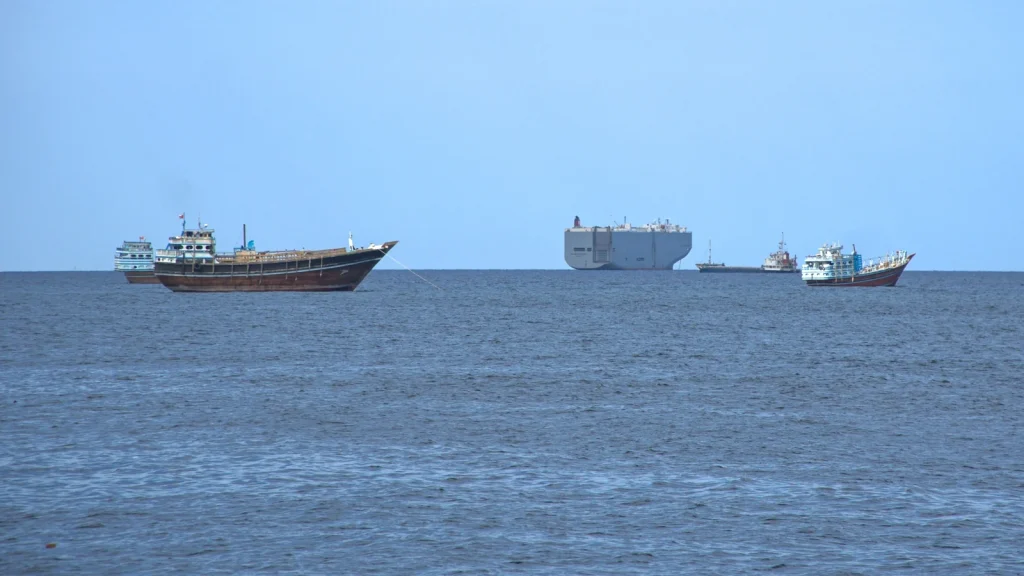
The flare-up coincided with fresh incidents in the Strait of Hormuz, where two tankers were struck as the waterway becomes the focal point of a conflict that remains deadlocked, with Iran pressing its efforts to blockade the strategic shipping line.
The US military has been escorting vessels through the narrow passage, which carried about one-fifth of the world’s oil before the war, while also maintaining what Tehran describes as a counter-blockade of Iranian ports.
Iranian deputy foreign minister Kazem Gharibabadi said yesterday that a Qatari delegation travelled to Tehran the previous evening and “held two hours of talks”, without elaborating on what was discussed.
Foreign Minister Abbas Araghchi said: “The ongoing talks in the region must be given a chance, and the blockade must be lifted rationally.”
“Our position is clear: as long as Iran’s demands are not met, the discussion on the Strait of Hormuz and its opening is pointless,” he said, according to state TV.
Iran’s demands include ending the war on all fronts, unfreezing Iranian assets, lifting oil sanctions and ending the US counter-blockade of Iranian ports.
British maritime agency UKMTO said one tanker was struck by an “unknown projectile” while transiting the Strait of Hormuz.
“There are no reported casualties at this time,” it said, adding that another tanker was hit in its engine room.
Iran’s army later said a ship caught fire after entering a “restricted zone” and striking a mine in the strait.
The vessel had turned off its identification and navigation systems “in defiance of issued warnings and maritime transit regulations”, the military said in a statement carried by state TV.
Iran has repeatedly reported ships catching fire in the strait in recent weeks, frequently asserting they hit mines.
But the US military has said it recently cleared all mines from the main routes through the waterway.
‘Economic asphyxiation’
US Central Command, which directs US military operations across the region, said last month it had helped Gulf states export 1.5 billion barrels of oil through the waterway since the summer.
Iran said yesterday it downed a US drone over Qeshm Island in the strait, according to state TV.
A US military official said American fighter jets struck an Iranian missile site on Qeshm last Tuesday.
Washington announced what it called an “economic asphyxiation” campaign on Iran in August, aimed at restricting its trade and financial flows.
Mr Gharibabadi said, according to Iran’s Tasnim news agency, that “we consider the economic blockade an act of war and we will take all necessary measures to lift it”.
“We have made this known to the other parties, including the mediators”, he said, adding “the United States was aware of this”.
In an interview published yesterday by the state-run Iran Daily newspaper, Mr Araghchi again said Tehran would not allow its stockpiles of enriched uranium to be removed from the country.
Iran’s nuclear programme remains a central point of friction in Iranian-American relations.
Western nations accuse Iran of pursuing a bomb, while Tehran says the programme is entirely civilian.
“I believe a solution can be found, but we have clear red lines: the material will not be taken out of the country,” Mr Araghchi said.