Next UN Chief to Face a Hotter Planet and Tougher Challenges
 Caalamka
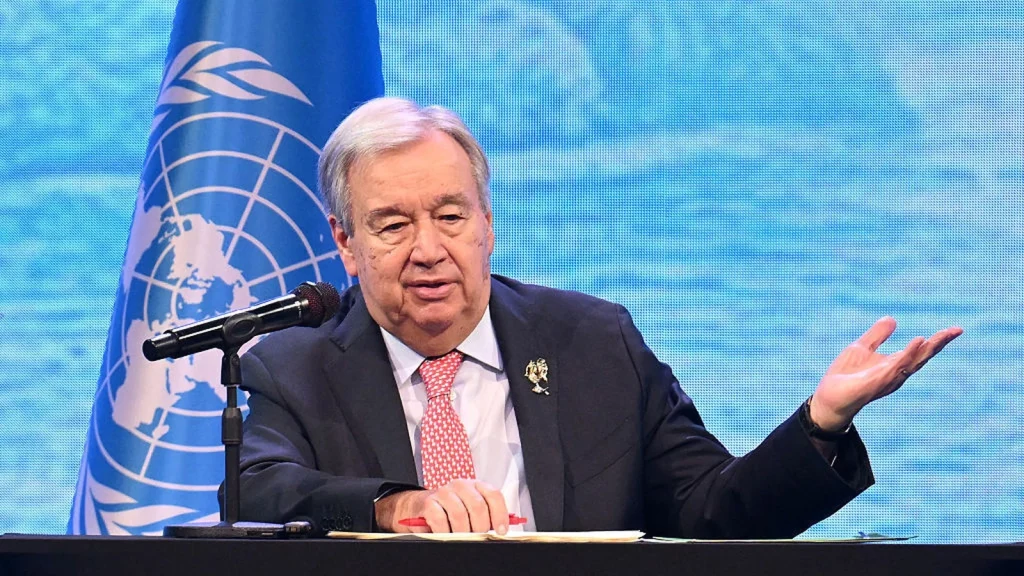
As he prepares to step down after a decade leading the United Nations, António Guterres is leaving the world stage with a blunt message: the tools to fight climate change have improved dramatically, but the political response has not kept pace.
Across his 10 years as Secretary General, he has addressed leaders at the opening of nine global climate summits.
COP31 in Antalya is his last. Looking back at his increasingly forceful speeches reveals both anger and the limits of his office.
His successor as secretary general inherits a hotter world and a harder task.
They will have better tools to tackle climate change, but less time, greater damage and the daunting challenge of bringing temperatures back down.
At COP31 in Antalya this week, Guterres put the central paradox of his tenure in stark terms: humanity is more capable than ever of confronting the climate crisis, yet governments are still moving too slowly and with too little ambition.
His final annual climate summit as secretary general offered a reckoning.
Innovation has surged and the business case for clean power has strengthened, but national decisions have not matched the scale or speed the science demands.
His successor will now inherit the consequences.
Behind the warnings is a leader who has made room for emotion, including anger.
At COP29 in Baku, speaking to small island leaders whose nations are exposed to rising seas and intensifying storms, he dropped any pretence of distance.
“You have every right to be angry, and I am too,” he said.
António Guterres demanded stronger actions on emissions at his first COP
The moment offered a glimpse of the person behind the lectern—and a reminder of the constraints of the job. He could amplify the fears of those in harm’s way, but he remained dependent on the same governments he cannot force to change course.
Mr Guterres took office on 1 January 2017, inheriting the Paris Agreement negotiated under his predecessor, Ban Ki-moon.
His task was to press governments to implement it and strengthen their commitments.
Paris did not simply settle on 2C as an acceptable destination. Countries agreed to hold warming well below that level and pursue efforts to limit it to 1.5C.
Small island states fought for the lower threshold because the difference had profound consequences for their survival.
At his first climate COP, in Bonn in 2017, Mr Guterres demanded stronger action on emissions, climate adaptation and finance.
He also insisted that prosperity need not depend on increasing pollution.
A year later in Katowice, he warned: “We are in trouble. We are in deep trouble with climate change.”
By Sharm el-Sheikh in 2022, he had found his most memorable image: “We are on a highway to climate hell with our foot still on the accelerator.”
In Dubai the following year, he demanded a timetable for phasing out fossil fuels.
António Guterres became more explicit about his identification of who and what was responsible
The shift in tone over the years was not a simple steady hardening—his language was already severe early on.
What became more explicit was his identification of who and what was responsible.
He increasingly named the drivers: fossil fuel expansion, inadequate finance, misleading corporate promises and the influence of interests that profit from delay.
The march of temperature records underpins that urgency.
In 2017, the World Meteorological Organization reported the annual global average at about 1.1C above the 1850–1900 baseline.
Its COP31 assessment puts January – September 2026 at about 1.47C above that baseline.
These are snapshots, not a precise calculation of the warming rate. Historical estimates have been revised and natural influences such as El Niño temporarily affect annual temperatures.
The full year average for 2024 was about 1.55C. That did not mean the Paris Agreement’s long-term threshold had been definitively crossed.
The agreement concerns sustained warming, not one particularly hot year. A subsequent cooler year does not mean the underlying problem has disappeared.
For Mr Guterres, the painful change was accepting that a temporary overshoot of the long term threshold could no longer realistically be avoided.
In a conversation with Arctic researchers reported by Associated Press before COP31, he recalled scientists challenging his intention to say otherwise.
He described it as “one of the most difficult days of my life”.
He also acknowledged a “sense of fury” towards those denying the danger or refusing necessary action.
The failure, he argued, was political leadership, not humanity’s capacity to respond.
At the Belém leaders’ summit last year, he had already acknowledged inevitable temporary overshoot.
His appeal became one to limit its height, duration and damage, while pursuing a return below 1.5C.
That is a more demanding proposition than governments were supposed to deliver when he arrived.
Donald Trump withdrew from Paris Climate Agreement in 2017
The difficulty of keeping countries aligned is illustrated by Donald Trump’s reversals.
When he announced withdrawal from Paris Climate Agreement in 2017, Mr Guterres office called it a “major disappointment”, while emphasising the continuing contribution of American states, cities and businesses.
The criticism targeted the decision rather than becoming a personal attack.
The United States rejoined under former president Joe Biden, before Mr Trump withdrew it again.
His administration sent no official federal delegation to COP30 or COP31, although other American participants remained involved.
Such reversals undermine confidence that international commitments will survive the next election.
Throughout, Mr Guterres has balanced indignation with caution: denouncing injustice while still needing those same governments at the table.
He cannot order a parliament to finance a flood barrier or a government to stop approving oilfields.
That left his summit speeches in an uneasy territory—morally urgent, politically exposed, and reliant on decisions made far from UN podiums.
It would nevertheless be wrong to describe Mr Guterres’ decade as a lost cause on the climate front.
The International Renewable Energy Agency reports that more than 90% of utility scale renewable projects commissioned in 2025 produced electricity more cheaply than the lowest cost new fossil-fuel alternative in their market.
That does not automatically mean cheaper household bills.
Grids, storage, finance and reliability must still be paid for. Industrial transitions involve jobs and difficult infrastructure choices.
The Global Carbon Project projects a small fall in fossil-fuel CO2 emissions this year, but not a confirmed lasting turning point, including land-use change, total human-caused CO2 emissions are projected to increase.
Governments agreed at COP28 to transition away from fossil fuels in energy systems.
But a sentence in a COP climate agreement does not equate to a completed power line, a closed coal plant or a financed transition for its workers.
This week’s UN assessment finds 136 countries reporting some multi-hazard warning capability
Alongside the calls for stronger national pledges, Mr Guterres also pushed practical programmes. Early Warnings for All aims to protect everyone from hazardous weather by the end of 2027.
This week’s UN assessment finds 136 countries reporting some multi-hazard warning capability, although major gaps remain.
Of course, those gains belong to scientists, communities and governments, not to one man. His contribution was to establish a shared goal and press institutions to deliver it.
Nearly 200 governments bring different responsibilities, resources and fears to negotiations.
Agreement is hard.
But countries do not need unanimous international permission to strengthen domestic policies. The difficulty of consensus does not absolve national leaders of responsibility.
The question for the next UN secretary general is how are they going to prevent global warming reaching 2C?
The latest Indicators of Global Climate Change assessment estimates human-induced warming at 1.37C in 2025, increasing at about 0.27C per decade.
A simple continuation would reach approximately 2C in the late 2040s.
That is an illustration, not a prediction of a particular crossing date.
Emissions, policy choices and the climate’s response matter. An individual year could exceed 2C before the long-term average does.
Nevertheless, the timescale is sobering. The IPCC’s intermediate and higher-emissions scenarios place sustained 2C warming around mid-century.
It is not merely a danger reserved for 2100.
Reducing temperatures after an overshoot would generally require sustained net-negative CO2 emissions
UNEP’s latest assessment projects approximately 2.8C this century under current policies, compared with about 2.6C if national climate action pledges are fully delivered and comparable efforts continue.
These are conditional projections, not unavoidable destinations.
Mr Guterres’s successor may not hold office when sustained warming reaches 2C. But decisions during that person’s tenure could help determine whether it happens and how high temperatures subsequently climb.
And stopping the rise is not the same as reversing it.
Reducing temperatures after an overshoot would generally require sustained net-negative CO2 emissions.
That means removing more carbon dioxide than human activities release. Deep emissions cuts must come first, or continuing pollution overwhelms removals.
Nor would lower temperatures undo every loss. Extinct species do not return. Sea levels can keep rising for centuries. Damage accumulated during a temperature overshoot cannot simply be cancelled when temperatures decline.
Mr Guterres leaves neither a completed success nor proof that cooperation is futile.
His speeches document the distance between what governments know, what they promise and what they deliver.
At COP31 in Antalya, he promised to remain an advocate for climate action: “I will not stop telling the truth.”
His successor will have better tools, but a harder truth to tell.
The task is no longer only to prevent a more dangerous world.
It is also to limit damage already being set in motion, without pretending that all of it can be repaired.