Smoke over Tai Po: Hong Kong’s Shock and a City Searching for Answers
There are scenes that lodge under your skin: the metallic scent of spent smoke, bouquets of lilies bending under the weight of condolence notes, and the endless columns of emergency tape that slice through a neighborhood once known for its morning markets and children’s laughter. In Tai Po’s Wang Fuk Court, those images are now the city’s newest, most painful memory.
Last week’s inferno, which authorities now say has claimed at least 151 lives, has left an entire community wrestling with grief and a city grappling with questions about how a blaze could move so fast through a cluster of high-rise homes. “We cannot rule out the possibility of this number increasing further,” police spokesperson Tsang Shuk-yin told reporters, her words folded into the hush that fell over Hong Kong as families waited for news.
From Renovation to Catastrophe: The Materials at the Center of an Investigation
Investigators have converged on a troubling detail: the renovation work underway around the estate. Polystyrene panels, bamboo scaffolding and exterior netting—materials that are cheap and familiar on construction sites across the city—are now under intense scrutiny. Officials say seven out of 20 samples of the scaffolding netting failed fire-resistance tests, and questions swirl around whether a combination of combustible cladding and flammable protective sheeting helped a single spark become a raging blaze.
“That kind of material can act like tinder in a high-rise canyon,” explained Dr. Mei-Lin Chan, a fire-safety engineer who has advised local councils across Asia for two decades. “When you stack buildings so close and you have vertical surfaces covered in untested panels or netting, you create a pathway. Heat rises; flames leap. It’s a perfect storm of density and vulnerability.”
Arrests, Accountability, and the Hard Task of Naming Blame
As the city tries to understand how the tragedy unfolded, law enforcement has moved swiftly. Authorities have arrested 13 people on suspicion of manslaughter—12 men and one woman, aged between 40 and 77—while searches have been completed in five of the estate’s eight blocks. Chan Tung, director of crime and security for the Hong Kong Police Force, said the arrests are part of a broad effort to determine responsibility.
But the net of accountability has not only caught contractors and construction supervisors. Police also detained three people under sedition-related allegations after they distributed flyers demanding government accountability—an action that has sparked debate about space for dissent in a city still adjusting to a tightened security landscape. One of those detained, 24-year-old student Miles Kwan, was seen leaving a police station but declined to comment.
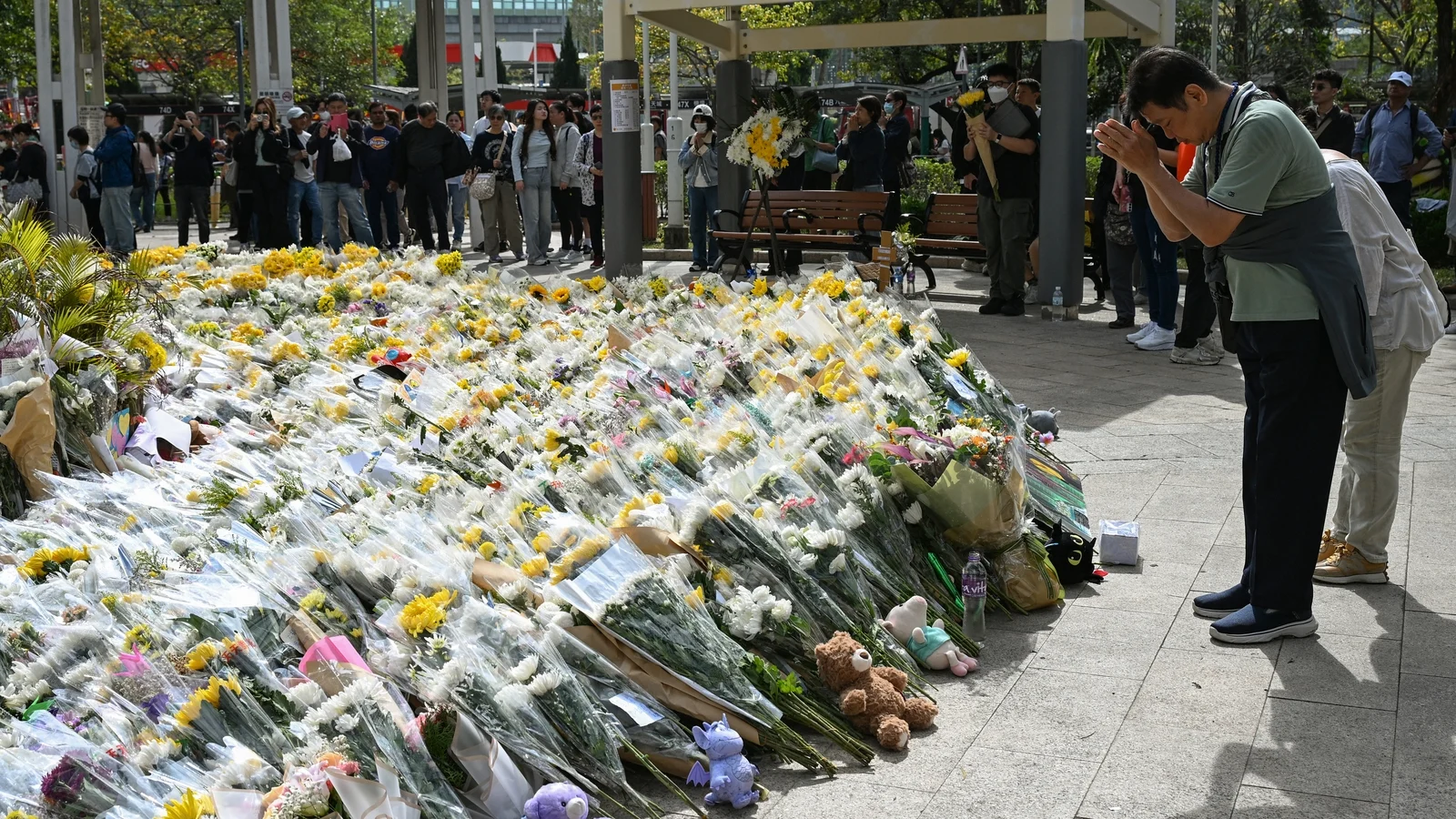
“There are two tragedies happening here,” said an older woman who refused to give her name as she laid flowers at a makeshift shrine. “The fire killed our neighbors, yes. But if people are afraid to ask why it happened, that fear kills trust too.”
What Officials Are Saying
- Police spokesman Tsang Shuk-yin confirmed the death toll of 151 and warned the number could rise.
- Chief Secretary Eric Chan announced that seven of 20 netting samples failed to meet fire-resistance standards.
- Security chief Chris Tang framed certain online comments and leaflets as threats to national security, saying authorities must act.
Scenes of Mourning and a City in Collective Grief
Thousands have visited Wang Fuk Court over a three-day mourning period. They leave flowers, teddy bears, and handwritten notes—some simply “Rest in peace,” others asking pointedly, “Who is responsible?” The notes become a ledger of grief and growing civic unease.
At a corner stall that sells tea eggs and instant noodles, shopkeeper Mrs. Leung wiped her hands on a towel and spoke of neighbors she’d known for decades. “They called me by my nickname, ‘Ah Leung’. We shared food. They watched my grandson when I worked late,” she said, voice thick. “The estate was ordinary. That’s what makes it worse. Ordinary people, suddenly gone.”
Evidence, Ashes, and the Grim Reality of the Search
Police have found human remains inside apartment units, in hallways and on staircases. Some bodies have been reduced to ashes, investigators say, which complicates identification and deepens the anguish of families waiting for closure. “We are searching methodically, but this is painstaking, emotional work,” said one investigator, who asked not to be named.
For the loved ones still hoping for good news, the waiting is a form of agony. For others, the discovery of charred remains has confirmed their worst fears. A neighbor, Mr. Ho, recalled banging on doors and yelling for people to wake up. “I pulled my wife out. We were lucky. But many weren’t,” he said, his hands clenched into fists.
Bigger Questions: Urban Density, Regulation, and the Global Context
This fire is not merely a local tragedy; it is a mirror held up to many of the world’s dense, rapidly urbanizing cities. High-rise living, cost-cutting construction practices, and aging infrastructure collide in neighborhoods from Hong Kong to Mumbai to Rio. The World Health Organization and international urban-safety groups have long warned that fire risk in dense housing compounds when regulations are weak or poorly enforced.
“You can’t separate this from global trends,” Dr. Chan said. “Population concentration in cities, the race to retrofit older buildings without adequate oversight, and the use of cheaper, less-tested materials—those are universal pressure points.”
Questions for the Reader
What should safety look like in a city where space is measured in centimeters and millions share the same skyline? How do we balance affordability and safety? And when grief meets governance, who gets to tell the story of what went wrong?
What Comes Next
Investigators say their work will continue. For families in Tai Po, that means more waiting—more DNA tests, more autopsies, more legal processes. For a broader public, it means a renewed scrutiny of building practices, municipal oversight, and the political context in which questions of accountability are asked and, sometimes, stifled.
“We will demand answers,” said a community organizer who is helping relatives navigate the aftermath. “Not out of malice, but out of duty. If we don’t know why this happened, how can we prevent the next one?”
In the days ahead, Hong Kong will grieve, investigate, and perhaps legislate. For now, the city stands with a ribbon of lamplight, bouquets, and the slow, stubborn work of piecing together what remains—both of the buildings and of the lives that were housed inside them.