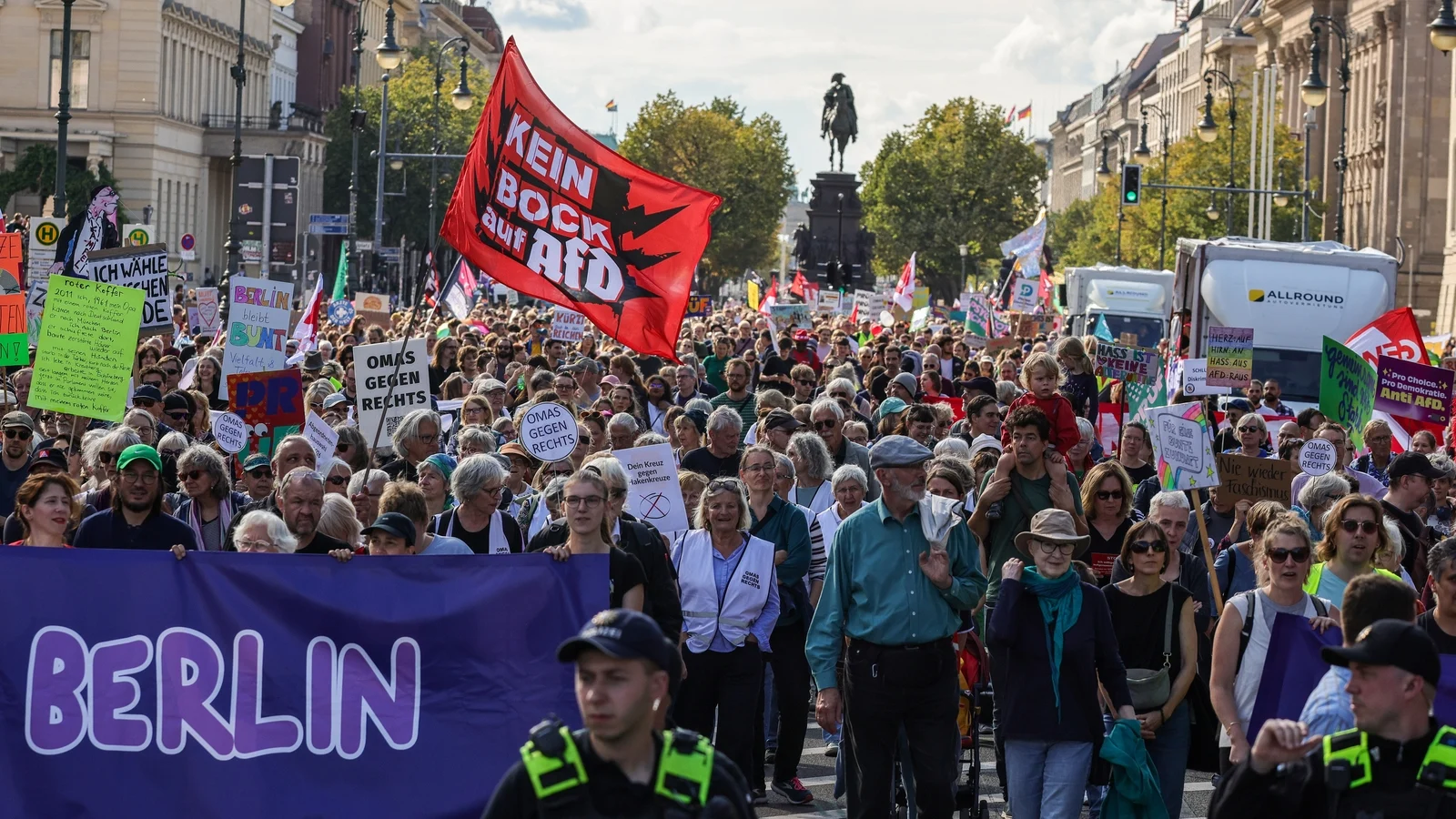
Germany’s streets filled with protest and placards this weekend as tens of thousands rallied against the far-right Alternative for Germany (AfD), days after the party delivered a sweeping result in a key state election.
The AfD finished first in the eastern region of Saxony-Anhalt and is now attempting to assemble what would be the first far-right state government in Germany since World War II.
Organisers said roughly 150,000 people joined demonstrations in about 20 cities nationwide, including Berlin, Hamburg and Munich, with many urging authorities to move toward banning the AfD.
Protestors held signs reading “Ban the AfD now,” and “Democracy needs no alternatives,” turning central squares and thoroughfares into a blunt message of resistance.
“A broad cross-section of civil society is taking to the streets to prevent the enemies of the constitution, the AfD in Saxony-Anhalt, from gaining government power,” said Christoph Bautz, head of campaign group Campact, which was also involved in organising the demonstrations.
The AfD’s momentum has alarmed many Germans who argue the country carries a particular duty to reckon with — and guard against a return to — extremist politics because of its Nazi past, intensifying calls for mainstream parties to pursue a ban.
Still, German Chancellor Friedrich Merz of the centre-right CDU has voiced scepticism about outlawing the AfD.
Campact said there were around 25,000 demonstrators in Hamburg and 12,000 in Munich
In Berlin, police said several thousand people took part in multiple protests spread across the city.
The AfD staged its own counter-demonstration in the capital, attended by Kristin Brinker, the party’s lead candidate in next weekend’s regional elections in Berlin.
The anti-immigration, Russia-friendly party secured almost 44% of the vote in last Sunday’s Saxony-Anhalt election, far ahead of the CDU on 17%.
Although the AfD came up three seats short of an absolute majority, it has begun talks with other groups and MPs as it tries to form a state government.