The man in the back of the Range Rover: a London morning, a long-delayed reckoning
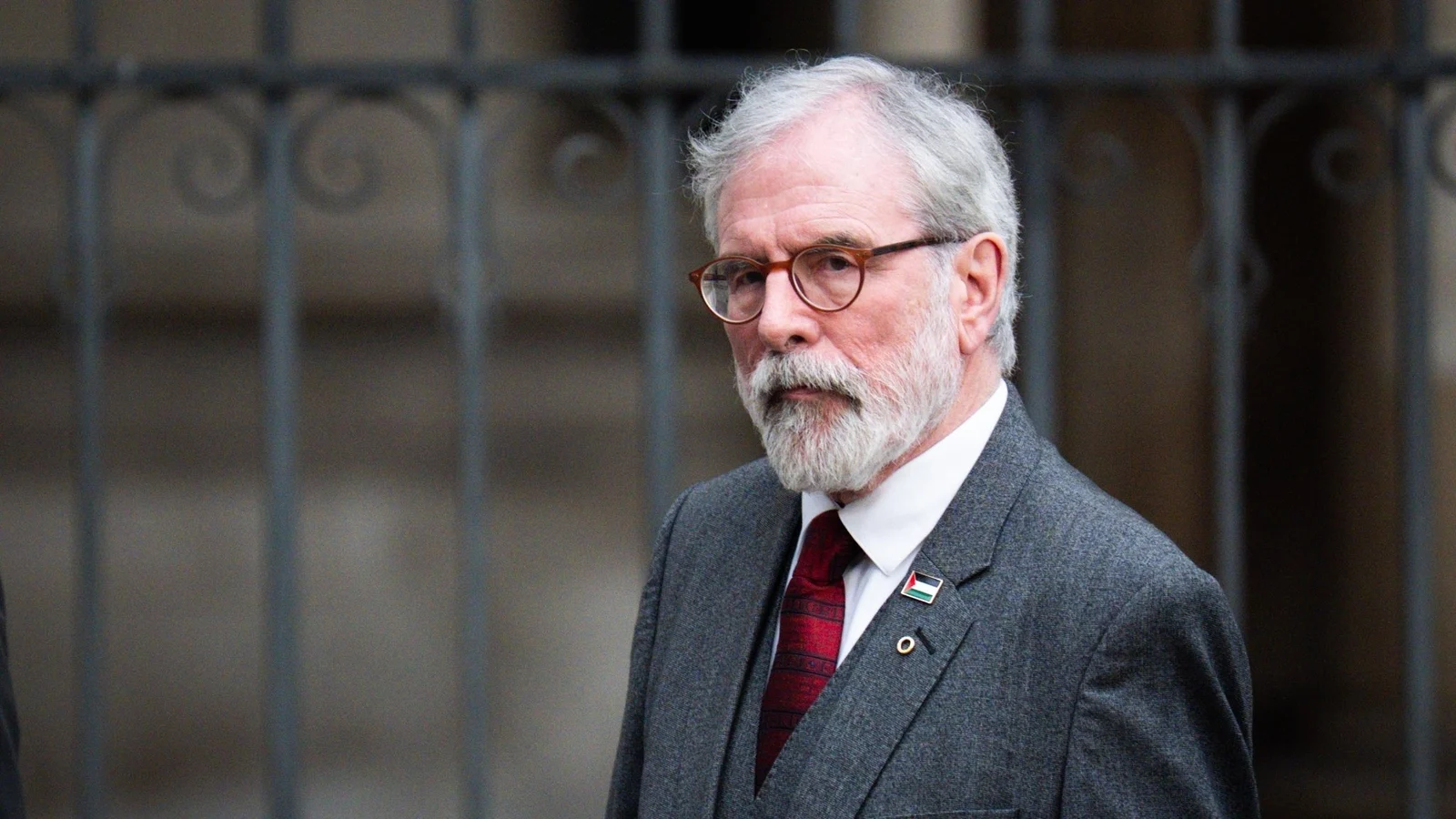
There is a ritual to mornings at the Royal Courts of Justice that feels almost cinematic: black leather seats, tinted glass, a small convoy cutting through security gates with military precision. On a wet London morning, Gerry Adams emerged from the back of a Range Rover as he has for several days — escorted, cordoned and watched — to take his place in a courtroom whose stone façade has seen every kind of human drama.
But today the scene will be quieter in one crucial way. The public will no longer only be watching him pass through the doors. For the first time in this civil lawsuit, Mr Adams — the long-time Sinn Féin leader whose name is entwined with the story of Northern Ireland’s Troubles — will speak under oath.
What this trial seeks to do
The claimants in this case are ordinary men whose lives were— they say — irreparably altered by IRA bombings in Britain. They allege that Mr Adams was “directly responsible for and complicit in” the injuries they suffered in separate attacks in London and Manchester in the 1970s and 1990s. It is personal grief transposed into the language of law: not a cry for vengeance so much as a demand for recognition and answer.
Outside court one of the claimants, who asked to remain anonymous, described the long process that brought him to this London courtroom. “You learn to live with the scars,” he said quietly. “But you never stop asking why. We want the truth. We want someone to say, ‘we know what happened’.”
He will be questioned by Max Hill KC, a former Director of Public Prosecutions now regarded as one of Britain’s leading barristers — a figure with the kind of forensic intensity that turns contested pasts into lines on a ledger. For many watching, the moment has the feel of a historical accountancy: tallying actions and responsibilities that span decades.
Allegations, denials and the fog of time
The claimants’ case rests on the assertion that Adams, accused by some witnesses of being a de facto leader and strategic architect of IRA operations, was engaged in the decision-making structures that authorised bombings in Britain. If true, the case would paint a portrait of a man whose public role in peace-building sat alongside a private role — prosecutors and claimants argue — in violence abroad.
“On the evidence put before us, it would be surprising if someone in his position did not have knowledge of, or influence over, such operations,” one legal analyst told me. “But ‘surprising’ is not the same as ‘proven’.”
Mr Adams has consistently denied membership of the IRA. His defence team has framed the case as one built on hearsay and historical conjecture, not hard proof. They argue first that the claims are time-barred. English civil procedure typically imposes a three-year limitation period for bringing claims; these allegations relate to events in 1973 and 1996, yet the litigation was issued only in 2022. “This delay is exceptional and destructive of fair trial rights,” his lawyers have told the court.
Second, the defence says the evidence simply does not reach the threshold required for a charge so grave. There are, they argue, no surviving participants in the alleged authorising meetings who have given testimony; no contemporaneous documents that tidy the narrative; no forensic traces that point to a single decision-maker. Much of what exists, they say, is built on memory and on intelligence material that has not been fully disclosed in open court.
Truth, memory and the long shadow of conflict
How do you litigate history? That is the deeper question this case asks of us.
About 3,500 people lost their lives in Northern Ireland during the Troubles — a figure that has been drilled into the public consciousness across generations. Thousands more were injured, and countless families feel the ache of unanswered questions. Bombings in Britain — from the 1970s through to the 1990s — left streets, pubs and workplaces with broken lives and broken windows. The 1996 Manchester bombing, for instance, injured more than 200 people and caused hundreds of millions of pounds of damage, a painful reminder that violence rippled beyond the island of Ireland.
But time is a peculiar arbiter of justice. Witnesses die, documents are lost or classified, memories fray. That is the essence of the defence’s argument: delay has eroded memory and documentary evidence to such an extent that the court cannot reliably adjudicate claims made decades after the facts.
“You cannot reconstruct perfectly what happened in 1973 from the wreckage of the present,” said a scholar of transitional justice. “Trials like this sit at the intersection of law and memory, and they demand that we confront how fragile our repositories of truth have become.”
The burden of proof — civil versus criminal standards
Importantly, this is a civil case, not a criminal prosecution. That matters legally: the claimants must prove their case on the “balance of probabilities,” a lower standard than the “beyond reasonable doubt” threshold used to obtain a criminal conviction. Mr Adams does not have to prove he was not a member of the IRA; the claimants bear the burden. Still, the courts are mindful of the gravity of the allegations and the risk of an enduring stain on reputation.
“Even in civil law, when allegations are of the most serious nature, courts will look for cogent and compelling evidence,” a senior barrister explained. “But cogent does not always mean contemporaneous — sometimes it means a careful aggregation of witness testimony, pattern and corroboration.”
What victory would look like — for whom?
For the men who have brought this suit, success would be more than a financial remedy. It would be a public acknowledgment that their pain was not a tragic accident of history but the consequence of identifiable decisions. For Mr Adams and his supporters, victory means resisting what they describe as a post-facto rewriting of political struggle into criminal culpability.
And for the wider public — in Ireland, Britain and beyond — the trial poses a larger question: how do societies navigate the boundary between accountability and peace? South Africa’s truth commission, Argentina’s prosecutions, and other post-conflict processes show there is no single model. Each approach involves trade-offs between revealing painful truths and preserving fragile reconciliations.
“We all want closure,” the anonymous claimant told me. “But closure isn’t the same thing as forgetting. You can lay a wound to rest without pretending it never bled.”
What to watch for
- Whether Mr Adams’ testimony alters the tenor of the case — will he offer more than denials?
- How the court treats the question of delay — will the limitation defence lead to dismissal?
- Whether previously secret intelligence will be disclosed or remain behind closed doors, shaping what the public can ever know.
As the city hums and the court’s great clock ticks on, London will hold its breath while a man whose name has shaped modern Irish politics speaks under oath. Whatever the outcome, the trial forces us to confront a persistent and universal dilemma: when history hurts, what is the path to justice? Are courts the right places to seek it, decades later? And how should societies remember the past without becoming trapped by it?
Listen to the quiet in the corridor and you can almost hear the decades that separate bombed-out streets from present-day legalese. Somewhere between memory and evidence, between apology and denial, this court will try to make a small, imperfect thing — a ruling — that attempts to answer a very big question: who pays for history?