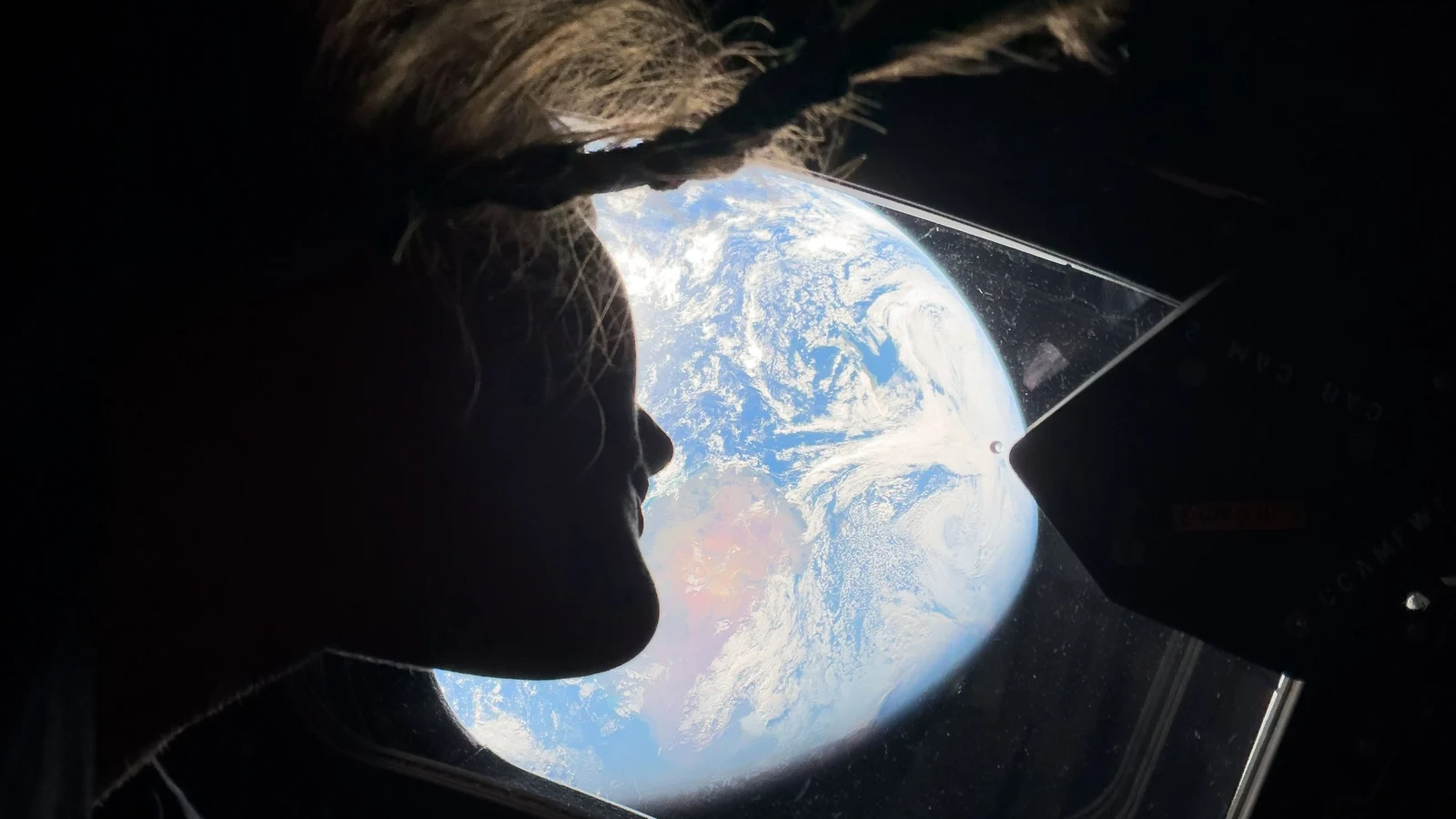
Riding a Fireball: Four Humans, One Capsule, and the Long Road Back from the Moon
There are moments in exploration when the world seems to hold its breath—when distance is not just a number but a story. This week, four astronauts aboard an Orion capsule became the most distant people in human history, looping around the far side of the Moon and beginning the long, incandescent arc back to Earth. They have a splashdown to make off the coast of Southern California, and a re-entry that will transform their tiny spacecraft into a meteor for minutes at a time.
Imagine, for a moment, sitting in a small cabin with three colleagues, 405,554 kilometres from home, watching nothing but black punctured by a perfect, pale moon. Imagine the silence that distant light brings—and then the weight of what comes next: a plunge toward an atmosphere that will heat the spacecraft to temperatures measured in the thousands as friction turns speed into sheer incandescent noise.
Who They Are — and What They Carried
The quartet inside Orion is an odd and luminous mix: a pilot who has been thinking about re-entry for years, a commander who jokes through the hard parts, a scientist with a steady hand and a smile, and a Canadian astronaut whose quiet courage grew louder as the mission unfolded. Their names—Victor Glover, Reid Wiseman, Christina Koch, and Jeremy Hansen—are now stitched into a new chapter of human exploration.
“I keep flashing back to the day we got assigned,” Glover told a conference call from orbit, his voice threaded with both levity and gravity. “Entry is the part you train for until it lives in your bones. But even with that, none of us have fully unpacked what just happened up here.”
They launched from Florida last week, the rocket’s roar falling away and leaving them under a canopy of stars. They are part of NASA’s Artemis series—a multibillion-dollar sequence of missions designed to bring humans back to the lunar surface within the decade, build sustainable infrastructure, and, if all goes to plan, point the way to Mars.
A Relic and a Relay
To the astronauts, the mission has felt less like a final destination than a handed baton. “We brought physical batons to orbit,” Koch said with a laugh during a transmission recorded for mission control. “It was kind of silly—until we realized every time we move, someone else is going to pick it up.”
This relay metaphor is apt. Artemis II is a bridge—testing systems, rehearsing rendezvous, and returning human eyes to the Moon in an era when most lunar knowledge has been inferred through orbiters and robotic landers. For a brief six-hour window, these humans became mobile observatories, describing textures, shadows, and strange pitted craters in real time to scientists listening over a quarter of a million miles away.
Record-Breaking Distance—and the Numbers That Matter
On Monday, the crew pushed farther out than any human before them, reaching approximately 405,554 km from Earth—a little over 6,400 km farther than the Apollo 13 record that stood for 56 years. Such numbers are not just trivia. At these distances, communications lag, contingencies feel different, and the thinking that shaped Apollo gives way to new engineering and new questions about how humans function in deep space.
When Orion re-enters Earth’s atmosphere, the capsule will be traveling at staggering velocity—up to 38,365 kilometres per hour. That translates to intense heating on the heatshield as kinetic energy becomes thermal energy. Every millimetre of that shield is therefore a small, literal difference between home and oblivion.
Mission Timeline—Milestones to Watch
- Launch from Cape Canaveral, Florida: last week
- Farthest distance from Earth: ~405,554 km, breaking a 56-year record
- Duration in space: nearly ten days
- Planned splashdown: off San Diego, California, around 8pm ET
- Peak re-entry speed: up to 38,365 km/h
Voices from the Capsule and the Ground
Inside Orion, laughter and tears have mingled. Wiseman described two brief video calls each crewmember made to their families—”small pockets of oxygen,” he called them—that let them feel the gravity of home while floating farther from it than anyone alive. “Hearing my kids laugh,” he said in one transmission, “felt like a tether back to Earth.”
On the other end, Mission Control in Houston has been a cathedral of concentration. Dozens of lunar scientists, engineers, and students sat in adjacent rooms, scribbling notes and debating interpretations as streams of data and audio came in. “There is a primal quality to watching human perception join remote sensing,” Dr. Elaine Mercer, a planetary geologist, said. “Robots send back pixels; people send back stories.”
And then there are the quieter, human gestures that feel like small lamp posts along a long road. As the capsule peeked near the moon’s surface, Hansen—who grew up watching Northern Lights in Saskatchewan and carries a Canadian flag in his flight suit—offered an idea: name a newly seen crater after Commander Wiseman’s late wife. “Those moments matter,” Wiseman later said, holding back his own emotion. “It’s hard to explain to someone on Earth standing in a crowd. Up there, the universe simplifies what’s important.”
Culture, Context, and the Moon’s Pull
There is a local color to every corner of this mission. In Florida, citrus groves once filled the corridor the rocket rose above; in Texas, barbecue smoke lingers in the parking lots outside mission centers where engineers trade jokes and worry. In San Diego, beachfront watch parties will gather tomorrow night to see the capsule return to sea—families with folding chairs, kids pointing telescopes at the sky, veterans with NASA patches on their jackets.
But beyond spectacle, the Moon carries symbolic freight: it is both a scientific archive and a mirror. “The Moon is a fossil of the early solar system,” Koch said before launch. “It tells us about impacts, early chemistry, and the migration of planets. It helps us understand how Earth itself came to be.” Scientists hope the samples, eyes, and instruments of Artemis missions will refine our models of solar system formation and, perhaps, unlock resources for long-duration human presence.
Why It Matters—Locally and Globally
At first blush, a splashdown off the coast of California might seem like a regional event with a lot of pomp. But the implications ripple globally. The Artemis missions are part technological testbed, part geopolitical statement, and part inquiry into what a human future off-Earth could look like. For countries watching—China, members of the European Space Agency, and emerging space nations—the mission is a signal: the Moon is again a stage where capability, cooperation, and aspiration will be displayed.
Think about the choices we make now: investment in science, in international partnerships, in training a generation that will live with long-duration spaceflight. These decisions will determine whether the Moon becomes a backyard for humanity or a chessboard for competition. Which path do we prefer?
Questions to Carry with You
As the crew prepares to re-enter—knowing the capsule will turn into a blazing streak and that the heatshield must do its job without fanfare—ask yourself: What stories do we want to carry forward? Whose voices are at the table as we sketch out a foothold on another world? And what does it mean, in this year and this decade, to see humans again leave the cradle of Earth?
Tomorrow, at around 8pm ET, the seas off San Diego will take a small, soot-streaked capsule back into the arms of humanity. For a brief moment, those four people will be very far away, then very close. In their hands they hold not just logs of data and samples, but a set of torches, lit for the next crew. How we choose to pass that light matters.