Beyond the Blue: What Artemis II’s Moonward Hush Reveals About Space, Radiation and the Human Body
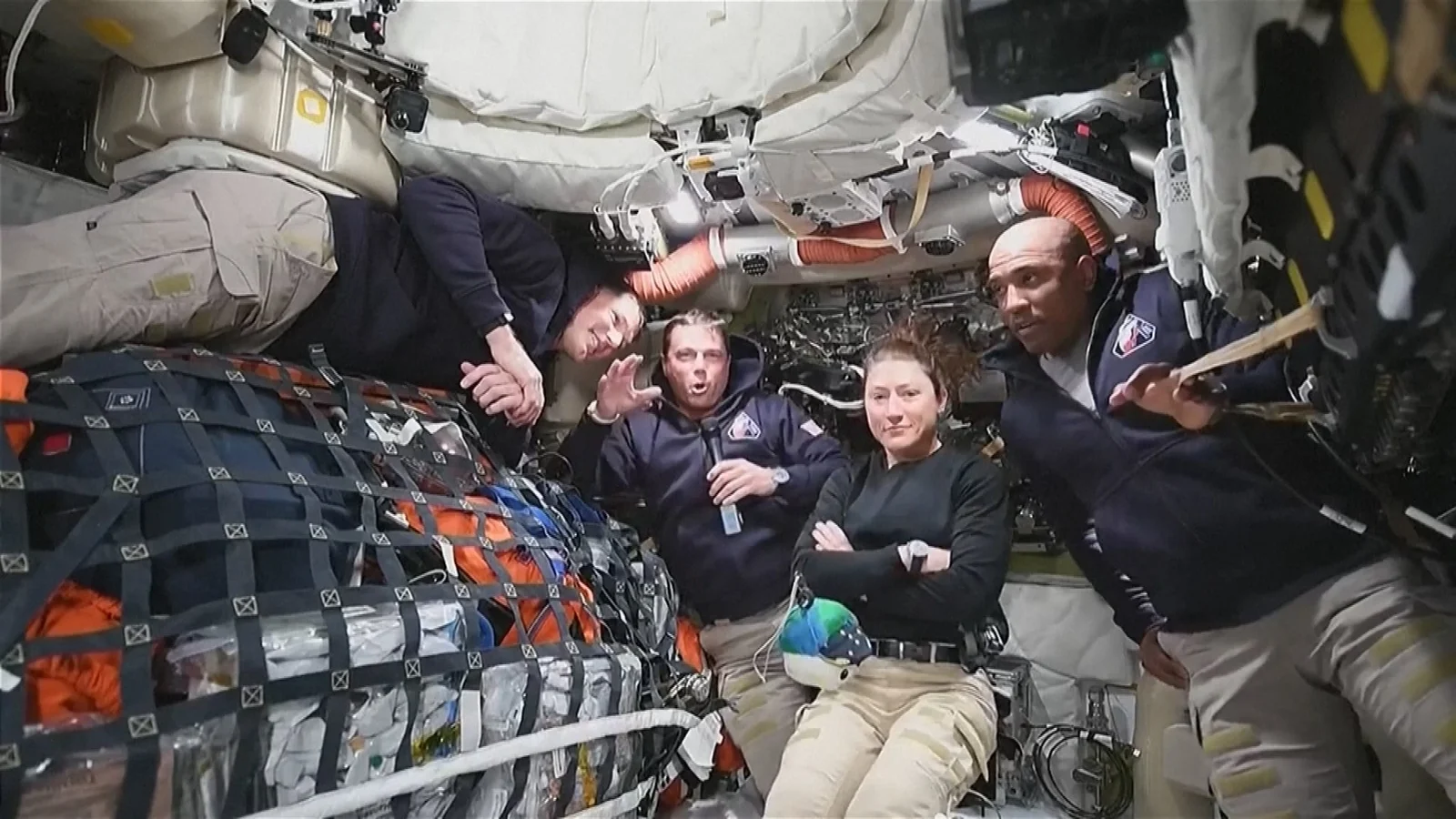
There is a peculiar kind of silence beyond low Earth orbit — not the cinematic quiet of spacewalks, but a clinical hush, the hum of equipment and a muted conversation among five human hearts: four aboard Orion and the millions of lives watching from a planet that looks impossibly small through a porthole.
On the surface, the Artemis II voyage was a triumph of engineering and imagination: four people carried farther from Earth than any human in living memory, skimming the Moon and swinging back toward home. But tucked beneath that simple story of distance is a complicated, urgent question—how does the body fare when it’s stripped of the planet’s soft, invisible armor?
From Magnetosphere to Moonlight: Leaving the Shield Behind
The International Space Station orbits some 400–420 kilometers above Earth, snug within the protective cradle of the magnetosphere. That magnetic cocoon deflects many of the charged particles that streak through space. The Artemis II crew crossed a boundary. They traveled a distance more than a thousand times that between the Earth and the ISS, where that shielding thins and vanishes.
“Once you step outside that cloak,” says Dr. Steven Platts, chief scientist with NASA’s Human Research Program, “you start seeing a different signature of radiation—particles that come from deep space, from ancient supernovae, and a very different threat profile than what we live with in low Earth orbit.”
That signature is dominated by galactic cosmic rays (GCRs), high-energy particles that penetrate tissue, damage DNA and can seed long-term health consequences. Solar particle events add bursts of intense radiation when the Sun erupts, and both are part of the puzzle that mission teams hope to decode.
Counting Particles, Counting Pulses
NASA packed Orion with instruments and protocols that read like a medical thriller. Radiation sensors mapped the flux of incoming particles in real time. Blood samples were taken from the crew before launch, and more samples awaited them on return. Saliva was sampled during the flight, and crew-worn smartwatches tracked heart rate variability and sleep—simple metrics that can give early clues to stress and physiological change.
But the agency did something stranger and more intimate with modern technology: it placed tiny living systems—organ-on-chip devices—inside the capsule. Built to mimic bone marrow, these microchips replicate one of the human tissues most vulnerable to radiation. Bone marrow spawns blood cells; damage there can ripple through immunity, oxygen transport, healing.
“We want to see not just how many particles hit the hull, but how tissue-like systems respond in a matter of days and weeks,” Platts told me. “It’s a bridge between counting events and understanding biology.”
Not Just Cancer: The Full Reach of Radiation
When most of us hear “radiation,” our thoughts snap to cancer. That’s a real, dread-worthy possibility. But the human body is complex, and radiation’s fingerprints show up in other, subtler places: the brain, blood circulation, immune response.
“Radiation isn’t only a future cancer risk,” says Dr. Maria Kovac, a neuro-radiobiologist at a leading research university. “We know that even moderate exposures can spark inflammation in the brain, disrupt neural signaling and increase vulnerability to neurodegenerative conditions over time. That’s not an immediate headline, but it matters for mission planners thinking decades ahead.”
The Artemis II mission was relatively short—about ten days—so the immediate risk window is small. Yet for future lunar habitats, for weeks- or months-long stays, and for dreams of sending humans to Mars (a journey that could take six to nine months one-way), the math changes. Exposure accumulates. So do the unknowns.
How NASA is Measuring the Unknown
Onboard and on the ground, NASA and its partners set a defensive perimeter of data. They are measuring:
- Radiation dose rates and particle types inside and outside Orion
- Blood chemistry changes pre- and post-flight
- Immune markers and stress hormones from saliva and wearable devices
- Responses of organ-on-chip models that simulate bone marrow function
“This is no longer exploration on instinct,” says Bruce Betts, chief scientist at the Planetary Society. “We have microelectronics, advanced biochips, continuous monitoring. The datasets from Artemis II will be orders of magnitude richer than Apollo’s—fifty years of technology compressed into ten or twelve days of concentrated observation.”
Inside the Capsule: The Human Cost of Compact Living
Beyond radiation, there’s another threat—one of the mind and the everyday spirit. Compare the ISS to Orion and you have a startling contrast. “It’s like going from a six-bedroom house to a camper van,” Platts says. That’s not a flippant metaphor. It’s about privacy, personal space, and the small rituals—making coffee, taking a walk around a module—that stitch together a human day.
Psychologists warn that confinement, monotony, and distance from home can erode resilience. Sleep disorders, interpersonal tensions, depressive symptoms, and cognitive fog are issues that could escalate on longer missions. The stakes feel intimate: what do you do when your teammate is also your only window to normalcy?
“We study crew dynamics the way sociologists study small communities,” says Dr. Kavita Rao, a space behavioral health specialist. “Food, humor, rituals, the way people share a cramped table—these are not trivial. They shape mission success.”
What This Means for the Future
Why does any of this matter to you, on your street, in a city far from launch pads? Because these questions reach into public health, ethics, and the economics of a new frontier.
If we decide humanity should live beyond Earth—mining, manufacturing, science, survival—how do we protect the people who go there? What are acceptable risks? Who signs that waiver? Nations and private companies are already racing to build a lunar economy; but the medical, legal and moral frameworks lag behind.
And there are spillover benefits. The same organ-on-chip technologies and continuous-monitoring approaches being refined for astronauts could revolutionize remote medicine on Earth, in rural clinics or in disaster zones. The data may also help us understand how prolonged low-grade stress affects cognition and immunity in aging populations worldwide.
Questions That Stay in Orbit
As Orion streaked back toward Earth, carrying bodies that had been shielded from the vacuum but exposed to an invisible storm of particles, the mission left us with more than telemetry. It handed us a ledger of questions:
- How do we design habitats that balance radiation shielding with human comfort?
- What medical countermeasures are feasible for deep space—drugs, shielding, new materials?
- Who decides acceptable risk, and how do we protect the most vulnerable crew members?
“Exploration has always been an ethical negotiation,” Betts told me. “We weigh risk against reward, curiosity against cost. With Artemis II, the negotiation becomes clearer, and the ledger is full of data that will inform policy, medicine, and design for decades.”
So look up tonight. The Moon sits, patient and luminous, a neighbor that doesn’t bother itself with our questions. We are the ones who must decide how to visit, how long to stay, and how to keep the fragile machines of our bodies humming in a place that does not want us.
Will we go carefully, with science and empathy guiding every choice? Or will ambition outpace prudence? The answers will matter not only for astronauts, but for all of us who imagine leaving the blue behind. What kind of explorers do we want to be?