Moonbound: Riding the Quiet, Thunderous Pulse of Artemis II
There are moments when a single sentence can feel like a rope thrown across centuries. “The Moon is definitely getting bigger,” one of the Artemis II astronauts reported — and in those words you can hear more than a trajectory: you can hear wonder, a small human voice against the great hush of space, pushing a story forward that began long before any of us were born.
A simple observation that carries weight
On day three of a ten-day voyage, as the Orion capsule slips farther from the familiar blue and nearer to the pale living thing that has watched over sailors and poets for millennia, the crew announced they had passed the halfway mark between Earth and the Moon.
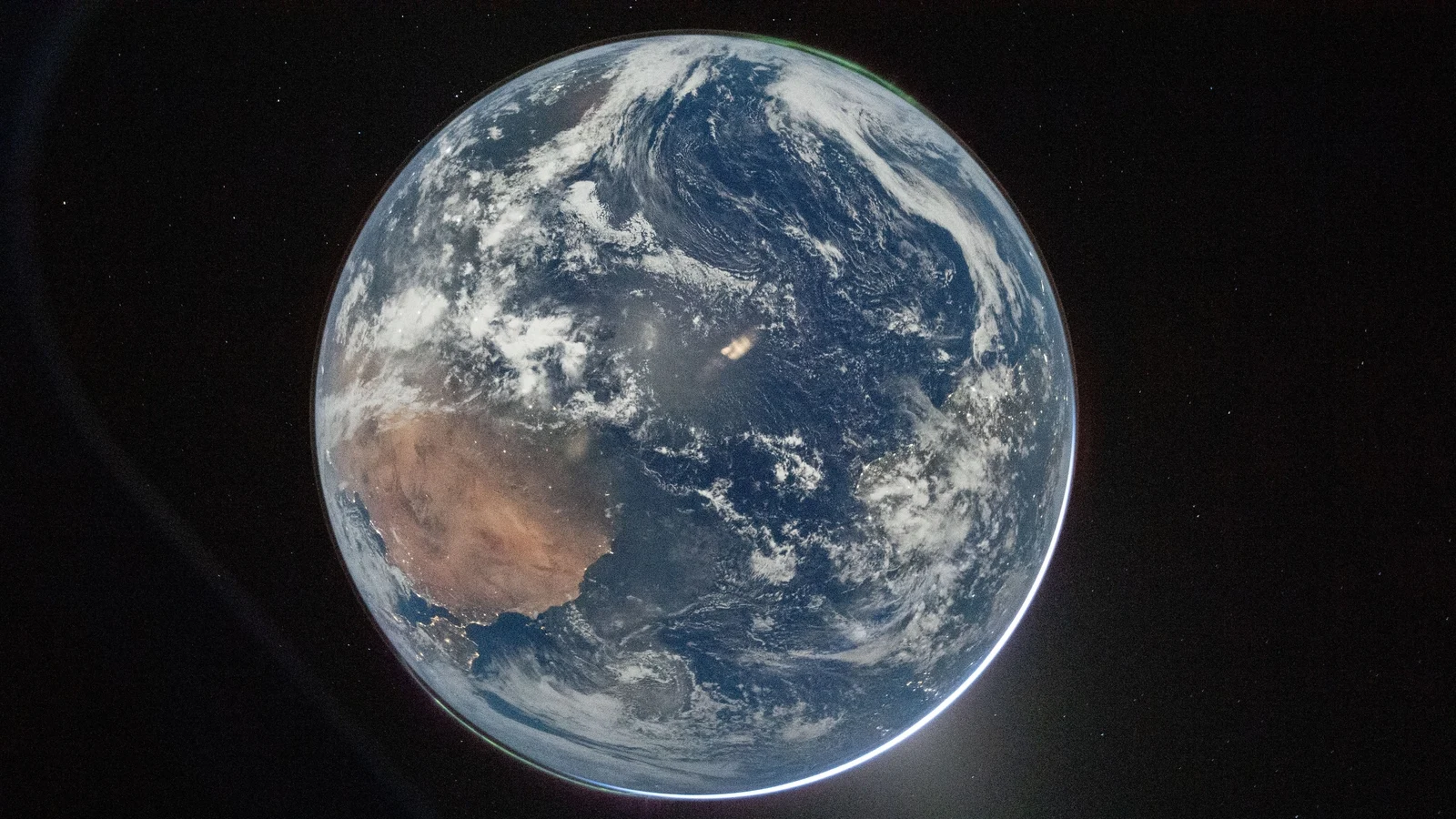
It sounds technical — a waypoint in a celestial dance — but imagine it: a four-person crew, strapped inside a ship that has never carried humans before, peering out at a planet that is shrinking into a memory and a Moon that swells with each heartbeat. NASA shared the view: a full portrait of Earth, deep ocean blues and drifting clouds, captured from inside Orion. The images were, in the words of a NASA official, “amazing.”
Who is on board — and why it matters
Artemis II is not only a mission of hardware and math. The crew — commander Reid Wiseman, pilot Victor Glover, mission specialist Christina Koch and Canadian astronaut Jeremy Hansen — represents a deliberate widening of possibility.
This flight is a string of firsts and reopenings: the first crewed mission to the Moon since 1972, the inaugural crewed flight of NASA’s Space Launch System (SLS), and a lineup whose diversity is itself a statement about who gets to belong in the sky. “We continue to learn all about our spacecraft as we operate it in deep space with crew for the first time,” Lakiesha Hawkins, a NASA official, said during a recent briefing. “It’s important to remind ourselves of that as we learn a little bit more day by day.”
The small miracles inside a small capsule
Space travel is glamour on the outside and a stubborn, patient apprenticeship on the inside. In the early hours the crew checked systems, resolved a communications hiccup and fixed a balky toilet — the tiny domestic dramas that remind you astronauts are people, too, who must live well enough in a capsule for exploration to be possible.
They fired Orion’s engine in a burn that lasted just under six minutes, the precise shove that nudged them out of Earth orbit and onto a three-day transfer to the Moon. The burn was routine in the calculus of rocketry and miraculous in human terms: a manufactured moment when velocity, timing and trust must align.
Scenes from inside and outside
Senior mission pilot Victor Glover described the growing clarity of lunar features as they drew nearer. “We took some pictures earlier today,” he said, “and after putting them on the computer to look closer, we found a feature — the Orientale Basin — and we were able to see the entire thing. And yes, the Earth is quite small and the Moon is definitely getting bigger.”
Jeremy Hansen, the Canadian crew member, offered a line that captures the surreal sensation of these trajectories: “It felt like we were falling out of the sky back to Earth. I said to Reid, ‘It feels like we’re gonna hit it.’ It’s amazing that we’re actually going to go around and miss this thing.”
From the launchpad to the public gaze
At Kennedy Space Center in Florida the day of the launch, the orange-and-white SLS rose through morning haze in a thunderous plume. Spectators along Cocoa Beach and Cape Canaveral still talk about the smell — a sting of ozone and hot propellant — and about the way the sky trembled as if remembering past Apollos. “My grandfather watched the Apollo launches,” said Maria Ortiz, a beachside resident. “We watched this one together on a screen, and I felt like we were making history again.”
Why this mission is more than a joyride
Artemis II is a stepping-stone: a ten-day mission designed to test systems and procedures that will underpin a planned crewed landing in 2028. If all goes according to plan, these astronauts will set a new human-distance record — traveling farther from Earth than anybody has before, more than 402,000 kilometres — and bring back data and imagery that scientists will use to refine future landings.
For lunar geologists, even photographs from an orbital flyby can be gold. “Seeing the Orientale Basin — it’s one of the most pristine multi-ring impact basins in the solar system,” said Dr. Maya Singh, a lunar scientist at the Lunar and Planetary Institute. “High-resolution imagery from crewed missions helps us calibrate orbital maps, ground-truth remote sensing data and plan potential landing sites.”
Costs, politics and the push of commerce
The mission also sits atop a tangle of budgets, schedules and geopolitics. SLS has endured years of delays and billions of dollars in cost overruns, and this mission’s timing has been amplified by a mix of national ambition and international rivalry. Contemporary coverage has framed Artemis as a response to other nations’ lunar ambitions, and U.S. political pressure has pushed timetables as policymakers and presidents emphasize symbolic milestones.
At the same time, NASA’s strategy increasingly mixes public will with private capability: contractors and commercial partners are central to the agency’s hope of putting humans back on the Moon and, eventually, sustaining a presence there. That partnership model raises questions about responsibility, access and who will benefit from a return to the lunar surface.
What this voyage asks of us
So where does this leave us, watching from a small blue planet? Do we look up and recall how fragile our orbiting shell is, or do we see the Moon as a new frontier where resources and power will be contested? Perhaps both.
Artemis II asks us to sit with complexity: to feel the simple awe of a circle that grows in your window and to hold the political and economic realities that trail in that awe’s wake. It asks us to consider who gets to write the next chapter of space exploration — and whether our look back at Earth while orbiting the Moon will change how we treat it.
In the quiet hours between mission updates, when the capsule cruises and the Earth becomes a pale blue coin, you can almost hear the future taking shape. The astronauts’ voices come through short transmissions and brief, human sentences: wonder, logistics, an occasional joke. “Lock in, we’re Moonbound,” NASA wrote on its social feed, and for the tens of millions watching, that felt like an invitation.
Are you in?